
Opinion|Videos|January 3, 2024
Managing Immune-Related Adverse Events
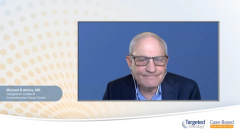
Author(s)Michael B. Atkins, MD
Immune-related adverse events are often a sign treatment is working. Dr Atkins discusses potential adverse events and how he counsels patients about them.
Advertisement
Episodes in this series
Case: A 62-Year-Old Female with Stage IV Melanoma
- A 62-year-old female consulted with her dermatologist for removal of a pigmented lesion that had recently become darker.
- She noted that she had been experiencing persistent fatigue, shortness of breath, and a dry cough that she attributed to a prior COVID-19 infection.
- LDH: 174 UI/L
- Excisional biopsy reveals melanoma with a Breslow depth of 1.2 mm, ulcerated, mitotic rate 4/mm2
- The patient underwent wide local excision and sentinel node mapping
- Staining was positive for melanoma in the right axillary node
- CT of the chest, abdomen, and pelvis indicated multiple lesions in both lungs
- The patient underwent core-needle biopsy of the largest lung lesion, measuring 1 cm
- Pathology revealed metastatic melanoma, cutaneous nonacral with a positive BRAF V600E mutation
- ECOG PS 1
- Diagnosis: Stage IV Melanoma, T2b N1a M1b
This is a video synopsis/summary of a Case-Based Peer Perspective, featuring Michael B. Atkins, MD.
A different perspective may be warranted regarding immune-related adverse events with immunotherapy. These toxicities, especially with nivolumab plus ipilimumab, are common but can be viewed as a marker of an active immune response rather than simply an adverse reaction. The goal of immunotherapy is to activate the immune system against the tumor, recognizing it as more foreign than normal tissues. Toxicity represents successful immune activation, which now needs modulation to prevent further attack on healthy tissue while maintaining antitumor activity.
Data show patients experiencing immune toxicities and stopping treatment do as well or better long-term compared with those without toxicity who continue therapy until progression. Thus, toxicity suggests the treatment is working on the immune system and hopefully on the tumor as well.
Video synopsis is AI-generated and reviewed by Targeted Oncology® editorial staff.
Advertisement
Related to this article
Recap the 4 late-breaking phase 3 trials from ESMO 2026 Presidential Symposium I in melanoma, bladder cancer, small cell lung cancer, and prostate cancer.
Adding the mRNA-based individualized neoantigen intismeran to pembrolizumab reduced the risk of disease recurrence or death by 42% in melanoma.

Findings highlight the need for individualized monitoring after discharge, despite low rates of severe toxicities.
Advertisement
Advertisement
Trending on Targeted Oncology - Immunotherapy, Biomarkers, and Cancer Pathways
1
ESMO 2026 Presidential Symposium II Showcases OS-Improving LBAs in Lung and GI Cancers
2
Key Takeaways From DeLLphi-305 at ESMO 2026
3
Late-Breaking Phase 3 Data Headline ESMO 2026 Presidential Symposium I
4
Lu-177-PSMA Retreatment Clears Interim Safety Bar in mCRPC
5