




Biomarker-Driven Lung Cancer
Latest News
Advertisement
Video Series







Latest Videos









Shorts

0:37
Are KRAS Mutations More Common Than We Think?
2 days ago
by
Benjamin Herzberg, MD

0:35
Changing Treatment Paradigms in ROS1+ Lung Cancer
9 days ago
by
Jorge Nieva, MD

0:42
Uncovering the Secrets of Tumor Resistance
2 months ago
by
Edgardo Santos Castillero, MD, FACP, FASCO

0:30
Dr Herzberg Talks Updates in KRAS-Mutant NSCLC
4 months ago
by
Benjamin Herzberg, MD

1:01
Combining KRAS Inhibition With Immunotherapy in NSCLC
5 months ago
by
Jamie E. Chaft, MD
Podcasts












































Advertisement
More News

Osimertinib was associated with a 47% reduction in risk of death among patients with stage II-IIIA EGFR-mutated non–small cell lung cancer at 8 years.

ARROS-1 data show zidesamtinib drives 94% responses in untreated ROS1+ NSCLC, including brain metastases, supporting first-line FDA filing.

A single blood draw 3 to 9 weeks into immunotherapy predicted survival outcomes in metastatic non–small cell lung cancer, according to a new Johns Hopkins study.

During a virtual event, Eric K. Singhi, MD, and participants discussed how the ROS1 G2032R resistance mutation is guiding second-line therapy selection in ROS1-positive advanced non–small cell lung cancer.
Phase 3 SANOVO shows savolitinib plus osimertinib extends PFS in first-line EGFR-mutant, MET-high NSCLC, hinting at OS gains.
Trastuzumab deruxtecan improved progression-free survival vs chemoimmunotherapy in the phase 3 DESTINY-Lung04 trial in HER2-mutant NSCLC.
Savolitinib plus osimertinib met PFS and OS end points vs chemotherapy in the phase 3 SAFFRON trial of EGFR-mutated, MET-driven NSCLC.
During a live event, Eric K. Singhi, MD, and participants discussed how CNS activity and cumulative toxicity, not guideline listing alone, are shaping frontline treatment selection in ROS1-positive advanced NSCLC.
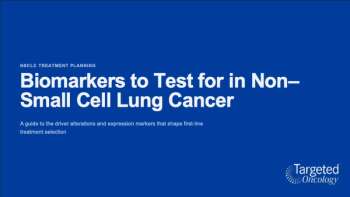
A guide to the biomarkers oncologists should test for in NSCLC, from established drivers like EGFR and ALK to newer targets such as MET exon 14 and HER2.

Benjamin Herzberg, MD, discusses unmet needs, immunotherapy sequencing, and referral timing in KRAS-mutant NSCLC.
Real-world data show Enhertu drives strong responses in HER2-mutant NSCLC, including brain metastases, while highlighting ILD risks and dosing insights.
FDA clears zidesamtinib for previously treated ROS1-positive metastatic NSCLC, showing 44% responses, CNS activity, and manageable safety in ARROS-1 trial.

Experts weigh newer ROS1 inhibitors like taletrectinib, highlighting long responses, fewer CNS/GI side effects, and trial challenges in rare NSCLC.
FDA gives full approval to selpercatinib for RET fusion solid tumors, backed by 47% response rate and long-lasting benefit across cancers.

During a live event, Bruna Pellini, MD, and participants discussed treatment sequencing and post progression management in patients with ROS1-positive advanced non–small cell lung cancer.
ASCO 2026 data reshapes lung cancer care, highlighting durable ALK control, new EGFR options, bispecific first-line gains, and SCLC progress.

Do Clinical Trial Results Hold Up in the Real World? A New Study on ALK+ Lung Cancer Says Yes—Mostly
Real-world claims data show alectinib beats crizotinib in ALK+ NSCLC survival, urging early use of newer ALK inhibitors.
During a live event, Bruna Pellini, MD, and participants discussed frontline treatment selection for patients with ROS1-positive advanced non–small cell lung cancer, including how evolving efficacy and tolerability data are shifting practice toward newer-generation TKIs.
FDA fast-tracks VS-7375, an oral KRAS G12D inhibitor, opening new hope for pretreated advanced NSCLC and fueling pivotal trials.

"Adjuvant selpercatinib should be considered as a new standard of care in early-stage RET fusion–positive lung cancer,” said Jonathan Goldman, MD.
FDA grants priority review to neladalkib for post-TKI ALK+ NSCLC, aiming to beat resistance and brain metastases; decision due Nov 27, 2026.
Nuvalent has submitted an NDA to the FDA for neladalkib, a brain-penetrant ALK-selective TKI for pretreated advanced ALK-positive NSCLC.
Phase 1 data show that setidegrasib degrades KRAS G12D, delivering durable NSCLC responses with manageable safety and biomarker-linked benefit as phase 3 plans advance.
FDA approves monthly subcutaneous amivantamab plus lazertinib for EGFR-mutated advanced NSCLC, cutting clinic time and infusion reactions while maintaining efficacy.

Adjuvant selpercatinib boosts event-free survival after surgery in early-stage RET fusion–positive NSCLC, signaling a potential new standard and expanding genomic testing.
Advertisement
Advertisement
Trending on Targeted Oncology - Immunotherapy, Biomarkers, and Cancer Pathways
1
FDA Oncology Recap: Approvals, Designations, and Decisions in September 2026
2
Plinabulin Receives FDA Fast Track Designation in Post-ICI NSCLC
3
Denosumab Biosimilar Approved For Existing Oncology Indications
4
CEPHEUS and Frontline Treatment in Newly Diagnosed Multiple Myeloma
5