


Mantle Cell Lymphoma
Latest News

Advertisement
Latest Videos




CME Content

































Advertisement
More News

Frontline treatment with ibrutinib, bendamustine, and rituximab showed a prolongation in progression-free survival along with a good response rate in older patients with mantle cell lymphoma.
The phase 3 ZILO-301 study will evaluate the combination of zilovertamab and ibrutinib in patients with relapsed or refractory mantle cell lymphoma.

Ibrutinib combined with bendamustine and rituximab extended the highest progression-free survival rate ever reported for this patient population, in the phase 3 SHINE study.

Oncternal Therapeutics announced it would terminate its study of ONCT-216 for patients with Ewing sarcoma and prioritize its phase 3 ZILO-301 study of zilovertamab plus ibrutinib for patients with relapsed/refractory mantle cell lymphoma.

Tycel Phillips, MD, discusses the need for more effective agents for treating patients with relapsed/refractory mantle cell lymphoma as alternatives to chimeric antigen receptor T-cell therapy.
An application seeking the approval of a new indication for the combination of ibrutinib, bendamustine, and rituximab in adult patients with previously untreated mantle cell lymphoma has been submitted.

Tycel Phillips, MD, discusses the potential use of glofitamab as therapy for patients with relapsed/refractory mantle cell lymphoma.

Michael Wang, MD, discusses the study design of the ongoing, multicenter, open-label study examining an acalabrutinib triplet in MCL.

Frontline Ibrutinib and Rituximab Are Safe to Use in Patients With Mantle Cell Lymphoma
By Will Pizii
Results from the WINDOW-1 signal promise for use of the R-HCVAD regimen in patients with mantle cell lymphoma.

Lori A. Leslie, MD, discusses her recent presentation around chimeric antigen receptor T-cell therapy for mantle cell lymphoma and indolent lymphomas.
Treatment of indolent mantle cell lymphoma tumors may require an individualize approach, but frontline ibrutinib and rituximab is one possibility.

Peter Martin, MD, discusses questions asked in regards to patient populations in a real-world study of treatment patterns and outcomes of mantle cell lymphoma.
In an interview with Targeted Oncology, Christopher Melani, MD, discussed the ongoing ViPOR study exploring a Bruton’s tyrosine kinase inhibitor and BCL2 inhibitor, and NF-κB survival pathway activating combination.

At the 63rd ASH Annual Meeting and Exposition, studies highlighted the promise of Bruton's tyrosine kinase inhibitors for the treatment of patients with mantle cell lymphoma and what oncologists should do after Bruton's tyrosine kinase inhibition.

National Cancer Institute expert, Christopher J. Melani, MD, discusses the synergy of 5 drugs that make up a targeted therapy regimen for patients with mantle cell lymphoma.

In an interview with Targeted Oncology, Michael Wang, MD, a professor in the department of lymphoma and myeloma at MD Anderson Cancer Center, discussed the safety, efficacy, and tolerability of acalabrutinib plus venetoclax and rituximab in mantle cell lymphoma.
Tycel Jovelle Phillips, MD, discussed the use of glofitamab in patients with R/R MCL who have failed BTK inhibitors in an interview with Targeted Oncology.
A study of zilovertamab in combination with ibrutinib for the treatment of relapsed or refractory mantle cell lymphoma will be launched in the second quarter of 2022.

Tycel Phillips, MD, a clinical associate professor of hematology and medical oncology at the University of Michigan Health, discusses the mechanism of action of glofitamab in patients with mantle cell lymphoma.
In the community setting, brexucabtagene autoleucel shows efficacy in patients with relapsed/refractory mantle cell lymphoma.
The novel non-covalent BTK inhibitor pirtobrutinib has shown encouraging preclinical efficacy in addressing resistance to ibrutinib and venetoclax resistance in mantle cell lymphoma models cell lines.

Michael Wang, MD, discusses the growing awareness of chimeric antigen receptor T-cell therapy among community oncologists and patients with mantle cell lymphoma.
Ocular adnexal region involvement remains rare, presenting in only between 1% to 5% of mantle cell lymphoma cases.
The FDA is considering an application parsaclisib as treatment of patients with relapsed or refractory follicular lymphoma, marginal zone lymphoma, and mantle cell lymphoma, and granted priority review for 2 of the 3 indications.
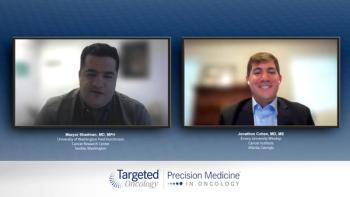
Mazyar Shadman, MD, MPH, and Jonathon Cohen, MD, MS, discuss possible future developments with BTKi as therapy options in B-cell lymphomas.
Advertisement
Advertisement
Trending on Targeted Oncology - Immunotherapy, Biomarkers, and Cancer Pathways
1
NCCN Survey Finds Persistent Cancer Drug Shortages Across US Centers
2
Risk-Adapted Quadruplet Therapy Sustains 5-Year Survival Benefit in High-Risk Myeloma
3
Rewriting the Playbook: How Biomarker-Driven Therapy Is Transforming Metastatic Prostate Cancer Care
4
FDA Delays Decision on Zanzalintinib Combo for mCRC
5