Closing out the program, Dr Gilles Salles highlights currently unmet needs in DLBCL and investigational treatments he finds exciting.


Your AI-Trained Oncology Knowledge Connection!
Closing out the program, Dr Gilles Salles highlights currently unmet needs in DLBCL and investigational treatments he finds exciting.
Dr Gilles Salles shares his opinion on the presented case’s treatment decision and the regimen he would have selected for the patient.
Gilles Salles, MD, PhD, explains data on the adverse events seen with the pola-BR regimen in R/R DLBCL during the GO29365 clinical trial.
A review of population, dosing, and efficacy data from the GO29365 clinical trial investigating the combination of polatuzumab, bendamustine, and rituximab (pola-BR) for R/R DLBCL.
Dr Salles provides an overview of the available third-line treatment options for patients with R/R DLBCL who are ineligible for or do not wish to receive autologous stem cell transplant or CAR T-cell therapy.
An oncologist describes the typical major challenges of managing patients with R/R DLBCL and the incidence of relapsed or refractory disease.
Gilles Salles, MD, PhD, presents the case of a 51-year-old woman with relapsed/refractory diffuse large B-cell lymphoma (R/R DLBCL).

Sam S. Chang, MD, MBA, discusses the methods and design of the QUILT 3032 study.
Jennifer Moss, PhD, discusses challenges that impact community cancer care in rural communities.
Eytan Stein, MD, presents the case of an 81-year-old patient with AML who is unfit for intensive induction therapy for discussion.
Hetty Carraway, MD, highlights the role of venetoclax + azacitidine in the treatment of patients with acute myeloid leukemia who are unfit for intensive induction therapy.
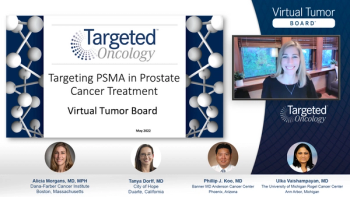
Oncologists share some final thoughts on lutetium-PSMA-617 and novel agents to look out for in prostate cancer treatment.

Evanthia Roussos Torres, MD, PhD, discusses the next steps and novel therapies currently showing promise in the HER-2 negative breast cancer space.
Jesus G. Berdeja, MD, discusses the potential of chimeric antigen receptor T-cell therapy to be approved for earlier lines of treatment in multiple myeloma.
Arndt Vogel, MD, discusses the study results of the IMMUTACE study in hepatocellular carcinoma.

Toni K. Choueiri, MD, discusses results from the KEYNOTE-564 efficacy analysis of adjuvant pembrolizumab in renal cell carcinoma.
David Barrington, MD, discusses the results investigators found in determining treatment patterns and recommendations for patients with endometrial cancer.

Sophia Kamran, MD, discusses future roles that radiation oncology will play in combination with resection and targeted therapy in urothelial carcinoma.
Eytan Stein, MD, continues the discussion of AML treatments with a look at the options for patients with AML and mutations.

Expert perspectives on the PROfound and TRITON2 studies of olaparib and rucaparib, respectively, in metastatic castration-resistant prostate cancer.

Closing out their discussion on novel treatment approaches in prostate cancer, experts consider future strategies and remaining unmet needs in this setting.

A brief discussion on the importance of germline/somatic BRCA1 and BRCA2 mutations in metastatic CRPC, accompanied by practical advice on genetic testing.
Eytan Stein, MD, reviews the available treatment options for patients with secondary AML or AML with myelodysplasia-related changes.
Tanios S. Bekaii-Saab, MD, FACP, discusses the evolution of treatment options prior to adagrasib for patients with KRAS G12C mutations.

David S. Hong, MD, discusses the data supporting the use of larotrectinib for the treatment of TRK fusion-positive lung tumors. He also explains the difference between larotrectinib another FDA-approved TRK inhibitor, entrectinib.

Matthew J. Matasar, MD, discusses the LOTIS-2 trial of loncastuximab tesirine in patients with relapsed/refractory diffuse large B-cell lymphoma.

In the first installment of the series, Allison Betof Warner, MD, PhD, reviews the mechanistic rationale behind tumor-infiltrating lymphocytes and considers where these experimental therapies may fit in the oncologic landscape.

Yuliya Mikheeva, MD, PhD, discusses the many challenges oncologists face in treating patients with anaplastic thyroid cancer harboring BRAF mutations.
Ghassan K. Abou-Alfa, MD,discusses the phase 2 study of tislelizumab in patients with unresectable hepatocellular carcinoma.
Michael Wang, MD, gives a brief overview of the safety and efficacy findings of a phase 1b study evaluating acalabrutinib plus venetoclax and rituximab in patients with mantle cell lymphoma.
