
Researchers explored a compelling new angle on the use of rectal spacers during prostate cancer radiotherapy, and emerging evidence suggests their benefits may extend further.


Your AI-Trained Oncology Knowledge Connection!
Researchers explored a compelling new angle on the use of rectal spacers during prostate cancer radiotherapy, and emerging evidence suggests their benefits may extend further.
Aaron T. Gerds, MD, discusses the unmet needs in the treatment of essential thrombocythemia, as well as novel methods for approaching disease treatment.

Anita Turk, MD, discusses what she is most excited about regarding immunotherapy in the realm of colorectal cancer treatment.
Anita Turk, MD, discusses the unmet needs that still exist in the realm of colorectal cancer treatment and management.

Mack Roach III, MD, discusses the development and evaluation of a multimodal AI algorithm designed to predict prostate cancer outcomes and its performance across racial subgroups.
Anita Turk, MD, discusses abstracts from ASCO 2025 highlight the evolving role of ctDNA in the management of colorectal cancer.
Anita Turk, MD, details her biggest takeaways from the 2025 ASCO Annual Meeting in gastrointestinal cancers.
Joseph Jacob, MD, discusses the promising impact of TAR-200.
Antonio Jimenez Jimenez, MD, discusses the ACCESS trial of PTCy-based GVHD prophylaxis after mismatched unrelated donor stem cell transplantation.
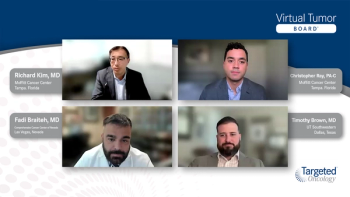
Panelists discuss how the evolution of anal cancer treatment began with the 1974 Nigro regimen combining 5-fluorouracil and mitomycin with radiation, which remains the preferred treatment approach despite alternative options like capecitabine, with modifications including day 28 mitomycin based on subsequent studies showing improved colostomy-free survival.
Panelists discuss how successful treatment of locally advanced anal cancer requires a multidisciplinary approach involving colorectal surgeons, radiation oncologists, pathologists, medical oncologists, and physician assistants. They emphasize the importance of proper histological classification to distinguish squamous cell carcinoma from adenocarcinoma.

Andrew Evens, DO, MBA, MSc, discusses the HOLISTIC consortium, which aims to gather and harmonize global Hodgkin lymphoma data from clinical trials and registries.

Panelists discuss the rapidly evolving endocrine treatment landscape in oncology, emphasizing the shift toward personalized therapy guided by tumor biomarkers such as ESR1, PI3K, and HER2-low, with excitement about new targeted agents and combination strategies expected over the next 5 years; they highlight challenges in treatment sequencing and resistance but remain optimistic that ongoing research and emerging data will enable more effective, tailored care that improves survival, delays toxicity, and potentially enhances cure rates.
Panelists discuss recent phase 3 trials of novel endocrine agents in advanced breast cancer, highlighting benefits—especially in patients with ESR1 mutations—from proteolysis-targeting chimeras (PROTACs) and oral selective estrogen receptor degraders (SERDs), including early switching based on molecular monitoring and combination strategies with CDK4/6 inhibitors; they emphasize the favorable safety profiles and the promise of personalized regimens, while also looking ahead to ongoing studies evaluating these agents earlier in treatment to improve cure rates and reduce recurrence in hormone receptor–positive breast cancer.
Panelists discuss the ELEVATE trial’s ongoing evaluation of elacestrant combined with targeted agents such as ribociclib, capivasertib, and everolimus, emphasizing the importance of optimizing dosing—such as the ribociclib reduction to 400 mg on a 3-weeks-on, 1-week-off schedule—to balance efficacy and tolerability, and highlighting the trial’s role in advancing precision combination therapies that may reshape treatment sequences in hormone receptor–positive breast cancer.
Panelists discuss the EMBER-3 trial, which evaluated single-agent oral selective estrogen receptor degrader (SERD) imlunestrant vs standard endocrine therapy and the combination of imlunestrant with abemaciclib beyond progression, highlighting enhanced progression-free survival with the combination regardless of ESR1 mutation status, underscoring the promise of dual blockade strategies to overcome resistance while emphasizing the need to balance efficacy, safety, and biomarker use as treatment paradigms evolve.
Panelists discuss the SERENA-6 trial evaluating camizestrant, which uniquely enrolled patients with molecularly detected ESR1 mutations before clinical progression, showing that early switching to this oral selective estrogen receptor degrader (SERD) improved progression-free survival and quality of life compared with continuing standard therapy, while highlighting ongoing questions about long-term benefits, optimal timing, and the practical challenges of frequent circulating tumor DNA (ctDNA) monitoring in clinical practice.
Panelists discuss recent phase 3 trials introducing novel endocrine agents such as proteolysis-targeting chimeras (PROTACs) that target estrogen receptors through new mechanisms, highlighting modest progression-free survival benefits—especially in patients with ESR1-mutated disease—and generally favorable tolerability profiles, while underscoring the importance of monitoring unique adverse effects and the potential for these therapies to advance treatment of endocrine-resistant metastatic breast cancer.
Panelists discuss the expanding array of treatment options for metastatic hormone receptor–positive breast cancer, emphasizing the critical role of molecular testing—both tissue biopsy and circulating tumor DNA (ctDNA)—in identifying targets and guiding therapy selection, with serial ctDNA testing enabling dynamic monitoring of tumor evolution and timely adjustments to personalized treatment plans.
Panelists discuss that although the use of everolimus has declined with newer targeted therapies, it remains an important option for patients without ESR1 mutations or PI3K/AKT pathway alterations, improving outcomes when endocrine therapy alone is ineffective and serving as a valuable alternative in later treatment lines when other targeted agents are unsuitable.
Panelists highlight that oral endocrine therapies for hormone receptor-positive breast cancer are generally well tolerated with manageable mild adverse effects, whereas PI3K/AKT/mTOR inhibitors often cause more challenging toxicities such as hyperglycemia and diarrhea, leading many clinicians to prioritize better-tolerated endocrine agents initially to balance efficacy with patient quality of life.
Panelists discuss that for patients with both ESR1 and PIK3CA mutations after progression on CDK4/6 inhibitors, single-agent elacestrant shows meaningful clinical activity and is often favored in the second line due to its efficacy and tolerability, with more toxic combination regimens typically reserved for later treatment lines.
Panelists discuss that, based on EMERALD trial data, elacestrant provides consistent clinical benefit in metastatic breast cancer regardless of ESR1 mutation allele frequency, supporting the use of any detectable ESR1 mutation—regardless of variant allele frequency (VAF)—as a valid criterion for treatment selection.
Panelists discuss how real-world evidence has reinforced the clinical effectiveness of oral selective estrogen receptor degraders observed in the EMERALD trial, showing consistent benefit—even in more heavily pretreated and diverse patient populations—thereby validating the drug’s utility and expanding its role in routine care for ESR1-mutated metastatic breast cancer.
Arturo Loaiza-Bonilla, MD, MSEd, discusses 5-year data from the phase 3 CheckMate 577 trial, presented at the 2025 ASCO Annual Meeting.


Sam S. Chang MD, MBA, discusses intravesical mitomycin in low-grade intermediate-risk nonmuscle-invasive bladder cancer vs different treatment paths.

Michael Green, PhD, discusses a new method of assessing lymphoma subtypes utilizing the tumor microenvironment.
Arturo Loaiza-Bonilla, MD, MSEd, discusses the phase 3 ATOMIC trial presented at the 2025 American Society of Clinical Oncology Annual Meeting.

A panelist discusses the evolving role of luspatercept in low-risk myelodysplastic syndrome, highlighting its broad efficacy beyond SF3B1 mutations, its advantage in reducing transfusions and improving quality of life, and the shift toward treatment decisions based on clinical presentation and lifestyle factors rather than genetic profiles alone.
