Dr Moshe Ornstein examines dosing considerations for the combination of lenvatinib plus pembrolizumab in clinical practice and how that compares with the findings from the CLEAR study.


Your AI-Trained Oncology Knowledge Connection!
Dr Moshe Ornstein examines dosing considerations for the combination of lenvatinib plus pembrolizumab in clinical practice and how that compares with the findings from the CLEAR study.

Ming Zhao, MD, explains the background of the FOHAIC-1 study.
Results of the efficacy and safety data demonstrated by the CLEAR study of lenvatinib plus pembrolizumab or everolimus as first-line treatment for metastatic renal cell carcinoma.
A summary of frontline treatment options for metastatic renal cell carcinoma and the rationale for the combination of lenvatinib plus pembrolizumab.
Closing out her discussion on ovarian cancer, Leslie Randall, MD, shares closing advice for community physicians on optimal treatment strategies.
Leslie Randall, MD, considers the possibility of relapse in ovarian cancer and reviews treatment options available at recurrence.
Ajay Chari, MD, discusses new blood testing options for patients with multiple myeloma.
Focused discussion on the safety profiles of PARP inhibitors in ovarian cancer and how these can be mitigated with proper dose management.
Shared insight on the selection of PARP inhibitors for maintenance therapy in ovarian cancer with deference to patient and disease factors.
A broad look at maintenance therapy selection and its use in ovarian cancer to improve patient outcomes.
Expert Leslie Randall, MD, discusses the case of a 71-year-old woman who is diagnosed with ovarian cancer. Dr. Randall reviews data with PARP inhibitors and rationale for use of maintenance therapy in patients with platinum-sensitive disease.

Daniel P. Petrylak, MD, discusses the targeted therapies that have shown encouraging results in patients with metastatic urothelial cancer.
Ryan Sugarman, MD, discusses the design and purpose of the CheckMate 649 trial for gastroesophageal cancers, gastric cancer, and esophageal adenocarcinoma.

Sophia Kamran, MD, discusses the research supporting the use of trimodality therapy for patients with urothelial cancer.
Nitin Jain, MD, discusses the significance of a study of UCART22, an allogeneic chimeric antigen receptor T-cell therapy for patients with relapsed/refractory B-cell acute lymphoblastic leukemia.

Tanios S. Bekaii-Saab, MD, FACP, discusses the phase 1/1b and 2 KRYSTAL-1 trial and his presentation from the American Society of Clinical Oncology Gastrointestinal Cancers Symposium.

Nazli Dizman, MD, explains that gut microbiome diversities play a large role in modulating response to immunotherapy.
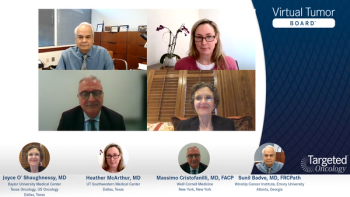
Heather McArthur, MD; Massimo Cristofanilli, MD, FACP; Sunil Badve, MD, FRCPath; and Joyce O’Shaughnessy, MD, comment on the role of preoperative endocrine therapy in HR-positive high-risk breast cancer.

Joyce O’Shaughnessy, MD, reviews the case of a 42-year-old woman with node-positive, HR-positive high-risk breast cancer and discusses clinical data from the POETIC and ADAPT clinical trials.

Carole Miller, MD, discusses the REVEAL study which enrolled patients with polycythemia vera at both academic and community practices.
Ghaith Abu-Zeinah, MD, discusses the unmet needs investigational drugs could address for patients with polycythemia vera.

Tracy L. Rose, MD, MPH, discusses ongoing research in bladder cancer that aims to add onto the standard of care and improve patient outcomes.

Cathy Eng, MD, discusses what can be done in order to integrate biomarker testing for anal cancer into clinical practice.
Marcia S. Brose, MD, PhD, concludes by listing some future directions she’d like to see within the treatment landscape, as well unmet needs that she hopes will be considered.
An expert briefly discusses the second-line treatment options for patients with DTC that have progressed on first-line therapy.
A medical professional explains how the size of lung metastases affect the treatment of DTC and clinician decision-making.
Marcia S. Brose, MD, PhD, introduces our second patient case, a 57-year-old man with DTC.
Dr Brose elaborates on treating patients with DTC with lenvatinib, including starting dosage and toxicities/adverse events.
A medical professional discusses Study 211 data and HRQoL analyses for patients with DTC on lenvatinib.
An expert explains the impact of patient age when taking lenvatinib for treatment.