




BREAST CANCER
Latest News

Advertisement
Latest Videos































Advertisement
More News
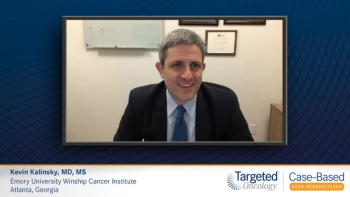
The rationale for treating patients with early-stage HR-positive breast cancer with abemaciclib and endocrine therapy.
Kevin Kalinsky, MD, MS, presents a case of ER-positive/PR-positive breast cancer and highlights the prevalence of cases such as this in the United States.

Using next-generation sequencing to help inform treatment options is growing in frequency, but the results can be difficult to interpret and implement in clinical practice.

In an interview with Targeted Oncology, Lee Schwartzberg, MD, further discusses the findings of KEYNOTE-522 and pembrolizumab in patients with triple negative breast cancer.
In KEYNOTE-522, treatment with adjuvant pembrolizumab following neoadjuvant pembrolizumab with chemotherapy showed a statistically significant prolonged event-free survival in patients with high-risk early-stage triple-negative breast cancer.

During a live virtual event, Sara Tolaney, MD, discussed the results of the ASCENT trial of sacituzumab govitecan in patients with triple-negative breast cancer.

Lowell Hart, MD, FACP, discusses what he’d like to see in the future for the treatment of ER+ breast cancer and includes a note concerning Ki-67 analyses.
Dr Hart explains his prognosis for our case patient.
Lowell Hart, MD, FACP, lists the different types of adverse events that are common when CDK4/6 inhibitors are used in both the adjuvant and advanced cancer setting.

In its new Sunnyvale, Texas location, GenesisCare offers comprehensive patient-centered services for patients with breast cancer.
Dr Hart delves into the CDK4/6 inhibitor clinical trials for breast cancer, some that he’s even participated in.
Dr Hart explains the different adjuvant therapy options for patients with HR+ breast cancer.
Lowell Hart, MD, FACP, introduces our patient case, a 54-year-old woman with ER+/PR+ breast cancer, and discusses his strategy and the risk of recurrence for the disease.
During a live virtual event, Lowell Hart, MD, discussed the findings of the monarchE trial of abemaciclib in high-risk patients with early breast cancer.

Lee Schwartzberg, MD, discusses the results of the KEYNOTE-522 trial of pembrolizumab in patients with early triple-negative breast cancer.
Research is ongoing to combat key resistance mechanisms, with new data recently presented by Sara A. Hurvitz, MD, FACP, and other oncologists and investigators during the 2021 San Antonio Breast Cancer Symposium.
Debu Tripathy, MD, said the 39th Annual Miami Breast Cancer Conference is always a well-rounded meeting.
During a live virtual event, Lowell Hart, MD, discussed the results of the monarchE trial of abemaciclib in patients with node-positive, hormone receptor–positive, HER2-negative, high-risk early breast cancer.

Gedatolisib has earned attention from the FDA after demonstrating encouraging efficacy and safety in a phase 1b clinical trial.
Enobosarm has been granted fast track designation from the FDA and is being explored alone and in combination with abemaciclib in 2 phase 3 clinical trials.
During a live virtual event, Joyce O'Shaughnessy, MD, discussed participants' experiences with the tolerability of sacituzumab govitecan in patients with metastatic triple-negative breast cancer. The participants also discussed their approaches to molecular testing for biomarkers at the time of disease relapse or progression.
During a live virtual event, Joyce O'Shaughnessy, MD, discussed treatment options for a patient with metastatic triple-negative breast cancer whose disease recurred 8 months after receiving adjuvant therapy.

Alexandra Higgins,MD, discusses the association of hepatopulmonary syndrome with the long-term use of ado-trastuzumab emtansine.
In using the biomarker approach to the treatment of triple-negative breast cancer, the challenge for the clinician is prioritizing the available treatment options based on the National Comprehensive Cancer Network guidelines for breast cancer, which focus on active agents, preferred single-agent chemotherapy approaches, and doublet options for certain patients at high risk.

Two oncologists explain how patients can better understand the NCCN Clinical Practice Guidelines.
Advertisement
Advertisement
Trending on Targeted Oncology - Immunotherapy, Biomarkers, and Cancer Pathways
1
FDA Accepts NDA for Daraxonrasib in Metastatic Pancreatic Cancer
2
Advanced Renal Cell Carcinoma: Tailoring Second-Line Therapy After Prior Immunotherapy
3
Teclistamab/Talquetamab Reduces Risk of Progression by 89% in R/R Multiple Myeloma
4
IMNN-001 Plus Chemo Cuts MRD Rate in Frontline Ovarian Cancer
5