
Returning to the patient case, experts review available frontline treatment options in the setting of nonmetastatic castration-resistant prostate cancer.


Your AI-Trained Oncology Knowledge Connection!
Returning to the patient case, experts review available frontline treatment options in the setting of nonmetastatic castration-resistant prostate cancer.

A brief review of the prevalence of familial risk and other high-risk factors for prostate cancer, followed by recommendations for patient follow-up and genetic testing.

Sam S. Chang, MD, MBA, discusses the research of N-803 in combination with BCG in patients with BCG-unresponsive non-muscle invasive bladder cancer.

Cathy Eng, MD, FACP, FASCO, discusses the types of patients who should be tested for biomarkers in the anal cancer space.

Dr Ulka Vaishampayan presents the case of a 67-year-old man with metastatic castration-resistant prostate cancer.

Phillip J. Koo, MD, provides a detailed explanation of the process of PSMA-PET imaging scans for prostate cancer.
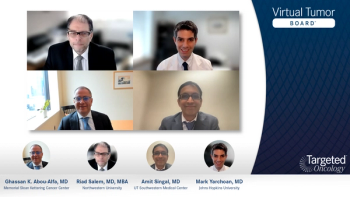
Shifting to a second patient case of metastatic hepatocellular carcinoma, experts consider best diagnostic practices and the initiation of therapy.

David Barrington, MD, discusses the key takeaways regarding the factors associated with variation of adjuvant treatments for patients with stage 1B, grade 3 endometrial cancer.
A brief discussion on the role of systemic therapies in combination with or following TACE/TARE in unresectable hepatocellular carcinoma.

Andreas Saltos, MD, discusses the key takeaways of the phase 1/1b clinical trial exploring the use of binimetinib plus erlotinib in patients with non–small cell lung cancer harboring either KRAS or EGFR mutations.
Robert Zeiser, MD, reviews the pathophysiology of graft versus host disease and explains its relationship to the desired graft versus leukemia effect.
Eytan Stein, MD, provides a brief overview of acute myeloid leukemia.

In this companion article, Dr. Estelamari Rodriguez reflects on the role of reactive and proactive treatment approaches for the management of chemotherapy-induced myelosuppression in small cell lung cancer.

Yelena Ginzburg, MD, discusses a long-term goal of the use of rusfertide in patients with chronic polycythemia vera.

Joshua K. Sabari, MD, discusses the significance of EGFR exon 20 insertion mutations in patients with non–small cell lung cancer.

A broad review of CNS-related clinical trial data in the setting of HER2+ breast cancer and concurrent brain metastases.

Grzegorz S. Nowakowski, MD, presents the case of a woman with relapsed DLBLC and provides his initial impressions.

A brief discussion on treatment options available for patients with HER2+ metastatic breast cancer and brain metastases who progress on the HER2CLIMB regimen.

Sam S. Chang, MD, MBA, discusses unanswered research questions about histologic subtypes of bladder cancer.

Eric S. Nadler, MD of Texas Oncology, discusses the real-world patient characteristics and treatment duration of the immunotherapy combination treatment of the IMpower133 trial in patients with extensive-stage small cell lung cancer.

Debra A. Patt, MD, PhD, MBA, discusses a study of digital health systems used at Texas Oncology locations and how it helps with remote communication between patients with cancer and clinicians.

Panelists center their discussion on a real-world patient case of nonmetastatic castration-resistant prostate cancer managed with surgery and adjuvant therapy.

Matthew T. Campbell, MD, discusses the results of a retrospective analysis of patients with metastatic renal cell carcinoma with sarcomatoid dedifferentiation.
Experts provide comprehensive insight on prostate cancer, covering its prevalence, subtypes, and the systemic treatment armamentarium.

Vivek Subbiah, MD, discusses the adverse events that come with the use of kinase inhibitors to treat patients with thyroid cancer.

Naomi B. Haas, MD, discusses how patient characteristics and preference influence the choice of frontline treatment for advanced clear cell renal cell carcinoma.

William J. Gradishar, MD, discusses the impact of new data on the National Comprehensive Cancer Network guidelines for patients with early-stage breast cancer.
Mark T. Fleming, MD, discusses the potential impact of positive data from the phase 3 SPOTLIGHT study, which assessed the how 18F-rhPSMA-7.3 PET scan use in male patients with biochemical recurrence of prostate cancer affects upstaging in comparison with conventional imaging.
Expert perspectives on the role of transarterial radioembolization in unresectable hepatocellular carcinoma following FDA approval.
Sharing the first patient case of unresectable hepatocellular carcinoma, experts consider optimal screening and diagnosis practices in this setting.
