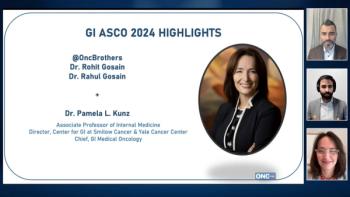
Following their review of recent data from the 2024 ASCO GI Cancers Symposium, the Oncology Brothers discuss their key takeaways.


Your AI-Trained Oncology Knowledge Connection!
Following their review of recent data from the 2024 ASCO GI Cancers Symposium, the Oncology Brothers discuss their key takeaways.
Medical oncologists offer comprehensive insights on the role of circulating tumor DNA in the treatment of patients with colorectal cancer.
Clinical insights on the recent data from the NETTER-2 trial looking at Lu-177 Dotatate in patients with advanced gastroenteropancreatic neuroendocrine tumors.
Pamela L. Kunz, MD, and the Oncology Brothers provide insights on the EMERALD-1 trial looking at durvalumab and bevacizumab plus TACE in patients with unresectable, embolization-eligible hepatocellular carcinoma.
Following ASCO GI 2024, Pamela L. Kunz, MD, joins the Oncology Brothers, Rahul Gosain, MD, and Rohit Gosain, MD, to discuss results from the CheckMate 8HW study investigating nivolumab plus ipilimumab in MSI-high/mismatch repair deficient metastatic colorectal cancer.

Francis P. Worden, MD, reviews the progression-free survival data and safety findings from the phase 3 COSMIC-311 study which evaluated treatment with cabozantinib in patients with radioiodine-refractory differentiated thyroid cancer.
Paul Richardson, MD, further discusses the data from the CC-92480-MM-002 trial, and future directions for research of mezigdomide combinations for patients with relapsed/refractory multiple myeloma.
Douglas Tremblay, MD, discusses the factors which influence the decision to recommend cytoreduction for patients with essential thrombocytopenia and polycythemia vera.
Paul Richardson, MD, discusses the safety and efficacy findings from the CC-92480-MM-002 trial of mezigdomide with dexamethasone and daratumumab or elotuzumab in patients with relapsed/refractory multiple myeloma.
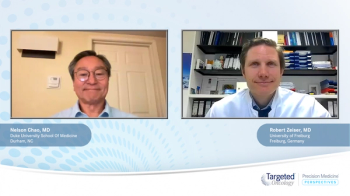
Dr. Zeiser and Dr. Chao review ongoing clinical trials in the management of cGvHD – specifically the use of axatilimab and abatacept in SR/D cGvHD.
Experts discuss the treatments for steroid-refractory/dependent chronic Graft vs Host Disease (SR/D cGvHD), focusing on the unique mechanisms and applications of belumosudil and role of ibrutinib.
Drs Safah and Koprivinikar discuss emerging therapies, such as imetelstat and canakinumab, and where they might fit in the treatment paradigm for lower-risk MDS.
Paul Richardson, MD, discusses the baseline characteristics of the patients with relapsed/refractory multiple myeloma enrolled in the CC-92480-MM-002 trial.
Michiel S. Van der Heijden, MD, PhD, discusses background of the phase 3 CheckMate 901 study which evaluated concurrent frontline nivolumab and gemcitabine/cisplatin followed by nivolumab maintenance therapy among patients with urothelial carcinoma.
Paul Richardson, MD, discusses the background and design of the CC-92480-MM-002 trial in multiple myeloma.
Binod Dhakal, MD, MS, discusses the safety data from the phase 2 IMPEDE study of isatuximab, pomalidomide, elotuzumab, and dexamethasone for the treatment of patients with relapsed/refractory multiple myeloma.

An expert on MDS reviews the biomarker analysis and patient-reported outcomes from the COMMANDS study as well as long-term outcomes from the MEDALIST study.
Dr Schiller reviews data updates from the IMerge phase 3 trial looking at patient-reported outcomes and cytopenias in patients with MDS following imetelstat treatment.
Gary J. Schiller, MD, reviews recent data on durable transfusion independence for patients with lower-risk MDS in the IMerge phase 3 study and discusses how transfusion frequency affects patient outcomes.
An expert on myelodysplastic syndrome discusses the impact of mutational status on response in the IMerge phase 3 study.
Virginia Kaklamani, MD, DSc, details that disease burden and location of metastases in patients with HR+/HER2- metastatic breast cancer guide approaches to management, with visceral metastases indicating potentially faster progression and more concerning symptoms.
Virginia Kaklamani, MD, DSc, shares that in deciding second-line therapy for metastatic breast cancer after CDK4/6 inhibitors, endocrine sensitivity guides the choice between treatments based on ESR1/PIK3CA mutations and safety profiles with/without fulvestrant injections.
Bruno R. Bastos, MD, discusses findings from a study which assessed the pharmacodynamic and radiographic changes among patients with renal cell carcinoma who were treated with the combination of nivolumab and TPST-1120.

Martin H. Voss, MD, discusses what community oncologists should takeaway from the the extended follow-up data of the phase 2 KEYNOTE-B61 study which assessed first-line pembrolizumab plus lenvatinib for patients with non-clear cell renal carcinomas.

Chakra Chaulagain, MD, discusses the context of an analysis which assessed autologous hematopoietic stem cell transplantation refusal rates among patients with multiple myeloma.

Joseph M. Jacob, MD, discusses the key takeaways from the SunRISe-1 study and data presented at the 2024 Genitourinary Cancers Symposium.
Benjamin H. Lowentritt, MD, FACS, discusses findings from a United States real-world study of patients with metastatic castration-sensitive prostate cancer treated with apalutamide or enzalutamide.

Future perspective on the growing treatment landscape for patients with MDS.
Dr. Garcia-Manero provides an overview of the toxicity profiles for therapies and mitigation strategies for patients with lower-risk MDS.
Guillermo Garcia-Manero, MD, highlights data updates presented at ASH 2023, outlining current and emerging therapies in frontline and second line lower-risk myelodysplastic syndrome (MDS).