
Centering discussion on the first patient case, panelists reflect on the importance of ESR1 mutation in the setting of HR+/HER2- metastatic breast cancer.


Your AI-Trained Oncology Knowledge Connection!
Centering discussion on the first patient case, panelists reflect on the importance of ESR1 mutation in the setting of HR+/HER2- metastatic breast cancer.
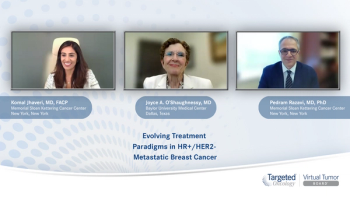
Focused discussion on the evolving role of germline testing in HR+/HER2- metastatic breast cancer and how it may impact treatment pathways.
Joshua K. Sabari, MD, discusses LY3537982 for patients with KRAS G12C-mutant advanced solid tumors.
John Diaz, MD, discusses some known biomarkers in ovarian cancer and where he hopes to see more research in the future.

George Nahas, DO, discusses ongoing research that may shape the future treatment landscape of multiple myeloma.

Ben Derman, MD, discusses next steps for using minimal residual disease-guided discontinuation of maintenance therapy in patients with multiple myeloma.

Michael Wang, MD, discusses where future research efforts for pirtobrutinib will be focused for patients with relapsed/refractory mantle cell lymphoma.
Sagun Shrestha, MD, discusses new trials that are exploring anti PD-1 therapy in the first-line setting for patients with small cell lung cancer.

The categories of steroid refractory gvhd are discussed: intolerant, unresponsive, and dependent.

The group discusses treatment goals and patient education for chronic GVHD.
Amy Dezern, MD, MHS, closes her discussion by emphasizing the need for more treatments in MDS.
Following the 2023 ASCO Annual Meeting, Abdulraheem Yacoub, MD, reviews key data updates from the IMerge trial investigating imetelstat in patients with lower-risk MDS.

Matthew Powell, MD, discusses findings from the phase 3 RUBY/ENGOT-EN6/GOG3031/NSGO trial of dostarlimab in combination with chemotherapy for patients with mismatch repair deficient/microsatellite instability-high primary advanced or recurrent endometrial cancer.
Daniel J. George, MD, offers closing thoughts and advice to community oncologists who treat patients with prostate cancer.
Clinical insights on managing adverse events associated with PARP inhibitor therapy in patients with prostate cancer.
Daniel J. George, MD, provides insights on how to treat patients with prostate cancer who have pathogenic non-BRCA HRD mutations, and his approach when patients progress on a PARP inhibitor.
A medical oncologist discusses situations in which he might recommend abiraterone alongside a PARP inhibitor as first-line treatment for patients with mCRPC.
An expert on prostate cancer provides insights on patients best suited for PARP inhibitor treatment and how to select and sequence therapy.
Daniel J. George, MD, discusses recent clinical trial data on the PARP inhibitors rucaparib and talazoparib for treatment of prostate cancer.
A comprehensive overview of the study design and findings from the PROpel trial, which looked at olaparib and abiraterone in patients with metastatic castration-resistant prostate cancer.
The transformative potential of antibody drug conjugates in NSCLC treatment is discussed, encompassing their design, bystander effect, biomarkers, and impact on the treatment landscape.
An expert oncologist outlines first-line treatment options for patients with metastatic castration-resistant prostate cancer (mCRPC).
Insights on when to test for BRCA mutations and HRR (homologous recombination repair) status when treating patients with prostate cancer, and whether to utilize tissue testing or ctDNA assays.
Dr. Florez and Dr. Sabari discuss standards of care for different patient populations in NSCLC.
Daniel J. George, MD, presents the case of a 65-year-old man with prostate cancer and offers his initial impressions.
Closing remarks on the overall clinical implications of imetelstat data, and patient populations that could benefit the most from it.

The panel explores unmet needs in aRCC treatment and shares expectations for changes and advances in the landscape in the near future.
Insights on patient-reported fatigue from the IMerge trial, reviewing imetelstat data and its potential to address an unmet need in lower-risk MDS.
Ongoing studies assessing triplet regimens in frontline advanced RCC and their influence on treatment decisions are discussed, including efficacy outcomes.

Jonathan E. Rosenberg, MD, explains the study design and patient inclusion criteria of the phase 2 EV-103 study investigating combination enfortumab vedotin plus pembrolizumab for the treatment of patients with metastatic or locally advanced urothelial carcinoma.