Michael Wang, MD, gives a brief overview of the safety and efficacy findings of a phase 1b study evaluating acalabrutinib plus venetoclax and rituximab in patients with mantle cell lymphoma.


Your AI-Trained Oncology Knowledge Connection!
Michael Wang, MD, gives a brief overview of the safety and efficacy findings of a phase 1b study evaluating acalabrutinib plus venetoclax and rituximab in patients with mantle cell lymphoma.

Robert J. Soiffer, MD, discusses the use of stem cell transplant in treating hematologic malignancies prior to the availability of chimeric antigen receptor T-cell products.
Hetty Carraway, MD, describes the criteria used to determine if a patient with newly-diagnosed acute myeloid leukemia is suitable for intensive induction therapy.
In an interview with Targeted OncologyTM, Leslie, assistant professor, Hackensack Meridian School of Medicine, director, Indolent Lymphoma and Chronic Lymphocytic Leukemia Research Programs, John Theurer Cancer Center, discussed the CAR T-cell product, brexucabtagene autoleucel, and its influence on both MCL and indolent lymphomas.
Eytan Stein, MD, provides an overview of the frontline treatment options currently available for acute myeloid leukemia.
Marcin Kortylewski, PhD, discusses what research he believes is next to come in the acute myeloid leukemia space.

Cary Gross, MD, discusses the results of a retrospective study of patients with advanced non-small cell lung cancer that showed an association between Medicaid insurance, rates of biomarker testing, and patient outcomes.
In the fifth interview of the series, medical oncologist and hematologist Dr. Jerome H. Goldschmidt from Blue Ridge Cancer Care elaborates on the rationale for use of CDK4/6 inhibitors such as trilaciclib for prevention of chemotherapy-induced myelosuppression (CIM) in extensive-stage small cell lung cancer (ES-SCLC), and touches on recently presented data on trilaciclib.

Shared insight on the VISION trial, which analyzed 177 Lu-PSMA-617 in previously treated PSMA-positive metastatic castration-resistant prostate cancer.

Moving on to their last patient case, expert panelists review the diagnosis and management of a patient with metastatic castration-resistant prostate cancer.
Raajit Rampal, MD, PhD, discusses his recommended approach to assessing and treating patients with myelofibrosis.
Manali Kamdar, MD, MBBS, discusses the efficacy and tolerability of a phase 1 clinical trial testing a novel anti-CD19 chimeric antigen receptor T-cell product in adults with relapsed/refractory B-cell lymphoma.

Lori J. Wirth, MD, discusses a new assay with the ability to perform DNA and RNA sequencing to better detect gene fusions.
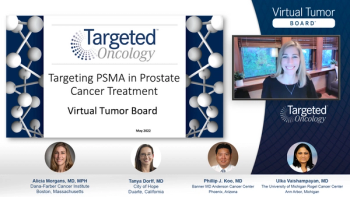
Alicia Morgans, MD, MPH, presents the case of a 67-year-old man with metastatic castration-resistant prostate cancer.
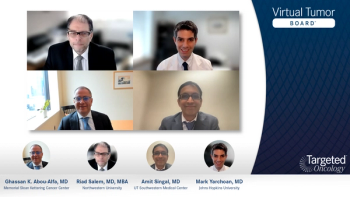
Expert panelists consider later-line treatment options for a patient with recurrent hepatocellular carcinoma.
Comprehensive insight on several clinical trials analyzing frontline combination therapies for patients with unresectable hepatocellular carcinoma.
Experts share their thoughts on sequencing hormonal agents and patient selection for clinical trials.
In the setting of unresectable hepatocellular carcinoma, experts consider the role of frontline atezolizumab + bevacizumab given data from IMbrave150.
Samuel J. Klempner, MD, discusses the preliminary results of a study of the investigational agent DKN-01 for patients with gastroesophageal adenocarcinoma.
Shana Wingo, MD, discusses the key goals of the partnership between community oncology practices and American Oncology Network.

Erika P. Hamilton, MD, discusses the evolution of fam-trastuzumab deruxtecan-nxki through its examination in various trials.
Lori J. Wirth, MD, explains the role of NTRK inhibitor in TRK fusion-positive thyroid cancer treatment.
Closing out the program, Robert Zeiser, MD, shares what he is looking forward to in the field of graft-vs-host-disease.
Adverse events related to chronic graft-vs-host-disease therapies and strategies to manage these adverse effects are considered.
Robert Zeiser, MD, touches on additional therapeutic options for steroid-refractory chronic graft-vs-host-disease, such as extracorporeal photopheresis, mycophenolate, everolimus, and more.
Therapies for steroid-refractory chronic graft-vs-host disease, ibrutinib, ruxolitinib, and belumosudil, are explored in a comprehensive analysis.
A GVHD expert comments on the frontline therapy available for the condition.
Selection of prophylaxis regimen is reviewed followed by a discussion of the typical patient presentation of GVHD.
Dr Zeiser outlines the differences between acute and chronic GVHD and also reviews factors that put transplant patients at greater risk of GVHD.

Alexander Drilon, MD, discusses the differences in how TRK fusions manifest in older patients vs younger patients.
