Anne O’Dea, MD, discusses factors that contribute to second-line treatment selection and offers clinical insights on improving outcomes for patients being treated for breast cancer.

Anne O’Dea, MD, discusses factors that contribute to second-line treatment selection and offers clinical insights on improving outcomes for patients being treated for breast cancer.
Expert perspectives on safety data from the EMERALD subgroup analysis, highlighting endocrine therapy–related adverse effects and supportive care strategies.
Dr O’Dea provides an overview of the EMERALD trial investigating elacestrant in patients with ER+/HER2- advanced breast cancer and discusses subgroup analysis data and their clinical implications.
A hematologist-oncologist discusses the importance of biomarker testing in breast cancer, provides clinical insights on how to prioritize different testing assays, and outlines the roles of circulating tumor DNA and repeat testing.
John M. Burke, MD, discusses results from a phase 2 study which evaluated brentuximab vedotin, nivolumab, doxorubicin, and dacarbazine for the treatment of early-stage and advanced classical Hodgkin lymphoma.
Anne P. O'Dea, MD, presents the case of a 49-year-old woman with HR+/HER2- metastatic breast cancer and offers initial impressions on the patient’s risk and prognosis.
Ira Zackon, MD, discusses the background of a real-world study which sought to identify some of the racial and socioeconomic disparities seen in patients with chronic lymphocytic leukemia.
Yi-Bin Chen, MD, provides an overview of the iNTEGRATE and ROCKstar trials, underscoring their significance in the current treatment paradigm for graft versus host disease, particularly highlighting their ability to inhibit the fibrosis cascade, which offers substantial benefits for patient healing and recovery.
Yi-Bin Chen, MD, presents the results of the phase-3 randomized REACH-3 Trial, highlighting the superior best overall response rate of 75% in the experimental arm compared to 60% in the best-available therapy arm.
Adam D. Cohen, MD, discusses ongoing research influencing the multiple myeloma treatment landscape.
Discussing perspectives on the future landscape of chronic GvHD management, including limitations of current targeted treatment options and emerging research of interest.
Evaluating the significance of the AGAVE-201 trial results for axatilimab in refractory chronic GvHD and key factors to consider when assessing the data.
Amer Zeidan, MBBS, discusses the primary end point and subgroup analyses performed on the COMMANDS trial of luspatercept-amt for treating anemia in patients with myelodysplastic syndromes.
Tina Cascone, MD, PhD, discusses the CheckMate-77T trial of perioperative regimen of neoadjuvant nivolumab plus chemotherapy followed by surgery and adjuvant nivolumab for the treatment of patients with stage IIA to IIIB non-small cell lung cancer.

Paul Richardson, MD, concludes his conversation by briefly discussing additional trials influencing the multiple myeloma treatment landscape, as well as the use of iberdomide.
Paul Richardson, MD, continues his conversation by highlighting various ongoing studies in the multiple myeloma space.
Paul Richardson, MD, highlights some of the important studies being done in multiple myeloma.
Paul Richardson, MD, delves into some of the studies significantly impacting the multiple myeloma treatment landscape and outcomes for patients.

This segment delves into the management of a case of moderate cGvHD involving the skin, eyes, and mouth, with a focus on the use of Belumosudil based on the ROCKstar trial data.
This segment delves into the management of a case of moderate cGvHD involving the skin, eyes, and mouth, with a focus on the use of Belumosudil based on the ROCKstar trial data.
Rebecca A. Shatsky, MD, looks to the future of HER2+ breast cancer treatment, highlighting unmet needs in the therapeutic space.
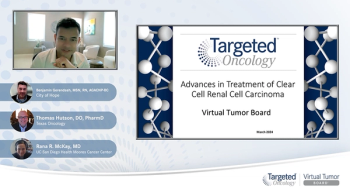
Sumanta Kumar Pal, MD, FASCO, presents the case of a 66-year-old man with metastatic renal cell carcinoma, and the panel provides comprehensive insights on treatment decisions, highlighting the NCCN Guidelines.
A panel of 4 experts on renal cell carcinoma introduce themselves and discuss IMDC risk stratification criteria and the evolution of the treatment landscape.
Lova Sun, MD, MSCE, discusses resistance mechanisms against targeted agents for the treatment of thyroid cancer.
A medical professional outlines the goals and challenges of communicating with his patient, emphasizing the importance of setting realistic expectations for halting disease progression and potentially achieving some degree of disease reversibility, while also exploring the roles of first-line and second-line therapies in the management of chronic graft versus host disease.
Yi-Bin Chen, MD, presents a patient case, detailing the symptomology and pathology of graft versus host disease, such as dry eyes, dry mouth, and difficulty swallowing, while also addressing steroid dependence as an indication for initiating second-line therapy.
Lucia Masarova, MD, PhD, discusses some of the latest updates across myeloproliferative neoplasms.
Dr. Schiller will discuss the limitations of current treatment options for BPDCN in elderly transplant-ineligible patients and the emerging BPDCN research and data that they are most interested in to improve outcomes in this specific patient population.
Dr. Schiller will discuss how their treatment approach would differ for a 74-year-old BPDCN patient with only well-controlled type 2 diabetes as a comorbidity and an ECOG performance status of 0.
Dr. Schiller will discuss the red flag symptoms that increase suspicion of BPDCN, the process for diagnosis, and any challenges with differential diagnosis. Dr. Schiller will also provide strategies and resources to improve community recognition and diagnosis of this rare disease.