
Carlos Rojas, MD, discusses preliminary findings from a phase 1 trial which of MK-1084 alone and with pembrolizumab in patients with advanced solid tumors and metastatic non–small cell lung cancer.

Carlos Rojas, MD, discusses preliminary findings from a phase 1 trial which of MK-1084 alone and with pembrolizumab in patients with advanced solid tumors and metastatic non–small cell lung cancer.
Dr Abdulraheem Yacoub discusses experience with the JAK inhibitor momelotinib in patients with myelofibrosis, noting robust efficacy in clinical trials for spleen volume reduction, symptom improvement, and anemia benefit, but explains that its utility in first-line versus second-line settings is still being determined.
Abdulraheem Yacoub, MD, reviews the current myelofibrosis treatment landscape including the four approved JAK inhibitors - ruxolitinib, fedratinib, pacritinib, and momelotinib - discussing the clinical trial data and indications for each in first-line and second-line settings.
Rohit Gosain, MD, and Rahul Gosain, MD, provide a summary of the key gastrointestinal cancer data updates discussed following the 2023 ESMO Congress Meeting.

Rachna Shroff, MD, details key data from the phase III GASTFOX study comparing FOLFOX to docetaxel (TFOX) in the first line treatment of advanced gastric cancer.
Expert medical oncologists review data from the CABINET trial evaluating cabozantinib compared with placebo in two cohorts of previously treated patients with neuroendocrine tumors.
Rachna Shroff, MD, chief of the Division of Hematology and Oncology in the Department of Medicine at the University of Arizona College of Medicine, highlights key data from the Codebreak300 study evaluating if the combination of sotorasib and panitumumab is superior to standard-of-care trifluridine/tipiracil or regorafenib in the setting of chemorefractory metastatic colorectal cancer.

Thoracic medical oncologists discuss the evolving role of biomarkers in the non–small cell lung cancer treatment landscape.
Anne S. Tsao, MD, and Edward B. Garon, MD, MS, introduce themselves and provide an overview of the incidence, prognosis, and treatment of non–small cell lung cancer.
Michael Hurwitz, MD, PhD, discusses the advances being made for the treatment of chimeric antigen receptor T-cell therapies and next steps for evaluating the agent across solid tumors.
A glimpse into the ever-changing treatment landscape of DLBCL, exploring frontline therapy options and the potential for tailoring treatments based on novel agents and randomized trials.
Dr. Lunning explores the FDA-approved CD3- and CD20-targeting bispecifics in relapsed/refractory DLBCL, highlighting their potential impact on heavily pretreated patients.
A comprehensive exploration of CAR T-cell therapy and additional agents such as loncastuximab in relapsed/refractory DLBCL, emphasizing clinical findings and treatment considerations.
A deep dive into the use of Polatuzumab Vedotin in DLBCL treatment, including insights from clinical trials and innovative strategies.
Matthew Lunning, DO, FACP, further explores relapsed/refractory DLBCL treatment strategies and clinical trial findings from the L-MIND and RE-MIND2 studies, discussing the impact of tafasitamab + lenalidomide on patient outcomes.
An in-depth examination of relapsed/refractory DLBCL treatment options, including CAR T-cell therapy and tafasitamab, based on clinical trial data and patient eligibility.
Expert insights into a 67-year-old man's journey through relapsed/refractory diffuse large B-cell lymphoma, exploring diagnosis, treatment options, and outcomes.
Bradley J. Monk, MD, FACS, FACOG, discusses the phase 3 KEYNOTE-A18 study of pembrolizumab with chemoradiotherapy for the treatment of patients with newly diagnosed, previously untreated, high-risk locally advanced cervical cancer.
Anthony Hunter, MD, details the primary goals when treating a typical patient with myelofibrosis, such as improving symptoms like weight loss and fatigue, addressing anemia, and, more recently, striving to extend survival, with treatments like JAK inhibitors showing potential for improving overall survival in patients.
Myelofibrosis can be categorized as primary (developing de novo) or secondary (arising in patients with pre-existing MPNs), and it further distinguishes between proliferative and cytopenic types, with each type having its unique diagnostic criteria and implications for treatment.
Rafael Fonseca, MD, envisions a future where bispecific antibodies and CAR T-cell therapy, currently used in advanced stages of multiple myeloma treatment, can offer potential cure for patients, and emphasizes the importance of advocating for their broader application in community settings.
Hussein Tawbi, MD, PhD, presents the case of a 67-year-old woman with stage IV melanoma and shared his initial impressions.
An expert oncologist discusses novel treatments for relapsed/refractory multiple myeloma presented at recent meetings, highlighting a study on elranatamab, a new compound targeting BCMA, and trials including the LINKER-MM1 study on linvoseltamab.
Hussein Tawbi, MD, PhD, emphasizes the importance of patient education in managing adverse events from the treatment of metastatic melanoma with checkpoint inhibition, discussing symptom recognition, potential side effects, and treatment adjustments while ensuring team accessibility and patient communication.
Hatem Soliman, MD, discusses future directions for the HER2-positive breast cancer treatment landscape.
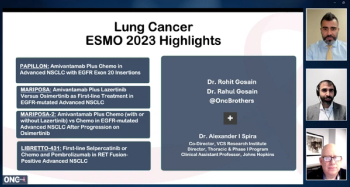
Following their program with expert Alexander Spira, MD, PhD, FACP, Oncology Brothers Rohit Gosain, MD, and Rahul Gosain, MD, share key takeaways from ESMO 2023 centered on advancements in the management of NSCLC.
Alexander Spira, MD, PhD, FACP, joins the Oncology Brothers in reviewing data from LIBRETTO-431 and frontline selpercatinib in patients with RET fusion–positive advanced non–small cell lung cancer.
Shared insight from key opinion leaders on results from MARIPOSA-2 and the role of amivantamab plus lazertinib and chemotherapy in patients with advanced NSCLC following progression on osimertinib.
Expert insight into results from MARIPOSA, a study of frontline amivantamab plus lazertinib in advanced non–small cell lung cancer, and the potential for this regimen’s use in real-world practice.
Oncology Brothers Rohit Gosain, MD, and Rahul Gosain, MD, are joined by Alexander Spira, MD, PhD, FACP, to review data from PAPILLON, which combined amivantamab and chemotherapy as frontline treatment for patients with advanced NSCLC.