
Opinion|Videos|January 16, 2026
Limitations of Steroids and Early Escalation in cGVHD Treatment
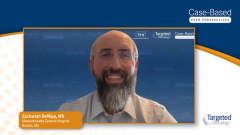
Author(s)Zachariah DeFilipp, MD
Explore effective third-line treatments for chronic GVHD, focusing on the latest FDA-approved therapies and their impact on patient outcomes.
Advertisement
Episodes in this series
Segment 5 examines the patient’s response to first-line corticosteroids and uses it to discuss broader limitations of steroid therapy in cGVHD. Although the patient experiences an initial improvement in skin involvement, attempts at tapering result in disease flare and progression, a pattern Dr. DeFilipp notes is highly reflective of real-world experience.
He explains that although steroids may reduce inflammatory manifestations early, they rarely produce deep or durable responses, particularly in patients with sclerotic disease. Prolonged exposure is also associated with significant toxicity, reinforcing the need for timely transition to second-line therapy. Dr. DeFilipp questions whether waiting a full month before escalating treatment is optimal and suggests that steroid failure may be apparent as early as the first unsuccessful taper.
The segment emphasizes a proactive treatment philosophy: maintaining steroids while introducing a more effective agent early to prevent further disease progression. This approach minimizes cumulative steroid exposure and addresses the underlying disease more effectively.
Advertisement
Related to this article
Giredestrant plus everolimus reduced the risk of progression or death by 44% in the ITT population and 62% in ESR1-mutated disease in phase 3 evERA data published in NEJM.

The oral azacitidine/cedazuridine combination was compared with subcutaneous azacitidine in the phase 3 portion of the AZTOUND trial.

Adding zabilugene almadenorepvec to standard gemcitabine/nab-paclitaxel extends survival and response in newly diagnosed metastatic pancreatic cancer, with manageable safety signals.

Late 2026 FDA oncology rulings may reshape care—from CSF-1R and ALK drugs to oral SERDs and BCMA CAR T breakthroughs.
Resubmitted FDA filing advances off-the-shelf EBV-specific T-cell therapy tab-cel for relapsed EBV+ PTLD after transplant, with longer follow-up.

Resection with cesium-131 tile-based radiation therapy prolonged time to surgical bed recurrence vs resection with stereotactic radiation in the phase 3 ROADS trial.

Degevma was approved for skeletal-related events in adults with bone metastases, giant cell tumor of bone, and the treatment of hypercalcemia of malignancy.
FDA fast-tracks plinabulin plus docetaxel for post-immunotherapy non-squamous NSCLC, as DUBLIN-4 phase 3 targets survival gains.
Advertisement
Advertisement
Trending on Targeted Oncology - Immunotherapy, Biomarkers, and Cancer Pathways
1
Denosumab Biosimilar Approved For Existing Oncology Indications
2
Plinabulin Receives FDA Fast Track Designation in Post-ICI NSCLC
3
FDA Oncology Recap: Approvals, Designations, and Decisions in September 2026
4
Giredestrant Plus Everolimus Improves PFS in ER+ Advanced Breast Cancer
5