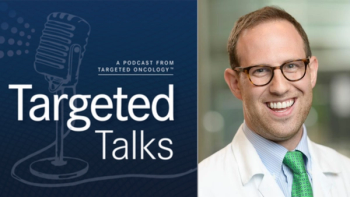
Benjamin Herzberg, MD, discusses KRAS-mutant non–small cell lung cancer, upfront biomarker testing, and the emerging RAS inhibitor toolkit on Targeted Talks.

Broad oncology bundles falter; experts push smaller surgery/radiation episodes, better navigation, and AI analytics to improve value-based care.
Just over a decade after the launch of the Oncology Care Model (OCM),1 the push toward value-based cancer care continues to evolve. The OCM and subsequent Enhancing Oncology Model (EOM)2 helped advance critical conversations around quality, cost, and payment reform, but they also highlight the challenges of applying broad bundled-payment models to an increasingly complex and rapidly changing cancer landscape.
In an interview with Targeted OncologyTM, Stephen Speicher, MD, MS, associate chief medical officer at Lantern and pediatric hematologist/oncologist, reflected on the lessons learned from the OCM, why oncology may benefit from more narrowly defined payment models, and how technological innovation could shape the next era of value-based care.
Stephen Speicher, MD, MS: I think there's a lot of opportunity in what the OCM, EOM, and the [Centers for Medicare and Medicaid Services (CMS)] programs have started to [implement] related to payment reform and payment structure in oncology. As I reflect on the past 10 years… I think there were some exciting things about it.
The conversations that were related to payment reforms since OCM were amazing; those conversations have to happen in order to move the needle on both quality and cost. If we take a step back and look at the fundamental goals of these programs, and of anybody working within them—whether they're designing them, the oncologists [themselves], the health plans, or the health systems—we want to drive quality for oncology patients, and we want to be able to do so in a way that is not completely ballooning the ongoing costs in cancer care. While those conversations were [happening before], I don't think real conversations were [happening] until they were [placed] into [the context of] a CMS program. I think that [the OCM designers and oncologists] were asking the right questions at the time: “How do we define quality in cancer? How do we make sure that we're really driving towards that?” Those are all meaningful and beneficial things from the program itself.
[But] if you look at the pure economics of how the program worked, it didn't. If you look at just how much the program ultimately cost Medicare, there was a net loss in the $600 million range from OCM in and of itself. And while we're hoping for meaningful progress on the quality side, we didn't see tremendous progress across all of the quality metrics that we were looking at…
[Looking forward, one idea where] we need to evolve how we think about bundled payments, specifically in oncology. That's what I am most passionate about: The idea that, just like everything in medicine, there's such diversity across medical specialties, across diseases, so we have to approach bundled payments and this broader concept of value-based care differently across different disease types.
When we think about the premise of a bundle and what we would need to make a bundle work from a quality and cost perspective, we need a disease that is fairly well understood from a pathophysiological stance. We need to understand how to diagnose it, the underlying cause, the treatment options, and the outcomes we can confidently expect. It needs to follow a fairly linear and predictable path. I think you see that in something like knee replacements [for example. Generally], we understand how to diagnose when a patient needs a knee replacement, the general best [treatment] approaches, and what the costs are going to be from preoperation anesthesiology to the procedure itself. We know how patients tend to [fare], and I think that is why you've seen a lot more success in bundled payments in the surgical space…
At the time when this model was conceptualized, cancer was a completely different disease. We thought of it as homogenous. What we've uncovered in pathophysiology and treatment has completely changed the way that we think about cancer. Fundamentally, cancer just does not function in the same way that a surgery does, so it’s a lot more challenging to think about how to bundle something together when we're still in the infancy of fully understanding [the disease].
Again, we take a very sweeping view of what a bundle is. When you talk to most people and ask, “What is a bundle?” they're going to say, “You have to bundle everything for the entire disease together, write a check, and you have to work within those constraints.” That broad, sweeping bundle is challenging oncology for the exact reasons I just outlined. Even when we define the “bookends” of the bundle, that gets tricky. If you start a bundle in oncology from the initiation of chemotherapy, you've missed the entire workup portion. Not only is there cost involved in that workup of the disease, but that's also where a lot of the most important treatment decisions are made, and those [decisions] impact the path of that individual and, therefore, the bundle.
I'm going to go back to what we know works better. I don't know if we know that surgical bundles necessarily work in a sweeping way, but we know that it works better than what we've seen in oncology bundles. So, I think that there's a lot of opportunity in oncology to have a tighter definition around some of these smaller, more well-defined bundles. There are a lot of interest and opportunity in surgical oncology, [for] surgical procedures that are predictable in oncology for specific diseases. For radiation oncology bundles, there's a lot of opportunity there because again, there's more predictability in terms of the spend and what we should expect from an outcomes perspective; it also removes the drug cost part from it, which I think is inherently what makes bundles in oncology so difficult.
My biggest fear as an oncologist in thinking about oncology bundles is when we lump in drug cost to an oncology bundle, it hamstrings you: This is the treatment that I've decided to give the patient, but what happens if that doesn't work out for whatever reason, whether the patient doesn't respond or has adverse reactions to it? Or the scenario I always think about: What happens if a groundbreaking new therapeutic that's expensive comes on the market while a patient is within the constraints of a bundle? All of a sudden, I'm put in this position where I need to make a decision: Do I do what I think is actually best for the patient, or do I go with what I've already signed off on from a bundle perspective?
I think there's too much risk in how we've structured them, and I think the opportunity to consider more episodic bundles around surgery and radiation would allow us to figure out whether these approaches work. Can we do this in a more episodic manner, and is that more effective for quality and cost? I also think we have to uncouple the quality and the cost equation. Oftentimes, we try to solve for both of those simultaneously, and conceptually that makes sense: If you drive quality, cost will improve. I believe in that fundamentally, but it's hard to do that from a practical perspective. We have to be really specific on what we are trying to drive from a quality perspective, how we want to curb cost, and try to solve for those independently, [while] thinking about more holistic payment reform.
I don't think they made enough changes to the underlying structure to answer the questions they're trying to answer and hit the objectives they're trying to hit. I think they have clearly defined objectives, [but] they did not make enough of a reimagined version of the OCM, and the reality is you can see that it's not working for people in general participation. Enrollment in the OCM was around 120 practices, and when I last got statistics on this, around 40 practices had agreed to participate in EOM. You need broad practice participation across a swath of different providers, and clearly the market is telling us that they are not bought into what EOM is and how it's positioned.
For the last 6 years of my career, prior to joining Lantern, I was really enmeshed in the community oncology environment. In order for these programs to be successful, you need very effective permeation into the community oncology space, and you need buy-in from them because that's where patients are being treated. I know from my perspective that community oncology was not fully bought into EOM and didn't find that it was going to be able to be sustainable for them. In order for a program like this to work, especially from CMS, you need it to work for large academic centers, large health systems and hospitals, and for community oncology, both large and small. That's a big undertaking. There's a lot of things that you need to think about before you can have a successful model where there's going to be widespread participation.
What makes me excited and optimistic is that no one has given up on this. There was a world where they could have thrown their hands up and said, "Listen, this didn't really work, and patients are surviving longer. Let's just go back to traditional fee-for-service and wash your hands of this whole value-based care thing.” I don't see that; I actually see reinvigorated excitement around value-based care… I do believe that there is still ongoing motivation across all the major stakeholders, including payers, technology companies, providers, and pharma. Folks are really motivated to solve these problems because this is a field where quality and outcomes are so important to every single person that's working in them. So, I do think that we will see substantial progress, and that there's room for innovation.
I think that the moment is defined by innovation with artificial intelligence [AI]… I think there's going to be immense excitement around how we are leveraging AI to drive down that cost curve. The ultimate way that you see if technology works is whether it can curb the costs, and so we can't just continue to build, build, build without actually showing that there are both outcomes and costs that are that are improved… I think they started to do that with aspects of the program in OCM and EOM. I think bundles will probably be a little bit more narrowly defined, [and that] there's going to be an aspect of technology [focused on] how we are leveraging and improving that. I also think we're going to be smarter on the analytic side on how we're defining outcomes and how we're showing that we're improving outcomes for these patients, because that's ultimately the goal.
I think one of the big core principles in these value-based care and bundled models is navigation and the importance of expert medical opinions. At Lantern, we've worked to really define the entire journey for an oncology patient and how we add and enhance value throughout that process. I think any part of future iterations of bundles and value-based care will continue to rely on very skilled navigators, again, enhanced by technology. We're so excited about how we can leverage our existing nurse navigators who are oncology-trained to take care of patients alongside amazing technology to do tremendous work. I think that there's so much opportunity there, and this world of expert medical opinions is so crucial in how we define quality and how we move the needle from an outcomes perspective.
I'm a firm believer that not everybody should be or needs to be treated at an academic medical center or a large hospital. There's amazing work that's being done at the community level, and for most [patients], being treated close to home and with skilled and high-quality oncologists is a huge goal of theirs. How do we layer in expert guidance, and how do we make sure that they have all the resources that they need? Cancer has become increasingly so complex, and the pace of change…is overwhelming. And so again, going back to how we appropriately leverage those specialists and technology, and how we build tools for doing that, is going to be super crucial.