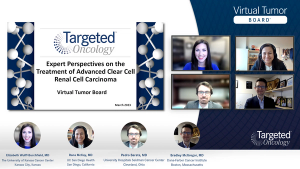
In this closing segment on advanced renal cell carcinoma, Dr. Wulff invites final reflections on anticipated changes in treatment guidelines over the coming year.

Bradley McGregor, MD, is the director of clinical research for the Lank Center of Genitourinary Oncology serving as a medical oncologist specializing in genitourinary malignancies at the Dana-Farber Cancer Institute.
In this closing segment on advanced renal cell carcinoma, Dr. Wulff invites final reflections on anticipated changes in treatment guidelines over the coming year.
In this segment on advanced renal cell carcinoma, Dr. Geynisman focuses on key principles for applying NCCN guideline recommendations in real-world community practice.
In this segment on advanced renal cell carcinoma, Dr. McGregor highlights the challenges of managing comorbidities in community practice and how these factors influence treatment selection. Dr. Wulff and Dr. Geynisman discuss practical strategies for adapting guideline-based therapies in patients with cardiovascular disease, pulmonary conditions, and baseline anemia.
In this segment on advanced renal cell carcinoma, Dr. Geynisman discusses how clinicians decide between single-agent TKIs and combination approaches in later-line treatment settings.
In this segment on advanced renal cell carcinoma, Dr. Wulff explores how the potential incorporation of belzutifan-based regimens into NCCN recommendations could influence future treatment sequencing.
In this segment on advanced renal cell carcinoma, Dr. McGregor introduces emerging data from the LITESPARK-011 study evaluating belzutifan in combination with lenvatinib compared with cabozantinib in previously treated patients.
In this segment on advanced renal cell carcinoma, Dr. Geynisman focuses on the clinical scenarios in which cabozantinib is selected following progression on first-line therapy.
In this segment on advanced renal cell carcinoma, Dr. Wulff transitions the discussion to treatment sequencing after progression on first-line IO-based therapy.
In this segment on advanced renal cell carcinoma, Dr. McGregor focuses on how clinicians move beyond guideline recommendations when multiple appropriate treatment options are available.
In this segment on advanced renal cell carcinoma, Dr. Geynisman raises the increasingly relevant question of how prior adjuvant pembrolizumab or earlier immunotherapy exposure influences treatment selection in the metastatic setting.
In this segment on advanced renal cell carcinoma, Dr. Wulff focuses on the role of cabozantinib across different treatment settings and how clinicians decide between monotherapy and combination approaches in practice.
In this segment on advanced renal cell carcinoma, Dr. McGregor explores the role of VEGFR TKI monotherapy in patients with favorable risk disease, where NCCN guidelines include both IO-TKI combinations and, in select cases, TKI alone.
In this segment focused on advanced renal cell carcinoma, Dr. Geynisman shifts the discussion to patients with intermediate and poor risk disease based on IMDC criteria and how this influences first-line treatment selection. Dr. McGregor and Dr. Wulff discuss how NCCN recommendations support both IO-IO and IO-TKI combinations in this population, while emphasizing that clinical context often guides the final decision.
In this introductory segment on advanced renal cell carcinoma, Dr. Wulff frames the challenge of selecting among multiple NCCN category 1 first-line regimens, including IO-IO and IO-TKI combinations. Dr. McGregor and Dr. Geynisman discuss how they approach treatment selection in clinical practice when several evidence-based options exist.
Bradley A. McGregor, MD, discusses the challenges shared by oncologists who treat renal cell carcinoma.
Bradley A. McGregor, MD, discusses the advancements in treating metastatic renal cell carcinoma.
Bradley McGregor, MD, discusses how ongoing trials hold the key for further breakthroughs in genitourinary cancer treatment.
Bradley McGregor, MD, discusses background of the DAD trial evaluating sacituzumab govitecan-hziy in combination with enfortumab vedotin-ejfv for the treatment of patients with treatment-resistant metastatic urothelial carcinoma.
Bradley McGregor, MD, discusses the rationale behind the multi-institutional, prospective, single-arm phase 2 trial of cabozantinib, nivolumab, and ipilimumab for the treatment of patients with renal cell carcinoma with variant histologies.

In an interview with Targeted Oncology, Bradley A. McGregor, MD, discussed the main takeaways from a phase 3 study of cabozantinib, nivolumab, and ipilimumab for patients with renal cell carcinoma with variant histologies.
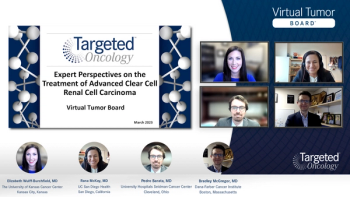
Expert genitourinary oncologists close their discussion with advice to community oncologists treating renal cell carcinoma.
A panel of experts on renal cell carcinoma discuss triplet therapy and review COSMIC-313, a study of cabozantinib, nivolumab, and ipilimumab in the first line.
Expert oncologists discuss the management of immune-related adverse events in renal cell carcinoma.
An overview of adverse event and toxicity considerations with TKI therapies in renal cell carcinoma.
Expert oncologists review data updates on IO-IO regimens in the treatment of advanced RCC, including CheckMate 214, and discuss treatment selection among IO-IO and IO-TKI combinations.
Multidisciplinary experts discuss the role of concurrent radiation in the treatment of renal cell carcinoma.
A panel of experts in renal cell carcinoma present the case of a 59-year-old woman with renal cell carcinoma and discuss systemic therapy options.
RCC experts discuss second-line therapy options following progression on first-line IO-TKI regimen.
Detailed insights on how the choice of tyrosine kinase inhibitors (TKIs) in IO-TKI regimens impact the treatment of advanced renal cell carcinoma.

In the third article of this series, Bradley McGregor, MD, gives comprehensive insights on treating patients with advanced renal cell carcinoma, with a focus on treatment sequencing.