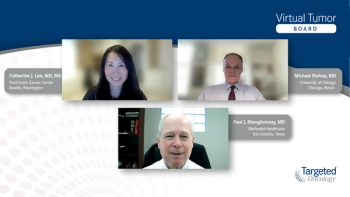
Panelists discuss how future directions in chronic graft-vs-host disease (cGVHD) management may include preemptive use of targeted therapies, first-line treatment with newer agents, and cell-based approaches.

Paul Shaughnessy, MD is Board Certified in Internal Medicine, Hematology and Oncology and is the Medical Director for Methodist Healthcare's Adult Blood and Marrow Stem Cell Transplant Program at Methodist Hospital.
Panelists discuss how future directions in chronic graft-vs-host disease (cGVHD) management may include preemptive use of targeted therapies, first-line treatment with newer agents, and cell-based approaches.
Panelists discuss how axatilimab demonstrates particularly good responses for gastrointestinal graft-vs-host disease (GVHD) and may improve sclerotic skin changes despite lower rates of overall skin response.
Panelists discuss how axatilimab showed promising response rates in the AGAVE-201 trial, even in patients with graft-vs-host disease (cGVHD) who had failed other approved therapies.
Panelists discuss how belumosudil is particularly effective for patients with lung involvement due to its antifibrotic mechanism.
Panelists discuss how clinicians typically taper steroids slowly after starting second-line agents for chronic graft-vs-host disease (cGVHD).
Panelists discuss how most clinicians prefer ruxolitinib over ibrutinib as second-line therapy due to better tolerability
Panelists discuss how FDA-approved therapies such as ibrutinib, ruxolitinib, belumosudil, and axatilimab provide treatment options for steroid-refractory chronic graft-vs-host disease (cGVHD).
Panelists discuss how prophylaxis against opportunistic infections is essential for patients on immunosuppressive therapy for chronic graft-vs-host disease (cGVHD).
Panelists discuss how specialists balance controlling chronic graft-vs-host disease (cGVHD) symptoms while minimizing steroid exposure when patients fail initial therapy.
Panelists discuss how steroid dosing for chronic graft-vs-host disease (cGVHD) typically starts at 0.5-1 mg/kg/day depending on severity, with careful tapering to avoid flares.
Panelists discuss how patient education and multidisciplinary involvement are critical for early detection of chronic graft-vs-host disease (cGVHD).
Panelists discuss how difficult-to-diagnose cases of chronic graft-vs-host disease (cGVHD) often include pulmonary involvement, gynecological manifestations, and neurological symptoms.
Panelists discuss how clinicians typically diagnose chronic graft-vs-host disease (cGVHD) based on clinical features rather than biopsies, except in atypical or uncertain cases.
Panelists discuss how posttransplant cyclophosphamide has changed the clinical presentation of chronic graft-vs-host disease (cGVHD), with potentially lower incidence but similar severity when it does occur.
Panelists discuss how chronic graft-vs-host disease (cGVHD) results from complex biological mechanisms involving inflammation, loss of peripheral tolerance, and fibrotic pathways affecting multiple organ systems.

May 12th 2025
May 12th 2025