






BREAST CANCER
Latest News
Advertisement
Latest Videos






























Advertisement
More News
The FDA granted a regular approval to sacituzumab govitecan for the treatment of patients with unresectable locally advanced or metastatic triple-negative breast cancer who have received two or more prior systemic therapies, at least one of them for metastatic disease.

Gerardo Umanzor, MD, explains the potential benefits of oral paclitaxel and encequidar compared with the intravenous formulation for the treatment of metastatic breast cancer during the coronavirus disease 2019 pandemic.

The FDA has administered a Breakthrough Device Designation to ProSense, a liquid-nitrogen based cryoablation system that allows for minimally invasive breast cancer treatment, for the treatment of T1 invasive breast cancer and/or patients not suitable for surgical alternative for breast cancer.
The FDA has issued a complete response letter to Merck’s supplemental Biologics License Application which sought FDA approval of pembrolizumab as treatment of patients with high-risk early-stage triple-negative breast cancer in combination with chemotherapy as neoadjuvant treatment, then as a single agent as adjuvant treatment.

A panel of experts review the tucatinib regimen including adverse effects to keep an eye on.

Key opinion leaders consider later-lines of therapy in metastatic breast cancer with lung and brain involvement.

The experts discuss data from clinical trials of metastatic breast cancer with brain involvement.

The experts present and discuss a case of a patient with relapsed HER2+ metastatic breast cancer with stable brain metastases.
The panelists discuss clinical experience with the HER2CLIMB regimen, including main adverse effects.
The experts have a detailed conversation on the HER2CLIMB trial, including third-line treatment options and the importance of having a detailed and balanced conversation with patients.
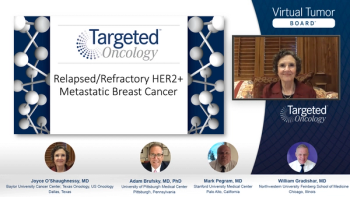
Experts discuss the treatment considerations for HER2+ metastatic breast cancer and provide an overview of the DESTINY-Breast01 trial.
The experts discuss a case presentation of a 63-year-old woman with relapsed HER2+ metastatic breast cancer and discuss rate of relapse in this patient population.
Experts in breast cancer review clinical cases, discuss individualized treatment options and key clinical trials.
The FDA has granted 2 breakthrough device designations to the molecular residual disease test, Signatera.

As the understanding of genetic risk factors in breast cancer continues to grow, professional organizations have sought to provide specific recommendations for genetic testing that would prevent overtesting yet still diagnose as many mutations as possible in patients.
Clinical development of the oral chemotherapy agent, tesetaxel is being discontinued as the treatment of metastatic breast cancer, colorectal cancer, and other solid tumors after the FDA provided feedback on a pre-New Drug Application.
The novel combined immunotherapy CRX100 has been dosed in the first patient with refractory solid tumors in a phase 1, open-label, dose-escalation study.

Adam M. Brufsky, MD, PhD, discusses the use of neoadjuvant therapy for patients with triple–negative breast cancer.
The FDA has issued a complete response letter to Athenex, Inc, regarding the New Drug Application for oral paclitaxel in combination with encequidar for the treatment of metastatic breast cancer. The FDA stated that the application review process has been completed, but the NDA is not ready for approval due to safety and efficacy concerns.
Can treatment with inhibitors of cyclindependent kinases 4 and 6 be optimized for patients with breast cancer? This remains an open question 6 years after the first approval of a CDK4/6 inhibitor, palbociclib.
Patients with BRCA-mutated high-risk HER2-negative early breast cancer demonstrated a superior invasive disease-free survival when compared with placebo in the phase 3 OlympiA trial.
In a 10 to 0 vote, the FDA’s Oncology Drug Advisory Committee did not support the approval of pembrolizumab (Keytruda) in combination with chemotherapy as neoadjuvant therapy for high-risk, early-stage triple-negative breast cancer.

Final analysis of data on HER2-positive disease presented at the 2020 San Antonio Breast Cancer Symposium from experts in the field of breast oncology.
Experts in breast oncology discuss the evolving role of trastuzumab deruxtecan for metastatic HER2-positive breast cancer.
Hatem Soliman, MD, reviews statistically significant data from the PERTAIN study, presented at the 2020 San Antonio Breast Cancer Symposium.
Advertisement
Advertisement
Trending on Targeted Oncology - Immunotherapy, Biomarkers, and Cancer Pathways
1
FDA Accepts NDA for Daraxonrasib in Metastatic Pancreatic Cancer
2
Advanced Renal Cell Carcinoma: Tailoring Second-Line Therapy After Prior Immunotherapy
3
Teclistamab/Talquetamab Reduces Risk of Progression by 89% in R/R Multiple Myeloma
4
Updated HARMONi Analysis Shows Consistent OS Benefit With Ivonescimab in EGFRm Lung Cancer
5