Expert Perspective Tumor Board

Experts featured in this show.

Dr. Eric Singhi from MD Anderson Cancer Center moderated a virtual tumor board with Dr. Bruna Pellini and nurse practitioner Idalmis Hernandez from Baptist Health Herbert Wertheim Cancer Institute, Dr. Gregory Riedlinger from Rutgers Cancer Institute, and Dr. Estalamari Rodriguez from Sylvester Comprehensive Cancer Center.

The program covered the full management landscape for patients with ROS1-positive advanced non-small cell lung cancer (NSCLC), including disease epidemiology, preferred biomarker testing methods across immunohistochemistry (IHC), fluorescence in situ hybridization (FISH), DNA-based and RNA-based next-generation sequencing (NGS), and liquid biopsy. The multidisciplinary team discussed frontline treatment selection with emphasis on CNS penetrance, toxicity profiles, and patient experience, with lorlatinib consistently emerging as the preferred agent. Two clinical scenarios—a newly diagnosed patient with high PD-L1 expression and osseous disease, and a previously treated patient with solvent-front resistance mutation and new intracranial progression—illustrated individualized decision-making. Insurance access barriers, bone-directed therapy, CNS surveillance strategies, second-line sequencing, the role of chemotherapy, and the rejection of immunotherapy monotherapy in ROS1-positive disease were discussed. Education and patient advocacy were identified as the primary unmet needs.


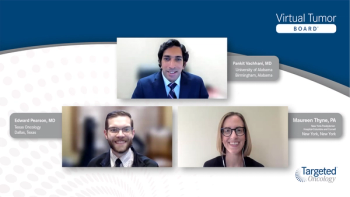
Pankit Vachhani, MD; Edward Pearson, MD, and Maureen Thyne, PA, discuss evidence-based approaches to myeloproliferative neoplasms, highlighting Janus kinase inhibitor selection strategies for myelofibrosis based on patient-specific factors such as cytopenia profiles and splenomegaly severity while addressing polycythemia vera management through strict hematocrit control, molecular monitoring, and emerging therapies including ruxolitinib, interferons, and hepcidin mimetics that offer disease modification beyond symptom control.

Aaron Gerds, MD; Jeanne Palmer, MD; Prithviraj Bose, MD; and Jonathan Abbas, MD, examine the comprehensive management of myelofibrosis, from molecular mechanisms through various disease stages, focusing on risk stratification, treatment sequencing, quality-of-life outcomes, and the integration of emerging therapies into evidence-based clinical practice.

Rafael Fonseca, MD​; Binod Dhakal, MD; Doris K. Hansen, MD; and Adriana Rossi, MD, explore evidence-based treatment strategies for newly diagnosed patients, focusing on transplant-ineligible cases, current therapeutic guidelines, and emerging clinical trial data such as the CEPHEUS study comparing daratumumab plus VRd vs VRd alone.

4 KOLs are featured in this series

Yi Bin Chen, MD; Corey Cutler, MD; Sami Brake, MD, and Colleen Danielson, NP, explore the multifaceted aspects of chronic graft-versus-host disease (cGVHD), from its impact on patient quality of life and diagnostic criteria to treatment strategies across multiple lines of therapy, including ruxolitinib, belumosudil, and axatilimab, while addressing clinical considerations and safety profiles.

Led by Dr Katy Beckermann, medical experts navigate three clinical cases, the patient journey, and updates from key clinical trial results.

Expert perspectives on the management of myeloproliferative neoplasms (MPNs) from a virtual tumor board discussion. The segments cover treatment approaches, including the use of JAK inhibitors, and key efficacy and safety data from clinical trials that inform treatment selection.

A panel of 3 experts on graft-vs-host disease

Expert perspectives on the management of chronic graft-versus-host disease (cGvHD) from virtual tumor board discussions. The segments cover treatment approaches, supportive care strategies, and clinical trial data on agents like ibrutinib, ruxolitinib, and belumosudil for optimizing care in cGvHD. The discussions also evaluate the management of a severe multi-organ cGvHD case, covering diagnosis, emerging therapies, and supportive interventions, featuring insights from Dr. Catherine Lee, Dr. Yi-Bin Chen, and Karolina Faysman, NP.

Jason Porter, MD, Eric Vail, MD, and Ana Velázquez Mañana, MD, MSc, present two clinical cases of non-small cell lung cancer (NSCLC), discuss targetable genomic alterations and their approaches to biomarker testing for these patients, and touch on how socioeconomic and racial disparities may effect use of testing.

In this panel discussion, experts review clinical cases of metastatic non-small cell lung cancer (mNSCLC), discuss commonly observed targetable genomic alterations, and share their perspectives on key clinical trial data that could impact treatment decision-making.