
The panel shares future areas of research in malignant PEComa that interest them, and how they see the treatment landscape evolving.


Your AI-Trained Oncology Knowledge Connection!
The panel shares future areas of research in malignant PEComa that interest them, and how they see the treatment landscape evolving.
Dr Andrew Wagner presents the case of a young man with a retroperitoneal PEComa.

Ashwin Kishtagari, MD, discusses the adverse events of pacritinib for patients with primary myelofibrosis and low platelet counts.
Amer Zeidan, MBBS, closes his discussion with a look at the potential implications of the COMMANDS trial data on the treatment of lower-risk MDS in clinical practice.
Dr Amer Zeidan details the design, patient population, and key efficacy and safety data from the phase 3 COMMANDS trial investigating luspatercept for the frontline treatment of lower-risk MDS with anemia.
Amer Zeidan, MBBS, explains the treatment options for patients with lower-risk MDS prior to the approval of luspatercept.

The panel engages in a discussion on lenvatinib dosing in clinical practice, addressing dose reductions, their impact on treatment effectiveness, and real-world tolerability.
Panelists analyze the 4-year follow-up results of the CLEAR study, covering study design, efficacy, safety, and clinical implications.

Dr Amy Dezern reviews the mechanism of action of luspatercept and its rationale for use in MDS.

Corey Cutler details the NIH Clinical Scoring of Organ System for chronic GHVD symptoms.
Amy Dezern, MD, MHS, details her experience with using erythropoiesis stimulating agents for the treatment of MDS in her clinical practice.

Colleen Danielson, NP, walks through how chronic GVHD symptoms are assessed.

Bradley J. Monk, MD, FACS, FACOG, discusses findings from the phase 3 KEYNOTE-826 trial of the addition of pembrolizumab to chemotherapy for patients with persistent, recurrent, or metastatic cervical cancer.
The discussion centered around emergent biomarkers and targeted therapies in NSCLC, exploring targets like CEACAM5, TROP2, HER3, cMET, and the potential role of antibody drug conjugates in refractory disease.
A comprehensive overview of the current landscape of non-small cell lung cancer (NSCLC), highlighting the impact of biomarkers on treatment selection.
An overview of the patient population and study design of the IMerge trial evaluating imetelstat, highlighting its MOA and rationale for its use in MDS, and reviews key efficacy outcomes, including HgB levels and transfusion independence.
Dr. Zeidan discusses first-line treatment options and the role of ESAs, while Dr. Savona reviews second-line treatment options and factors influencing treatment decisions in lower-risk MDS.
Benjamin Besse, MD, PhD, discusses the biomarker analysis of cohort D of the phase 1/1b CHRYSALIS-2 study.

Frederick Locke, MD, discuss 2 allogeneic CD19-directed chimeric antigen receptor T-cell agents for the treatment of relapsed or refractory large B-cell lymphoma.

Tara Seery, MD, explains the next steps for the QUILT 88 study looking at a novel combination of therapies for patients with metastatic pancreatic cancer.
Liza C. Villaruz, MD, discusses what research in the KRAS G12C-mutated non–small cell lung cancer space has appeared to be most promising in recent years.

George Nahas, DO, discusses recent and ongoing research that has impacted the current treatment landscape for patients with multiple myeloma.

Funda Meric-Bernstam, MD, discusses fam-trastuzumab deruxtecan-nxki and the evaluation of the agent in the phase 2 DESTINY-PanTumor02 trial.
Martee Hensley, MD, presents the case of a post-menopausal woman with a hormone receptor positive malignant uterine PEComa.
A review of the available treatment options for a patient with PEComa who have disease progression after nab-sirolimus.
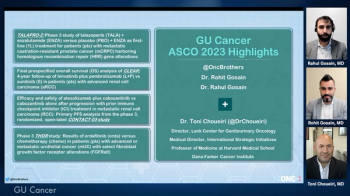
Rohit Gosain, MD, and Rahul Gosain, MD, summarize recent key data updates for genitourinary cancers following the 2023 ASCO Annual Meeting.
Expert oncologists offer insights on recent data from the THOR trial, which compared erdafitinib with chemotherapy in patients with metastatic bladder cancer.
Following ASCO 2023, experts in oncology review recent data from the CLEAR and CONTACT-03 clinical trials in the metastatic renal cell carcinoma space.
Toni Choueiri, MD, joins the Oncology Brothers, Rohit Gosain, MD, and Rahul Gosain, MD, to discuss recent updates from TALAPRO-2, which studied talazoparib plus enzalutamide in first-line metastatic castration-resistant prostate cancer.
Bradley J. Monk, MD, FACS, FACOG, discusses the rationale behind the KEYNOTE-826 study.
