An expert gynecologic oncologist comments on recent revisions to FDA-approved indications for PARP inhibitors in the treatment of ovarian cancer.


Your AI-Trained Oncology Knowledge Connection!
An expert gynecologic oncologist comments on recent revisions to FDA-approved indications for PARP inhibitors in the treatment of ovarian cancer.
Leslie Randall, MD, MAS, reviews recent long-term data on PARP inhibitors in the treatment of ovarian cancer.
Clinical insights on how to manage adverse events for patients with ovarian cancer who are receiving PARP inhibitors.
An expert on ovarian cancer discusses factors that influence PARP inhibitor selection, when to initiate maintenance therapy, and how to counsel patients on PARP inhibitors.
Leslie Randall, MD, MAS, reviews the available treatment options for BRCA-mutated advanced ovarian cancer.
An overview of guideline recommendations for molecular testing in ovarian cancer.
Leslie Randall, MD, MAS, presents the case of a 55-year-old woman with BRCA-mutated ovarian cancer and provides her initial impressions.
Rami Komrokji, MD, discusses the different systems of classifying myelodysplastic syndrome.

Mohamad Mohty, MD, PhD, discusses the growing role of bispecific antibodies for the treatment of multiple myeloma.

Mark J. Levis, MD, PhD, discusses the takeaways from the phase 3 BMT CTN 1506/MORPHO trial which evaluated maintenance gilteritinib after allogeneic stem cell transplant in patients with FLT3-ITD–positive acute myeloid leukemia.

Mark A. Socinski, MD, discusses his approach to managing toxicities related to osimertinib for patients with non–small cell lung cancer and EGFR mutations.
Bhagirathbhai R. Dholaria, MBBS, discusses updated findings from the TRIMM-2 trial of talquetamab and daratumumab for the treatment of relapsed/refractory multiple myeloma.
Yael Cohen, MD, discusses the main safety findings from the phase 1/2 RedirecTT-1 trial, which is evaluating the combination of teclistamab-cqyv and talquetamab for the treatment of patients with relapsed/refractory multiple myeloma.

Michael Wang, MD, discusses what led to the start of the phase 3 BRUIN MCL-321 trial for patients with mantle cell lymphoma.
Hope S. Rugo, MD, FASCO, discusses background and key findings from the phase 3 CAPItello-291 trial in breast cancer.

Anna Jo Bodurtha Smith, MD, MPH, MSc, discusses her research on issues facing patients who need care for gynecologic cancers who have private insurance in the United States.
Lucia Masarova, MD, discusses available treatment options for patients with essential thrombocythemia.
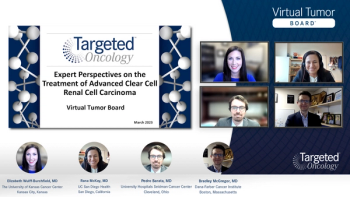
Expert genitourinary oncologists close their discussion with advice to community oncologists treating renal cell carcinoma.

Sara Tolaney, MD, MPH, discusses sacituzumab govitecan-hziy as an effective and safe treatment for patients with hormone receptor-positive/HER2-negative metastatic breast cancer.
Katherine B. Peters, MD, PhD, discusses the findings from the phase 3 INDIGO trial which were presented at the 2023 ASCO annual meeting.
Dennis J. Slamon, MD, discusses the key findings from the phase 3 NATALEE trial of ribociclib with endocrine therapy as adjuvant treatment in patients with HR+/HER2- early breast cancer.

Roby Thomas, MD, the ongoing shortage of the PSMA-targeted radionuclide therapy, Pluvicto and the impact it is having on prostate cancer care.
Manmeet Ahluwalia, MD, discusses results from the CRUX trial which were presented during the 2023 American Society of Clinical Oncology Annual Meeting.
Liza C. Villaruz, MD, discusses the most promising biomarkers in the non–small cell lung cancer space.
Marc S. Ernstoff, MD, provides recommendations for managing patients with metastatic melanoma.
Tanios S. Bekaii-Saab, MD, FACP, discusses the patient population, methods, and design utilized in the phase 3 MOUNTAINEER-03 study.

Joshua K. Sabari, MD, discusses the shortage of carboplatin, its impacts, and how oncologist can still treat patients.
Joshua K. Sabari, MD, explains how the shortage of drugs in the oncology space, including carboplatin and cisplatin, began.

Rupesh Kotecha, MD, discusses the key findings from an analysis centered around the use of pulse reduced dose rate intensity-modulated radiotherapy in patients with central nervous system malignancies.
Melissa Alsina, MD cites recent data from ongoing studies as well as highlights remaining questions and unmet needs in the NDMM landscape.
