Centering discussion on first-line therapy in endometroid adenocarcinoma, Matthew A. Powell, MD, highlights molecular targets and treatment options in this setting.


Your AI-Trained Oncology Knowledge Connection!
Centering discussion on first-line therapy in endometroid adenocarcinoma, Matthew A. Powell, MD, highlights molecular targets and treatment options in this setting.
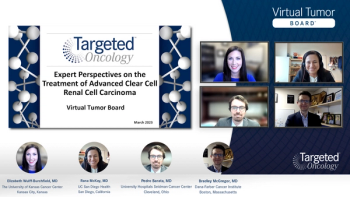
Multidisciplinary experts discuss the role of concurrent radiation in the treatment of renal cell carcinoma.
Expert Matthew A. Powell, MD, reviews the diagnosis, treatment, and recurrence of a 71-year-old woman who presents with endometroid adenocarcinoma.
A panel of experts in renal cell carcinoma present the case of a 59-year-old woman with renal cell carcinoma and discuss systemic therapy options.
The approved PARP inhibitor niraparib has been beneficial for patients with recurrent ovarian cancer, but new second-line restrictions for certain patients have led physicians to be more cautious when re-challenging these patients.

Mark A. Socinski, MD, discusses how the FLAURA trial led to the adoption of osimertinib for patients with non–small cell lung cancer and EGFR mutations.

Salman Fazal, MD, discusses the use cases for older matched sibling donors vs younger unrelated donors in stem cell transplants for patients with cancer.
Hatem Soliman, MD, discusses the current first-line treatment options for patients with HER2-positive breast cancer.
Closing out their program on endometrial carcinoma management, key opinion leaders highlight key novel therapeutic strategies in the evolving treatment landscape.
Collaborative discussion on the advent of triplet therapy in patients with metastatic uterine serous carcinoma and clinical data behind this strategy.

Jeffrey R. Schriber, MD, FRCP, discusses some of the available treatment options for patients with multiple myeloma and how the treatment landscape has evolved over time.
John Nakayama, MD, discusses what the evolution of endometrial cancer treatment has looked like in recent years.
Hans Hammers, MD, PhD, discusses the evolving treatment paradigms in patients with advanced renal cell carcinoma and how recent clinical trial data may optimize future treatment selections.
Yuri E. Nikiforov, MD, PhD, discusses the over treatment of thyroid cancer and why the incidence of this disease has been increasing over the past few decades.
Brian A. Jonas, MD, discusses studies investigating the use of uproleselan for the treatment of patients with acute myeloid leukemia.
RCC experts discuss second-line therapy options following progression on first-line IO-TKI regimen.
Detailed insights on how the choice of tyrosine kinase inhibitors (TKIs) in IO-TKI regimens impact the treatment of advanced renal cell carcinoma.
Ruta D. Rao, MD, discusses her approach to managing adverse events associated with the antibody-drug conjugate sacituzumab govitecan in patients with metastatic triple-negative breast cancer.
Samer A. Srour, MD, explains the history of researching chimeric antigen receptor T-cell therapy in solid tumors.
Ashish Saxena, MD, explains the outcomes of the addition of immune checkpoint blockade to standard chemotherapy for patients with metastatic small cell lung cancer.
Yazan Samhouri, MD, discusses some of the current research that his team at AHN is working on.
Ghassan K. Abou-Alfa, MD, discusses the significance of disease etiology when exploring the results of recent trials of patients with unresectable hepatocellular carcinoma.
Natalie Callander, MD, offers advice for community oncologists and discusses unmet needs in treating transplant-preferred patients with newly diagnosed MM.
An overview of recent data from the SKylaRK and GMMG-HD7 trials evaluating non-daratumumab-based regimens for patients with transplant-preferred NDMM.
Natalie Callander, MD, details findings from her study, evaluating the impact of quadruplet therapy on newly diagnosed patients with high-risk multiple myeloma.
Insights on how the subgroup analysis of the MASTER trial informs the role of autologous stem cell transplantation and the use of quadruplet therapy for elderly patients.
Natalie Callander, MD, reviews the results and quality-of-life outcomes from the GRIFFIN trial on Dara-RVd for patients with transplant-eligible NDMM.
An expert oncologist discusses the role of stem cell transplantation and currently available therapies for the treatment of newly diagnosed multiple myeloma.
Natalie Callander, MD, presents the case of a 61-year-old woman with transplant-preferred newly diagnosed multiple myeloma (NDMM) and offers her initial impressions.
