Expert Robert L. Coleman, MD, details the final patient case and provides an overview of metastatic uterine serous carcinoma.


Your AI-Trained Oncology Knowledge Connection!
Expert Robert L. Coleman, MD, details the final patient case and provides an overview of metastatic uterine serous carcinoma.
Key opinion leaders in the field of endometrial carcinoma provide advice on adverse event management, focusing on immune checkpoint inhibitor therapy.

Emma Searle, PhD, discusses the dosing approach of the MajestTEC-2 trial (NCT04722146) and sequencing teclistamab (Tecvayli) in patients with multiple myeloma.
Yann-Alexandre Vano, MD, explains some of the findings from the phase 2 BIONIKK trial which evaluated nivolumab and ipilimumab in metastatic renal cell carcinoma.
Catherine C. Coombs, MD, discusses unmet needs and offers advice for community oncologists treating patients with relapsed/refractory chronic lymphocytic leukemia.
An overview of recent data from ongoing trials evaluating CAR T-cell therapy and BTK inhibitors in patients with relapsed/refractory CLL.
An expert oncologist reviews the MURANO trial of venetoclax plus rituximab in patients with relapsed/refractory CLL and discusses MRD as a parameter of treatment response.
Catherine C. Coombs, MD, reviews currently available treatment options for patients with relapsed/refractory chronic lymphocytic leukemia.
An expert on chronic lymphocytic leukemia discusses disease progression and prognostic factors that influence treatment decisions.
Catherine C. Coombs, MD, presents the case of a 70-year-old man with relapsed/refractory chronic lymphocytic leukemia and offers her initial impressions.

Ashish Saxena, MD, PhD, discusses the standard-of-care regimens use to treat patients with small cell lung cancer at every stage.
Martin Dreyling, MD, discusses the next steps for research with ibrutinib in the mantle cell lymphoma space following the presentation of data from the phase 3 TRIANGLE study.
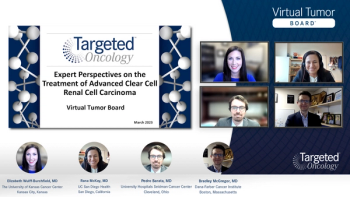
Experts on renal cell carcinoma discuss frontline treatment options for favorable-risk disease and factors that impact treatment decisions.
A comprehensive discussion on how to select the appropriate IO-TKI regimen in the frontline setting in advanced renal cell carcinoma.

Charles Geyer, MD, advises his peers on how to manage the grade 3 or higher toxicities and any serious adverse events seen in the clinical trial setting with adjuvant olaparib.

Marc S. Ernstoff, MD, discusses why physicians would treat metastatic melanoma with immunotherapy prior to small molecule inhibitors in most cases.

Valencia D. Thomas, MD, MHCM, discusses the current landscape for patients with non-melanoma skin cancers.

Mark A. Socinski, MD, discusses types of EGFR mutations in non–small cell lung cancer and the treatments that target these mutations.
Pierre Gholam, MD, discusses his thoughts on a phase 3 trial which evaluated camrelizumab plus rivoceranib vs sorafenib in the first-line for patients with unresectable hepatocellular carcinoma.
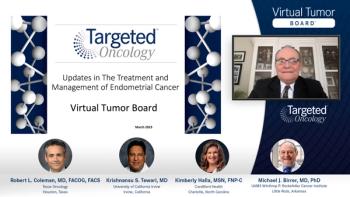
Robert L. Coleman, MD, and Krishnansu S. Tewari, MD, reflect on data from the GARNET clinical trial of dostarlimab in dMMR recurrent endometrial carcinoma.
Shared insight on the utilization of pembrolizumab in dMMR recurrent endometrial carcinoma in the context of the KEYNOTE-158 clinical trial.

Rupesh Kotecha, MD, discusses results of an analysis which centered around the use of pulse reduced dose rate intensity-modulated radiotherapy in patients with central nervous system malignancies.

Matthew A. Ingham, MD, discusses the key takeaways from an article he co-authored regarding novel therapeutics in uterine sarcoma.

Anna Jo Bodurtha Smith, MD, MPH, MSc, discusses why the number of patients with gynecologic cancer that never see a gynecologic oncologist is so high.
Closing out her discussion on the management of recurrent endometrial cancer, Ritu Salani, MD, MBA, shares clinical pearls amidst the shifting treatment paradigm.
A focused review of clinical trial data that inform the use of immune checkpoint inhibition in the setting of recurrent endometrial cancer.
An expert gynecologic oncologist shares her perspective on treatment options available to patients in the first- and second-line settings of endometrial cancer.
Opening her discussion on a patient case of recurrent endometrial cancer, Ritu Salani, MD, MBA, highlights the evolving role of molecular testing in this setting.

Bradley McGregor, MD, discusses the current landscape for advanced renal cell carcinoma therapies, emerging clinical evidence, and considerations for optimal treatment sequencing.

Matthew Anderson, MD, PhD, discusses how the results with niraparib for patients with advanced ovarian cancer impacts the use of somatic profiling in this patient population.
