Alan Tan, MD, discusses the 8-year follow-up data from the CheckMate 214 trial of patients with advanced renal cell carcinoma.


Your AI-Trained Oncology Knowledge Connection!
Alan Tan, MD, discusses the 8-year follow-up data from the CheckMate 214 trial of patients with advanced renal cell carcinoma.
Shirish M. Gadgeel, MD, provides and overview of the MARIPOSA trial of lazertinib and amivantamab vs osimertinib in EGFR-mutated advanced or metastatic NSCLC.
Seth Wander, MD, PhD, discusses genomic variations effect on elacestrant in ESR1-mutated breast cancer from findings in real-world data.

An expert shares their perspective on the future of care for patients with myeloproliferative neoplasms (MPNs).

Nicolas Girard, MD, PhD, discusses data from the COCOON trial for patients with EGFR-mutant advanced non–small cell lung cancer.

Trisha Wise-Draper, MD, PhD, provides an overview of the advancements for the management of head and neck cancers.
Panelists discuss how ongoing trials in first-line advanced hepatocellular carcinoma (HCC) may reshape treatment paradigms, influencing tyrosine kinase inhibitor (TKI) and immune checkpoint inhibitor (ICI) use. Patient selection depends on clinical (liver function, ECOG status) and biological (PD-L1, VEGF expression) factors. Lenvatinib remains a key TKI, balancing efficacy and safety. As emerging regimens (CARES-310, CheckMate-9DW) gain traction, lenvatinib’s role evolves, with experts assessing its place in monotherapy and combinations.
Panelists discuss how current first-line systemic therapies for advanced hepatocellular carcinoma (HCC) include atezolizumab + bevacizumab and durvalumab + tremelimumab, replacing tyrosine kinase inhibitors (TKIs) like sorafenib and lenvatinib. Emerging combinations with anti–PD-L1 agents enhance efficacy. TKI + immune checkpoint inhibitor (ICI) combinations offer synergistic benefits but pose toxicity, cost, and biomarker challenges.
John L. Marshall, MD, discusses the impact of the SUNLIGHT trial in patients with refractory metastatic colorectal cancer.
Firas Eladoumikdachi, MD, FACS, and M. Michele Blackwood, MD, FACS, assess preoperative radiation boosts in breast cancer care.
Nicolas Girard, MD, PhD, discusses the final overall survival results from the MARIPOSA trial of amivantamab plus lazertinib in EGFR-mutant advanced non–small cell lung cancer.
Alan H. Bryce, MD, discusses ongoing research in radioligand therapies.
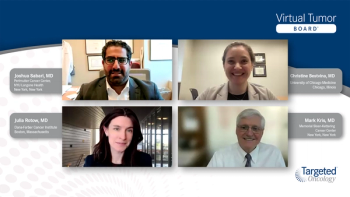
Panelists discuss the presentation and management of a case involving HER2-mutated metastatic non–-small cell lung cancer (NSCLC), exploring treatment options and clinical decision-making
Panelists discuss the management of metastatic non–-small cell lung cancer (NSCLC) with a ROS1 alteration in patients with central nervous system (CNS) involvement, focusing on treatment strategies and challenges.

Marleen I. Meyers, MD, discusses how for patients with cancer, diet influences prevention, treatment outcomes, and long-term survivorship.

Petros Grivas, MD, PhD, discusses challenges in cancer care in the bladder cancer setting.
Alan H. Bryce, MD, discusses areas of need to help guide treatment decisions in the clinic for prostate cancer management.
An expert discusses how monitoring capillary leakage syndrome (CLS) requires vigilant assessment of fluid balance, hemodynamics, and biomarkers. Academic settings may have advanced resources, whereas community settings rely on standardized protocols. Key adverse effects include hypotension, edema, and organ dysfunction. Management includes fluid resuscitation, vasopressors, and close monitoring.
An expert discusses how, for younger/fitter patients with blastic plasmacytoid dendritic cell neoplasm (BPDCN), treatment selection as a bridge to transplant is based on efficacy, toxicity, and response depth. Patient-specific (age, comorbidities) and systemic (drug access, center expertise) factors guide decisions. Emerging real-world evidence, such as Berning et al (ASH 2024), highlights CD123-targeted therapy’s role in optimizing response rates before allogeneic stem cell transplantation (allo-SCT).
Wojciech Jurczak, MD, PhD, discusses the future of B-cell lymphoma therapy, with a focus on Bruton's tyrosine kinase inhibitors and degraders.
Paul B. Renz, DO, discusses anecdotal changes observed by clinician researchers using the MR-LINAC system.
Paul B. Renz, DO, discusses the ideal uses of magnetic resonance-guided linear accelerator system.
A panelist discusses how recent advancements in molecular diagnostics, targeted therapies, and individualized treatment approaches give them greatest optimism for patients with polycythemia vera (PV) by potentially altering disease trajectory, reducing complications, and significantly improving quality of life and long-term outcomes.
A panelist discusses how available therapeutic strategies have enhanced their approach to treatment sequencing in patients with polycythemia vera (PV) by providing a broader armamentarium that allows for customized stepwise management based on disease characteristics, risk stratification, treatment response, and evolving symptom burden.
Hedy Lee Kindler, MD, shares new mesothelioma guidelines that have been released by the American Society of Clinical Oncology.
Wojciech Jurczak, MD, PhD, discusses advancements in B-cell lymphoma therapy, focusing on immunotherapy, molecular-targeted agents, and more.

Deborah Wong, MD, PhD, discusses therapeutic options for patients with nasopharyngeal carcinoma.

Rodabe Amaria, MD, discusses the current role of OBX-115 for the treatment of patients with checkpoint inhibitor-resistant metastatic melanoma.
Wojciech Jurczak, MD, PhD, discusses nemtabrutinib and its development for the treatment of follicular lymphoma.
An expert discusses how quality-of-life assessments guide treatment strategies for patients with myeloproliferative neoplasms (MPNs).
