In interviews with Targeted Oncology, Ronan J. Kelly, MD, MBA, and David Zhen, MD, discuss the CheckMate 649 trial of nivolumab plus ipilimumab and look back on last year's ODAC meeting on its use in PD-L1–negative gastrointestinal cancers.


Your AI-Trained Oncology Knowledge Connection!
In interviews with Targeted Oncology, Ronan J. Kelly, MD, MBA, and David Zhen, MD, discuss the CheckMate 649 trial of nivolumab plus ipilimumab and look back on last year's ODAC meeting on its use in PD-L1–negative gastrointestinal cancers.
An expert discusses how addressing unmet needs in early diagnosis, treatment options, and long-term management, alongside exploring targeted therapies, combination approaches, and advancements in stem cell transplantation, holds promise for more effective and less toxic treatments for blastic plasmacytoid dendritic cell neoplasm (BPDCN).
An expert discusses how structuring clear roles, fostering communication, and using technology in the shared-care model between academic and community centers, alongside monitoring blood glucose levels, kidney function, and comorbidities, ensures effective collaboration and safe use of tagraxofusp (TAG) therapy.
An expert discusses how effective use of tagraxofusp in blastic plasmacytoid dendritic cell neoplasm (BPDCN) requires proactive monitoring for capillary leak syndrome, liver toxicity, and myelosuppression, with structured protocols and multidisciplinary coordination—especially in community settings—to ensure early intervention and safe, successful treatment delivery.
An expert discusses how treatment selection in blastic plasmacytoid dendritic cell neoplasm (BPDCN) involves balancing disease-specific targeting and patient fitness, with tagraxofusp remaining the frontline standard due to its efficacy and favorable hematologic recovery, whereas venetoclax/azacitidine may be reserved for less fit patients or relapsed settings.
An expert discusses how effective blastic plasmacytoid dendritic cell neoplasm (BPDCN) management requires early central nervous system (CNS) evaluation and a multidisciplinary approach, with treatment decisions guided by disease burden, patient fitness, and CNS involvement—highlighting the need for systemic tagraxofusp combined with prompt intrathecal therapy to address high-risk features.
Ahmad Tarhini, MD, PhD, discusses inherited genetic variations and genetic ancestry, particularly for patients with high-risk melanoma.
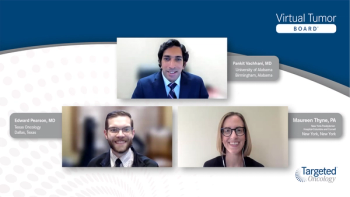
Panelists discuss how Janus kinase (JAK) inhibitors like pacritinib offer crucial treatment options for myelofibrosis patients with severe thrombocytopenia (platelet counts <50,000 ), highlighting its advantages in providing significant spleen volume reduction (29% vs 3% in PERSIST-2 trial) while also offering unexpected anemia benefits possibly due to ACVR1 inhibition, with clinicians noting they set realistic expectations about platelet stabilization rather than improvement when counseling patients.
Panelists discuss how Janus kinase (JAK) inhibitor dosing strategies must be carefully tailored for anemic myelofibrosis patients, with clinical experience suggesting starting at lower doses (10 mg twice daily ) and gradually escalating based on the REALIZE trial approach, while balancing efficacy goals against cytopenia risks and monitoring unique toxicity profiles of different JAK inhibitors including Wernicke encephalopathy with fedratinib and gastrointestinal issues with pacritinib.

Julie Brahmer, MD, discusses the unique features of the phase 3 CheckMate 9LA trial in patients with metastatic non–small cell lung cancer.
Mark D. Tyson, MD, MPH, discusses cretostimogene and how it varies from other therapies for bladder cancer.
Mark Tyson, MD, MPH, discusses practice-changing data from the phase 3 BOND-003 study.
An expert discusses how the diagnosis and management of blastic plasmacytoid dendritic cell neoplasm (BPDCN) require careful recognition of characteristic dermatologic and hematologic features, with tagraxofusp as frontline therapy and vigilant monitoring for central nervous system (CNS) involvement and treatment-related toxicities to guide a multidisciplinary care approach.

A panelist discusses how the MARIPOSA, SKIPPirr, and COCOON studies highlight the significant overall survival benefit of the amivantamab and lazertinib combination in first-line treatment for EGFR-mutant non–small cell lung cancer (NSCLC), while also emphasizing the importance of proactive management of adverse events (AEs), which may shift the standard of care and improve patient tolerability and adherence.

Panelists discuss how managing asymptomatic splenomegaly in myelofibrosis requires a nuanced approach, balancing observation in low-risk patients with early intervention using Janus kinase (JAK) inhibitors in higher-risk cases, while emphasizing the importance of regular monitoring, patient preferences, and shared decision-making.
A panelist discusses how strategies such as clear patient education, simplified skin care regimens, personalized recommendations, and regular follow-ups, along with family involvement and addressing barriers to adherence, can significantly improve patient adherence to prophylactic dermatologic care, leading to better management of dermatologic adverse events (DAEs) in cancer treatment.
Panelists discuss how survival data from the COMFORT trials support the use of ruxolitinib in myelofibrosis, especially in intermediate- to high-risk patients with significant symptom burden or splenomegaly, while highlighting the need to consider patient selection, crossover effects, and real-world applicability when interpreting these results.
A panelist discusses how proactive management of dermatologic adverse events (DAEs) in cancer treatment, through early detection, tailored interventions, and collaboration with specialists such as dermatologic oncologists, advanced practice providers (APPs), and pharmacists, significantly enhances patient comfort, treatment adherence, and overall outcomes.
Jethro C.C. Kwong discusses a novel artificial intelligence-based model, PROGRxN-BCa.
Panelists discuss how posttransplant cyclophosphamide has changed the clinical presentation of chronic graft-vs-host disease (cGVHD), with potentially lower incidence but similar severity when it does occur.
Panelists discuss how chronic graft-vs-host disease (cGVHD) results from complex biological mechanisms involving inflammation, loss of peripheral tolerance, and fibrotic pathways affecting multiple organ systems.

Quoc-Dien Trinh, MD, MBA, discusses a sub-analysis of the phase 3 ARANOTE trial, focusing on Black patients with metastatic hormone-sensitive prostate cancer.
Sophia Kamran, MD, discusses how salvage therapy after biochemical recurrence may improve outcomes for patients with prostate cancer.

Panelists discuss how thrombotic risk assessment—anchored in age, thrombotic history, and additional factors like leukocytosis and JAK2 allele burden—guides personalized therapy in polycythemia vera (PV), balancing cytoreduction, symptom control, and prevention of vascular events.
Panelists discuss how integrating molecular markers—particularly JAK2 V617F allele burden—and clinical features such as symptom burden and thrombotic history inform diagnosis, risk stratification, and monitoring strategies in polycythemia vera to anticipate disease progression and guide personalized treatment.
A panelist discusses how the treatment landscape for chronic graft-vs-host disease (cGVHD) has evolved significantly in recent years, with several pivotal clinical trials beyond REACH3 informing our approach, including the REACH1 and REACH2 trials for acute GVHD; the ROCKstar trial supporting belumosudil approval; and studies evaluating ibrutinib, axatilimab, and extracorporeal photopheresis.

Felix Guerrero-Ramos, MD, PhD, discusses findings from cohort 4 of the phase 2 SunRISe-1 trial of TAR-200 in patients with high-risk, BCG-unresponsive NMIBC with papillary-only disease.
Oncologists at AUA 2025 share promising data, including sasanlimab, cretostimogene grenadenorepvec, and TAR-200 in NMIBC.