
Nicholas J. Robert, MD, discusses the main findings from the MYLUNG Consortium.

Nicholas J. Robert, MD, discusses the main findings from the MYLUNG Consortium.
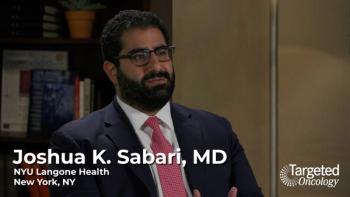
Mark Socinski, MD and Joshua Sabari, MD, share their insight for community oncologists who treat patients with KRASG12C-mutated NSCLC with CNS metastases.

Two experts discuss the potential role of using adagrasib and sotorasib in the front-line setting and how it might shift the treatment paradigm for patients with KRASG12C-mutated NSCLC with CNS metastases.
Drs Socinski and Sabari comment on the use of sotorasib in patients with KRASG12C-mutated NSCLC with brain metastases and review data from the CodeBreak 100 and CodeBreak 200 trials.
Mark Socinski, MD and Joshua Sabari, MD review the key efficacy data from the KRYSTAL 1b cohort and discusses strategies for managing adverse events seen with adagrasib.
Drs Socinski and Sabari discuss the emergence of the KRAS12C mutation, specifically in patients with CNS metastases and how this factors into their treatment decision.
Alexander Spira, MD, PhD, FACP, discusses osimertinib-relapsed disease and its sensitivity to EGFR or MET inhibition.
Yazan Samhouri, MD, discusses his impressions of the TRIANGLE clinical trial presented at the 2022 American Society of Hematology Annual Meeting.
Drs Socinski and Sabari explain the different types of testing methods commonly used in their clinical practice and share advice for community oncologists who are testing for biomarkers in their patients with NSCLC.
Matthew T. Campbell, MD, discusses survival outcomes for patients with both metastatic renal cell carcinoma and sarcomatoid dedifferentiation and how they each have evolved over the past few years.
Dr Srdan Verstovsek discusses how ruxolitinib might fit into the myelofibrosis treatment landscape in the future, and highlights remaining unmet needs.
Srdan Verstovsek, MD, reviews data presented at ASH 2022 on combination ruxolitinib and selinexor for the frontline treatment of myelofibrosis.
Dr Srdan Verstovsek, MD, details how the JAK-STAT pathway is utilized in the treatment of myelofibrosis.
Srdan Verstovsek, MD, provides an overview of myelofibrosis and the clinical signs and symptoms to look for.
Dr Joshua Richter explains which patients with multiple myeloma are most suitable for triplet combination therapies.
Joshua Richter, MD, highlights key data from an update to a study investigating a selinexor triplet combination therapy.
Dr Joshua Richter explains triple class refractory myeloma and the need for more data on treatment options.
Joshua Richter, MD, reviews data from two clinical trials investigating selinexor combination therapies for the treatment of multiple myeloma.
Dr Joshua Richter describes the mechanism of action of XPO1 inhibitor selinexor and its use in treating multiple myeloma.
Joshua Richter, MD, gives an overview of relapse/refractory multiple myeloma and the available treatment options.
Carolyn Owen, MD, discusses the phase 3 GLOW study which evaluated fixed-duration ibrutinib and venetoclax in elderly or unfit patients with chronic lymphocytic leukemia. .
Subject matter expert provides a comprehensive overview of available first-line therapy options for patients with unresectable or metastatic melanoma and a BRAF mutation.
Hussein Tawbi, MD, PhD reviews a case study of a 47-year-old woman with BRAF-mutated metastatic melanoma and discusses his approach to workup, including biomarker testing, for patients with the disease.

Erika P. Hamilton, MD, discusses the updated safety analysis of the DESTINY-Breast03 trial and the patients who were enrolled in the study.

David O’Malley, MD, discusses the mechanism of action of ubamatamab as well as findings from a phase 1 trial evaluating the agent in patients with recurrent ovarian cancer.

Emma Searle, PhD, discusses results of the MajestTEC-2 trial combining teclistamab with daratumumab and lenalidomide for patients with multiple myeloma presented at the 2022 American Society of Hematology Annual Meeting and Exposition.
Closing out her discussion on PD-L1–high metastatic NSCLC, Marina Chiara Garassino, MD, looks toward future evolutions in the treatment paradigm.
Centering focus on the second-line setting of PD-L1–high metastatic NSCLC, a key opinion leader defines a potential role for chemoimmunotherapy,
Highlighting data from the EMPOWER-Lung1 trial, Marina Chiara Garassino, MD, considers the role of first-line cemiplimab in managing PD-L1–high metastatic NSCLC.
Comprehensive insight to factors that inform the optimal selection of first-line therapy for patients with PD-L1–high metastatic non–small cell lung cancer.