Nicolas Girard, MD, PhD, discusses patient-reported outcomes from the LUMINOSITY trial of telisotuzumab vedotin in NSCLC.

Nicolas Girard, MD, PhD, discusses patient-reported outcomes from the LUMINOSITY trial of telisotuzumab vedotin in NSCLC.

Joshua K. Sabari, MD, discusses how, despite the relatively small numbers of CRs and PRs in the DeLLphi-301 trial, the DOR to tarlatamab (exceeding 6 months in 59% of patients and more than 9 months in 29%) is promising, particularly considering that more than 50% of responders maintained their response at the data cutoff, indicating potential long-term benefits in this treatment setting.
Panelists discuss how the introduction of adjuvant immunotherapy has influenced their first-line treatment decisions for patients with newly diagnosed metastatic renal cell carcinoma.
Panelists discuss how the management of adverse events differs between tyrosine kinase inhibitor (TKI) monotherapy and immune checkpoint inhibitor plus TKI (ICI+TKI) combinations, including any notable differences in adverse effect profiles among various ICI plus TKI regimens used in treating metastatic renal cell carcinoma.

Yoshiaki Nakamura, MD, PhD, discusses how the COSMOS-CRC-01 study demonstrated statistically significant recurrence-free intervals across various postoperative and adjuvant chemotherapy time points, highlighting the prognostic value of serial, tissue-free ctDNA assays for real-time detection of MRD vs single postchemotherapy assessments.
Saeed Sadeghi, MD, reviews real-world data on luspatercept, discussing treatment patterns and outcomes, including transfusion burden, hemoglobin increase, and other key baseline data that may differ from registrational studies in the context of managing lower-risk myelodysplastic syndromes (LR-MDS).
Joshua K. Sabari, MD, discusses how the ORR of 32% to 40% observed in the DeLLphi-301 clinical trial among participants receiving tarlatamab is clinically meaningful, particularly given that these responses occurred between 5 and 7 weeks after initiation and emphasize the importance of ORR as a primary end point in evaluating the efficacy of treatment in this patient population.
John Strickler, MD, discusses targeting c-Met as a biomarker in gastric and gastroesophageal junction cancers.
John M. Burke, MD, examines how new obesity treatments, such as GLP-1 agonists, might influence future cancer rates.
Nicolas Girard, MD, PhD, discusses the rationale of targeting PD-L1 and LAG-3 in NSCLC in the RELATIVITY-104 study.
Ticiana Leal, MD, discusses how in cases of extensive stage small cell lung cancer (ES-SCLC) that progress within 6 months of platinum-based chemotherapy, treatment options such as tarlatamab, lurbinectedin, topotecan, and irinotecan should be considered, alongside the potential to extend chemoimmunotherapy cycles. She also addresses the impact of National Comprehensive Cancer Network (NCCN) guidelines and the consideration of prophylactic cranial irradiation (PCI) despite negative brain imaging results.

Panelists discuss how NICHE-2 trial updates offer valuable insights into the role of minimal residual disease assessment in guiding neoadjuvant immunotherapy for colorectal cancer patients.
Panelists discuss how updates from the POD1UM-303/InterAACT2 trial presented at European Society for Medical Oncology Congress (ESMO) 2024 shed light on retifanlimab’s potential role in advancing treatment options for anal cancer patients.
Panelists discuss how KEYNOTE-811's study design and key findings presented at the European Society for Medical Oncology (ESMO) Congress 2024 demonstrate the potential impact of pembrolizumab plus trastuzumab and chemotherapy in HER2-positive gastric cancer treatment.
Panelists discuss how LEAP-012 trial results show promising progression-free survival, while anticipating further data on overall survival outcomes.

Amy Selly, CNP, AOCNP, discusses how physicians can support their patients' survivorship journeys.
Amy Selly, CNP, AOCNP, discusses the challenges facing cancer survivors from underserved populations.
Amy Selly, CNP, AOCNP, discusses the role support plays in the cancer survivor experience.
Amy Selly, CNP, AOCNP, discusses the varying challenges facing cancer patients and survivors.
Amy Selly, CNP, AOCNP, discusses how cancer as a chronic illness impacts definitions of survivorship.
Amy Selly, CNP, AOCNP, discusses the different definitions of cancer survivorship.

Angeles Alvarez Secord, MD, MHSc, discusses key takeaways from the PICCOLO trial.

Erika P. Hamilton, MD, discusses the patient population with breast cancer enrolled in the TROPION-PanTumor01 trial in relation to the efficacy of datopotamab deruxtecan.
David Braun, MD, PhD, discusses how biomarkers are evolving for the treatment of renal cell carcinoma.
Jaime Merchan, MD, discusses what the potential clinical implications or takeaways for colleagues are based on findings from the phase 3 CLEAR study in advanced renal cell carcinoma (RCC).
Ticiana Leal, MD, discusses how recently approved targeted therapies for small cell lung cancer (SCLC) significantly enhance survival outcomes and reshape treatment strategies for both limited and extensive stages of the disease.

Byoung Chul Cho, MD, PhD, discusses the implications of the CHRYSALIS-2 study of amivantamab and lazertinib.
Panelists discuss how final thoughts emphasize the importance of ongoing research, collaborative care, and adapting treatment strategies to improve patient outcomes in the evolving therapy landscape.
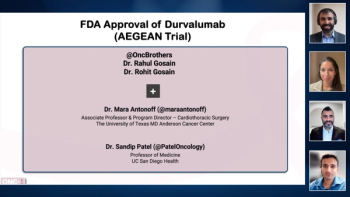
Panelists discuss how surgical perspectives on durvalumab emphasize its role in enhancing patient outcomes, informing surgical decision-making, and integrating immunotherapy into comprehensive treatment plans.
Panelists discuss how considerations for treatment approach encompass patient-specific factors, treatment modalities, and the integration of emerging therapies to optimize outcomes in clinical practice.