Dr Sekeres discusses how he approaches second-line therapy selection in ESA-refractory, transfusion-dependent lower-risk MDS (LR-MDS) patients, specifically with luspatercept.

Dr Sekeres discusses how he approaches second-line therapy selection in ESA-refractory, transfusion-dependent lower-risk MDS (LR-MDS) patients, specifically with luspatercept.
Dr Sekeres discusses key takeaways for optimizing anemia management in lower-risk MDS, as well as where he sees the most significant unmet needs.
Dr Sekeres discusses how he approaches second-line therapy selection in ESA-refractory, transfusion-dependent lower-risk MDS (LR-MDS) patients, specifically with lenalidomide.
Dr Sekeres shares his thoughts about the choice between an EMA and a telomerase inhibitor in the RS-negative patient.
Dr Sekeres discusses the adverse event profile and AE management of imetelstat.
Oncology specialists analyze the COSMIC-313 trial results and explore alternative treatment strategies for patients with poor-risk metastatic renal cell carcinoma.
Renal cell carcinoma experts examines risk stratification strategies to guide their treatment approaches for a 59-year-old woman with RCC.
Key opinion leaders in renal cell carcinoma provide a comprehensive overview of first-line immune checkpoint inhibitor combination regimens for patients with intermediate-to-poor risk metastatic renal cell carcinoma.
A panel of renal cell carcinoma experts deliberates on the treatment approach for a 59-year-old woman diagnosed with a left renal mass.
Rohan Garje, MD, provides an overview of a study evaluating how mutations, including TP53, RB1, and PTEN, impact overall survival in patients with metastatic prostate cancer.
Following EHA 2024, an expert on hematologic malignancies provides key takeaways and reviews additional data updates on treatments for CLL/SLL.
Mazyar Shadman, MD, MPH, shares comprehensive insights on the latest analyses of zanubrutinib compared with other BTK inhibitors in relapsed/refractory CLL/SLL.

Timothy F. Cloughesy, MD, discusses the impact and significance of the FDA’s approval of vorasidenib, a first-in-class option for the treatment of patients with IDH-mutant gliomas.
Douglas Tremblay, MD, discusses the different cytoreduction approaches available to patients with myeloproliferative neoplasms and their safety profiles.

Yannis K. Valtis, MD, provides background on a single-institution, retrospective cohort study which assessed laboratory and clinical tumor lysis syndrome in patients with chronic lymphocytic leukemia/small lymphocytic lymphoma.

Paula Rodríguez Otero, MD, PhD, discussed the findings from the minimal residual disease analysis of the PERSEUS study.
Edwin Choy, MD, PhD, discusses the mechanism of action of afamitresgene autoleucel and the recent accelerated approval from the FDA for patients with advanced synovial sarcoma.
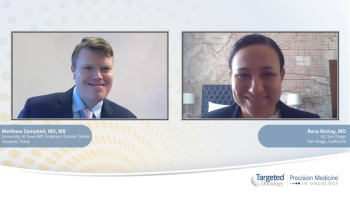
Matthew Campbell, MD, MS, and Rana McKay, MD, conclude by addressing the remaining unmet needs and persistent treatment challenges faced in managing patients with advanced renal cell carcinoma.
Pierfranco Conte, MD, discusses findings and implications of the A-BRAVE study.
The panelists examine the CheckMate-67T study, which evaluated the efficacy and safety of subcutaneous versus intravenous administration of nivolumab in patients with previously treated advanced or metastatic clear cell renal cell carcinoma.
Mikkael Sekeres, MD details a clinical presentation of a 74-year-old man diagnosed 9 months ago with LR-MDS with a hemoglobin of 7.8 g/dL.
An expert on CLL/SLL provides clinical insights on approaching the treatment of patients who progress beyond initial therapy.
Mazyar Shadman, MD, MPH, discusses the safety profile of BTK inhibitors in patients with chronic lymphocytic leukemia/small lymphocytic lymphoma.

Caitlin Costello, MD, looks to the future of treating patients with relapsed/refractory multiple myeloma, highlighting potential opportunities and challenges in the therapeutic landscape.
A hematologist-oncologist provides clinical advice to community-based clinicians on key strategies for optimizing the treatment of patients with relapsed/refractory multiple myeloma.
Caitlin Costello, MD, provides clinical insights on best practices for treating patients with relapsed/refractory multiple myeloma who receive early-line CAR T-cell therapy and later relapse.
Harry Erba, MD, PhD, discusses myeloMATCH, a precision medicine umbrella trial for patients with acute myeloid leukemia or myelodysplastic syndrome.
An expert on relapsed/refractory multiple myeloma discusses the role of stem cell transplantation in current treatment paradigms.
Following the recent approvals of ide-cel and cilta-cel CAR T-cell therapy for patients with relapsed/refractory multiple myeloma, a hematologist-oncologist discusses clinical research supporting their utilization.
Caitlin Costello, MD, presents the case of a 60-year-old woman with later relapsed/refractory multiple myeloma and discusses how the treatment landscape has evolved, highlighting remaining unmet needs.