Insights into treatment goals and review of the current treatment landscape for lower-risk MDS.

Insights into treatment goals and review of the current treatment landscape for lower-risk MDS.
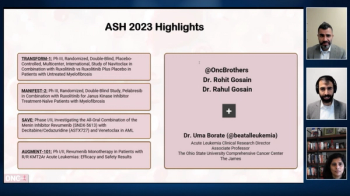
Following their review of updates from clinical trials presented at ASH 2023, the Oncology Brothers provide their key takeaways on recent data in myelofibrosis and acute myeloid leukemia.
Medical oncologists discuss the results from the SAVE and AUGMENT-101 clinical trials investigating revumenib in patients with acute myeloid leukemia.
Uma Borate, MBBS, and the Oncology Brothers provide insights gleaned from the MANIFEST-2 study, a phase 3, randomized, double-blind study on pelabresib plus ruxolitinib for JAK inhibitor treatment–naïve patients with myelofibrosis.
Following ASH 2023, Uma Borate, MBBS, joins the Oncology Brothers, Rahul Gosain, MD, and Rohit Gosain, MD, to discuss results from the TRANSFORM-1 trial investigating navitoclax plus ruxolitinib in patients with untreated myelofibrosis.

Dr Shadman provides an overview of zanubrutinib efficacy and safety data for relapsed/refractory CLL from the Phase 2 ALPINE trial.
An overview of highlights from ASH 2023 on integrating BTK inhibitors into frontline CLL therapy.
Dr Mazyar Shadman reviews emerging targeted therapies shaping the treatment landscape and optimal sequencing in CLL.

In an interview with Targeted Oncology, Reshma Mahtani, DO, discussed data from a quality improvement initiative identifying issues for health care professionals and patients with HER2-positive breast cancer.
Two experts explore the essentials of Graft vs Host Disease (GvHD), understanding its symptoms, diagnosis, and distinguishing characteristics between acute and chronic forms.
Dr. Zeiser discusses the dynamic clinical evolution of Graft vs Host Disease (GvHD) in a concise overview, gaining insights into its progression and changing manifestations over time.

Halle Moore, MD, discusses findings from a study on young breast cancer survivors who attempted pregnancy after interrupting hormone therapy.

Expert perspectives on 2 abstracts presented at ASH 2023 looking at durable continuous transfusion independence and efficacy across different risk subgroups in the IMerge phase 3 trial in MDS.
Gary J. Schiller, MD, a hematologist/oncologist, discusses the current treatment landscape for patients with lower-risk myelodysplastic syndrome [MDS].

Julie Chang, MD, discusses the reasoning behind the development of a minimal residual disease-adapted study in patients with previously untreated mantle cell lymphoma.
Brea C. Lipe, MD highlights key takeaways and patient outcomes from the PERSEUS phase three trial.
Brea C. Lipe, MD explains the trial design and patient population of PERSEUS phase three trial.
Brea C. Lipe, MD describes the unique treatment technology explored in the PERSEUS phase three trial.
Ashley Yocum, PhD, discusses the Beat AML trial of biomarker-based treatments in acute myeloid leukemia.
Jennifer A. Woyach, MD, provides an overview on some of the updated safety and efficacy data observed with pirtobrutinib in the phase 1/2 BRUIN study.

Following their review of clinical trial data presented at SABCS 2023, the Oncology Brothers discuss their key takeaways on recent updates in HER2+ breast cancer.
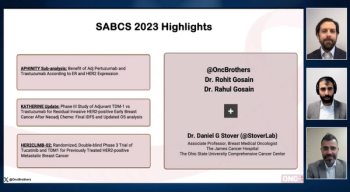
Daniel Stover, MD, and the Oncology Brothers review results from HER2CLIMB-02, a randomized, double-blind phase 3 trial of tucatinib and T-DM1 in patients with previously treated HER2+ metastatic breast cancer.
Medical oncologists discuss the recent update from the KATHERINE trial investigating adjuvant T-DM1 (trastuzumab emtansine) following neoadjuvant chemotherapy in patients with residual invasive HER2+ early breast cancer.
Following SABCS 2023, Daniel Stover, MD, joins the Oncology Brothers, Rohit Gosain, MD, and Rahul Gosain, MD, to discuss the benefit of adjuvant pertuzumab and trastuzumab according to ER and HER2 expression in patients with HER2+ breast cancer.
James Zou, PhD, elaborates on some of the challenges associated with machine learning techniques and its utilization in oncology.
Clinicians discuss the importance of early detection in patients with MDS as well as providing insights into some of the unmet needs in MDS, such as a better understanding of the role of molecular alterations and its specific impact in MDS.
Hana Safah, MD explains how the risk stratification for MDS has evolved over time and provides an in-depth of the current risk stratification tools, IPSS, IPSS-R and IPSS-M.
Drs Safah and Koprivnikar review updates made to the WHO and ICC guidelines when classifying MDS as well as discussing the impact of molecular alterations when treating MDS.

Sabarish Ram Ayyappan, MD, discusses the mechanism of action of odronextamab and highlights the phase 2 ELM-2 trial which evaluated the agent in patients with relapsed/refractory diffuse large B-cell lymphoma.
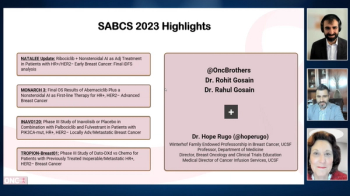
Following their review of clinical trial data presented at SABCS 2023, the Oncology Brothers offer their key takeaways on recent updates in HR+/HER2- breast cancer.