Pierre Gholam, MD, discusses the phase 3 RATIONALE-301 study of frontline tislelizumab vs sorafenib for patients with hepatocellular carcinoma.

Pierre Gholam, MD, discusses the phase 3 RATIONALE-301 study of frontline tislelizumab vs sorafenib for patients with hepatocellular carcinoma.

Viktor Grünwald, MD, PhD, discusses what findings from the post hoc analysis of the CLEAR trial of lenvatinib plus pembrolizumab vs sunitinib for patients with renal cell carcinoma mean for community oncologists.
Arnab Basu, MD, MPH, FACP, discusses molecular residual disease-guided adjuvant therapy in patients with renal cell carcinoma, highlighting the rationale and goals of the MRD gate RCC clinical trial.
Hossein Borghaei, MS, DO, provides an overview on his presentation given at the 18th Annual New York Lung Cancers Symposium.
Alan Tan, MD, discusses areas of interest in the research and development of circulating tumor DNA in renal cell carcinoma.

Paul Lammers, MD, MSc, talks about the future of cell therapies and the applications of TAC-01 in solid tumors.
Treatment goals for patients with myelofibrosis include prolonged survival and improved quality of life, with decision-making incorporating risk level, transplant eligibility, toxicity, and clinical trial data to select among the available JAK inhibitors.
Abdulraheem Yacoub, MD, provides an overview of myelofibrosis, including diagnosis via bone marrow examination, clinical criteria, and risk stratification using prognostic models to determine appropriate therapy.
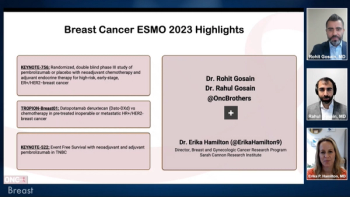
Following their review of data presented at ESMO 2023, the Oncology Brothers offer their key takeaways on the evolving breast cancer treatment landscape.
Erika P. Hamilton, MD, and the Oncology Brothers offer clinical insights on recent data from KEYNOTE-522 on pembrolizumab in patients with triple-negative breast cancer.
Experts on breast cancer review recent data updates from TROPION-Breast01 on Dato-DXd (datopotamab deruxtecan) in metastatic HR+/HER2- breast cancer.
Erika P. Hamilton, MD, joins the Oncology Brothers, Rohit Gosain, MD, and Rahul Gosain, MD, to discuss recent data from KEYNOTE-756 investigating pembrolizumab plus chemotherapy in early-stage ER+/HER2- breast cancer.

Johanna Kaufmann, PhD, discusses promising preclinical findings on first-in-class oncolytic viral therapy in breast cancer treatment.
Paul Lammers, MD, MSc, talks about the ongoing clinical trial investigating TAC-01 in HER2-expressing solid tumors.
Paul Lammers, MD, MSc, breaks down T-cell antigen coupler technology and its use in various solid tumors.
Nicolas Girard, MD, discusses data from the phase 3 MARIPOSA trial of amivantamab-vmjw plus lazertinib for patients with advanced non–small cell lung cancer harboring classical EGFR sensitizing mutations.
Anthony Hunter, MD, presents the case of a 76-year-old woman with newly diagnosed primary myelofibrosis with a JAK2 mutation, for which he recommended treatment with momelotinib due to her moderate anemia and refusal of transplant.
Anthony Hunter, MD, presents the case of a 76-year-old woman with newly diagnosed primary myelofibrosis with a JAK2 mutation, for which he recommended treatment with momelotinib due to her moderate anemia and refusal of transplant.
Over the past decade, the frontline treatment landscape for metastatic melanoma has evolved with studies like CheckMate-067 and KEYNOTE-006 highlighting the superiority of PD-1-based therapies over ipilimumab, and recent trials introducing new combination treatments.
Rafael Fonseca, MD, discusses the sequencing of CAR-T and bispecific antibodies in patients with relapsed/refractory multiple myeloma and tailoring treatment based on prior medical history for elderly and frail individuals.
Dr Fonseca shares findings from the MonumenTAL-1 trial presented at ASCO 2023, suggesting potentially reduced infection rates in patients with relapsed/refractory multiple myeloma receiving talquetamab relative to BCMA-targeted agents.
Hussein Tawbi, MD, PhD, emphasizes that combination immunotherapies offer higher efficacy than single agent PD-1 inhibitors for metastatic melanoma; however, patient characteristics guide the choice of treatment regimen, with toxicities playing a key role.

Arlene O. Siefker-Radtke, MD, discusses the results of the phase 3 THOR study of erdafitinib vs pembrolizumab in pretreated patients with advanced or metastatic urothelial cancer with select FGFR alterations.
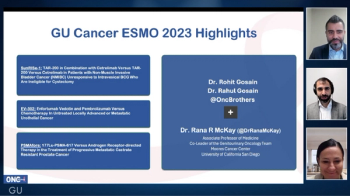
Following their program on data updates in GU cancer from ESMO 2023, Oncology Brothers Rahul Gosain, MD, and Rohit Gosain, MD, share key takeaways from SunRISe-1, EV-302, and PSMAfore.
Shared insight from Rana McKay, MD, and the Oncology Brothers on updated data from PSMAfore and the use of Lutetium-177–PSMA-617 in patients with metastatic castration-resistant prostate cancer.
Shifting their focus to metastatic bladder cancer, the Oncology Brothers and Rana McKay, MD, reflect on data from EV-302 and consider how enfortumab vedotin + pembrolizumab has shifted the treatment landscape.
Key opinion leader Rana McKay, MD, joins the Oncology Brothers Rahul Gosain, MD, and Rohit Gosain, MD, to review updated data in GU cancer from ESMO 2023, starting with TAR-200 monotherapy in patients with NMIBC and the SunRISE-1 trial.
Bradley McGregor, MD, discusses the rationale behind the multi-institutional, prospective, single-arm phase 2 trial of cabozantinib, nivolumab, and ipilimumab for the treatment of patients with renal cell carcinoma with variant histologies.

Nirav Shah, MD, discusses long-term data from the phase 1/2 BRUIN study which evaluated pirtobrutinib in mantle cell lymphoma, and next steps for evaluating the agent.

Vijaya Raj Bhatt, MBBS, MS, discusses background and findings from a multicenter, phase 2 study of ruxolitinib for the treatment of patients with steroid refractory sclerotic chronic graft-versus-host disease.