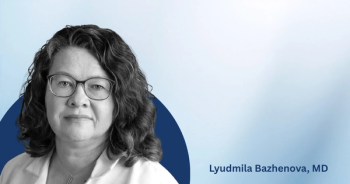
Lyudmila Bazhenova, MD, explains why the updated taletrectinib label does not change her practice and reviews new WCLC subgroup data in ROS1+ NSCLC.

Theodore Wagener, PhD, discusses psychedelics beyond depression in cancer, including neuropathy and chemo brain, and why he expects cancer centers to adopt them.
Theodore Wagener, PhD, founding director of the Center for Tobacco Research at The Ohio State University and co-leader of the Cancer Control Program at the Ohio State University Comprehensive Cancer Center – James (OSUCCC – James), discusses the potential of psychedelics in oncology beyond mental health, including possible benefits for physical symptoms and cognition. He points to a recent paper in Science from UT MD Anderson showing that psychedelics improved chemotherapy-induced neuropathy in a mouse model, and says Ohio State has a study on the question under way. He also sees potential for psychedelics to help with cognitive impairment related to cancer treatment, such as chemo brain. He attributes this to their apparent ability to increase neuroplasticity, with some suggestion of neurogenesis.
Wagener says he has given grand rounds at cancer centers over the past 4 to 5 years. He now believes that any cancer center without a robust psychedelic research program, and potentially a clinical program depending on trial results, will be behind within the next decade. He notes that colleagues once dismissed the idea as fringe, and that some assumed he was talking about recreational drug use.
To address that skepticism, Wagener makes 2 points. The first is about dose and setting. The therapeutic approach is nothing like taking a mushroom cap and wandering through a museum. Patients receive what he calls a “heroic dose” in a planned, controlled setting, after preparation that tells them what to expect. The experience is largely internal, with patients wearing eye shades and listening to instrumental music through headphones.
The second point is the data. He emphasizes that the findings appear in journals such as The New England Journal of Medicine, Science, and JAMA, not obscure outlets. Sample sizes are small because psilocybin is a schedule I drug that is difficult to obtain and requires extensive screening. Even so, Wagener describes the results as remarkable. He adds that, having treated patients in clinic and therapy, he finds them striking.
Stay up to date on practice-changing data in community practice.
Subscribe