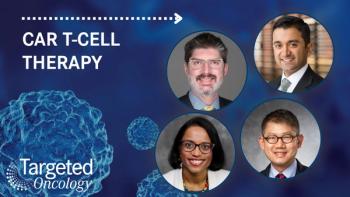
Multiple oncologists share their perspectives on what is still limiting access to CAR T-cell therapies in 2026.

Omar Nadeem, MD, discusses conclusions and next steps based on the CAR-PRISM trial in smoldering myeloma.
Omar Nadeem, MD, of the Dana-Farber Cancer Institute, outlines the core conclusions of the CAR-PRISM trial (NCT05767359), emphasizing the clinical benefits of administering autologous anti–B-cell maturation antigen chimeric antigen receptor (CAR) T-cell therapy in patients with asymptomatic smoldering multiple myeloma. The trial serves as powerful proof of principle, confirming the long-standing hypothesis that T-cell therapies exhibit significantly greater activity when used before the immune system is exhausted by multiple lines of subsequent treatment. Remarkably, this study demonstrated profound therapeutic activity using ciltacabtagene autoleucel (cilta-cel; Carvykti) even at the lowest doses previously administered in clinical settings, underscoring the heightened sensitivity of early-stage disease.
This extreme sensitivity raises the distinct possibility that early CAR T-cell intervention could completely eradicate the disease in a subset of patients. Nadeem highlights that while other early-intervention strategies are currently being explored, such as ongoing phase 3 trials investigating T-cell–engaging bispecific antibodies, CAR T-cell therapy offers a unique, highly desirable logistical advantage.
Unlike continuous therapies that require ongoing clinic visits and adherence to medication, CAR T-cell therapy is a “one-and-done” procedure. A single infusion can induce an unprecedented depth of response, resulting in universal and sustained minimal residual disease negativity.
The ability to achieve this deep response early in the treatment paradigm, without the burden of continuous maintenance therapy, represents a major shift in the management of multiple myeloma. Nadeem concludes that the remarkable efficacy and convenience demonstrated in the CAR-PRISM trial will pave the way for future studies in the high-risk smoldering myeloma space, ultimately driving the development of novel cellular and T-cell–directed approaches aimed at early intervention.