
Commentary|Videos|July 15, 2026
ROS1+ NSCLC: Key Takeaways From Case-Based Roundtables With Dr Santos
Fact checked by: Sabrina Serani
Edgardo Santos, MD, discusses ROS1+ NSCLC treatment advances, taletrectinib data, toxicity profiles, and emerging therapies from recent Case-Based Roundtables.
Advertisement
Episodes in this series


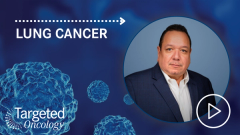

In this interview, Edgardo Santos Castillero, MD, reflects on the key discussions from his Case-Based Roundtables with Targeted Oncology, which centered on the evolving treatment landscape for ROS1-positive non–small cell lung cancer (NSCLC).
Santos Castillero is physician lead at The Oncology Institute, Lung Cancer Center of Excellence; clinical associate professor, Charles E. Schmidt College of Medicine, Florida Atlantic University; and president, Florida Society of Clinical Oncology.
Dr Santos begins by tracing the evolution of ROS1 tyrosine kinase inhibitors (TKIs), from first-generation agents like crizotinib (Xalkori) roughly 15 years ago to newer, more potent compounds with improved toxicity profiles. He highlights updated data from the TRUST-I and TRUST-II trials presented at the AACR Annual Meeting in April, noting that the ROS1 inhibitor taletrectinib (Ibtrozi) demonstrated a median duration of response and progression-free survival approaching 50 months—outcomes he describes as clinically significant and unprecedented for this population.
A recurring theme throughout the roundtables was the challenge of generating robust phase 3 data in rare, biomarker-defined populations like ROS1 (occurring in only 1-2% of NSCLC cases), which limits both clinical trial enrollment and physicians' hands-on experience comparing sequential inhibitors. Dr Santos also discusses the favorable tolerability profile of taletrectinib, including reduced CNS effects such as dizziness and manageable, short-lived gastrointestinal toxicity compared to earlier ROS1 inhibitors.
Looking ahead, he touches on emerging investigational agents as well as the ongoing research into resistance mechanisms, such as the G2032R mutation, that inform sequencing decisions after progression on newer TKIs like taletrectinib and repotrectinib (Augtyro). Dr Santos closes with a call for expanded real-world data collection to complement clinical trial findings, given the practical limitations of studying such a rare molecular subgroup.
This conversation offers valuable insight for oncologists managing ROS1+ NSCLC, covering the latest efficacy data, safety considerations, and the future direction of targeted therapy development in this space.
Advertisement
Related to this article
Theodore Wagener, PhD, of The Ohio State University discusses the design of the phase 2 DREAM LUNG study of psilocybin-assisted therapy for depression in non–small cell lung cancer.

J. Thaddeus Beck, MD, discusses how the shift from intravenous to subcutaneous formulations is changing oncology practice, from clinic logistics to patient preferences.
Gary Simmons, DO, MSHA, discusses outpatient CAR T-cell therapy in the community, the operational and payer bottlenecks his practice has faced, and advice for colleagues.

During a virtual event, Neil M. Iyengar, MD, and participants discussed how approvals for trastuzumab deruxtecan before and after surgery complicate sequencing for patients with HER2-positive early breast cancer.

During a live event, Mary Jo Fidler, MD, and participants discussed how an intermediate-risk regimen, insurance resistance, and limited experience with trilaciclib shape neutropenia prevention in extensive-stage disease.

Cancer deaths keep falling as survival rises, fueled by prevention, early detection, and therapies—yet gaps persist, and research funding uncertainty threatens future gains.
For Hispanic Heritage Month, Narjust Florez, MD, discusses lung cancer risk, biomarker testing, and trial access in Hispanic and Latinx patients.

During a live event, Seth M. Pollack, MD, and participants discussed 2 investigational agents for recurrent diffuse tenosynovial giant cell tumor.
Advertisement
Advertisement