



BREAST CANCER
Latest News
Advertisement
Latest Videos





























Advertisement
More News

PARP inhibitors are anything but dead as breast cancer treatment, argued Patricia LoRusso, DO.

Endocrine therapy has come a long way as a treatment for breast cancer since tamoxifen ruled the adjuvant therapy landscape in 1989, but much remains unknown about newer therapies and combating endocrine resistant mutations<br />
Hope S. Rugo, MD, discusses immunotherapies, androgen receptor (AR)-targeted agents, and targeted therapies all on the horizon in TNBC.

Existing data for androgen receptor (AR) antagonists are encouraging and anticipated future results could soon show a benefit for these agents in large populations of patients with breast cancer.
Radiologists have been challenged by the ever-changing recommendations of when breast cancer screening should begin and the frequency of screening, says Sarah M. Friedewald, MD. The controversy surrounding screening recommendations can be a distraction to the implementation of new technologies, such as tomosynthesis.

Kimberly J. Van Zee, MS, MD, FACS, presented her findings on the benefits of nomogram during a panel on “Breast Pathology for the Non-Pathologist” at the 18<sup>th</sup> annual Lynn Sage Breast Cancer Symposium in Chicago.<br />
The selection process for determining which procedure to utilize for an image-directed core breast biopsy often remains a mystery to those outside of the pathology and radiology world.
William J. Gradishar, MD, discusses combining and sequencing novel targeted therapies.
In an era of simultaneous increased evaluative testing in the United States and a rise in early-stage breast cancer diagnosis, it’s important that those facing treatment decisions for curable cancer understand the advances and advantages in precision medicine, explained Steven J. Katz, MD, MPH.
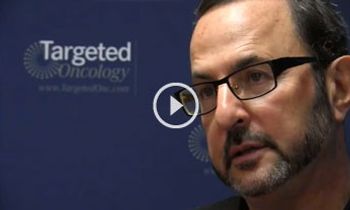
Steven Katz, MD, professor, internal medicine, at the University of Michigan Medical School, discusses the major advances in precision medicine in the field of breast cancer.
Advances in the computerization of the imaging, blood flow, and tumor measures of exact volume and vessel density are now less operator dependent. That provides for an accurate and repeatable diagnosis, and a means to follow the individual patient’s unique pattern of cancer development, progress, and response to treatment.

Meena Savur Moran, MD, professor, therapeutic oncology, and director of the radiation therapy breast program, Smilow Cancer Hospital at Yale-New Haven, discusses the margin guidelines that have been identified in breast conservation.

Francisco Esteva, director, breast medical oncology program, Perlmutter Cancer Center, NYU Langone Medical Center, discusses the findings of a biosimilar trastuzumab study in patients with HER2-positive breast cancer.
Chau T. Dang, MD discusses several recent trials investigating novel treatment approaches for patients with HER2-positive breast cancer.
A new drug application (NDA) for neratinib as an extended adjuvant therapy for patients with HER2-positive breast cancer following prior treatment with postoperative trastuzumab (Herceptin) has been accepted by the FDA
To more effectively treat patients with triple negative breast cancer (TNBC), a greater understanding of the disease must first be obtained, said Angela DeMichele, MD, professor of medicine and epidemiology, breast cancer oncologist, University of Pennsylvania.
According to findings of a recent study, obesity is more prevalent in cancer survivors, specifically in those with a history of breast or colorectal cancer (CRC), compared with those without any history of disease.

<div>The developer of neratinib, Puma Biotechnology, has announced the European Medicines Agency (EMA) has validated the marketing authorization application for neratinib as a potential extended adjuvant therapy for patients with HER2-positive early stage breast cancer following 12 months of trastuzumab (Herceptin).</div>
Pfizer has announced plans to acquire the biopharmaceutical company Medivation, which is the developer of the androgen receptor inhibitor enzalutamide (Xtandi). Under the terms of the agreement, Pfizer will pay $81.50 per share in cash for Medivation, totaling approximately $14 billion. Both companies agreed to the transaction, which is expected to complete later this year.
Approximately 46% of patients with breast cancer at high risk for recurrence but low genomic risk with the 70-gene breast cancer recurrence assay (MammaPrint) might not require adjuvant chemotherapy, according to prospective 5-year results of the MINDACT trial published in <em>The New England Journal of Medicine</em>.<sup>1</sup>

Linda Bosserman, MD, medical oncologist, City of Hope, discusses the effects that payment reform may have on clinical practice in oncology.

Eleftherios P. Mamounas, MD, surgical oncologist, UF Health Cancer Center - Orlando Health, compares mastectomy with breast conservation in the surgical management of breast cancer.
The CDK4/6 inhibitor ribociclib (LEE011) has received a breakthrough therapy designation from the FDA for its potential as a frontline therapy when given in combination with letrozole for patients with hormone-receptor (HR)-positive, HER2-negative advanced breast cancer.<br />
Advertisement
Advertisement
Trending on Targeted Oncology - Immunotherapy, Biomarkers, and Cancer Pathways
1
FDA Accepts NDA for Daraxonrasib in Metastatic Pancreatic Cancer
2
Advanced Renal Cell Carcinoma: Tailoring Second-Line Therapy After Prior Immunotherapy
3
FDA Approves Zidesamtinib for Previously Treated ROS1-Positive NSCLC
4
Teclistamab/Talquetamab Reduces Risk of Progression by 89% in R/R Multiple Myeloma
5