




GI CANCERS
Latest News
Advertisement
Latest Videos













































Advertisement
More News

Immune checkpoint inhibitors are approved for dMMR/MSI-H gastrointestinal cancer treatment; however, approximately half of patients with dMMR/MSI-H gastrointestinal cancer exhibit primary resistance to them.

Based on the largest clinical trial of patients with HER2-amplified biliary tract cancer, a novel anti-HER bispecific antibody may be the next option.
Early clinical trial in gastrointestinal and brain cancers aim to better understand the safety and efficacy of CEND-1-targeted therapy and develop a novel CEND-1 agent.
The phase 2b VIRAGE study evaluating the combination of VCN-01 with standard-of-care chemotherapy in patients with pancreatic cancer remains on track to be fully-enrolled in the first quarter of 2024.
A promising disease control rate and overall response rate was seen with elraglusib when given with chemotherapy for patients with pancreatic cancer, according to phase 2 study findings.
According to data from the primary and updated analyses of the phase 2 DESTINY-Gastric02 study, trastuzumab deruxtecan is beneficial for patients with HER2-positive advanced gastric cancer.
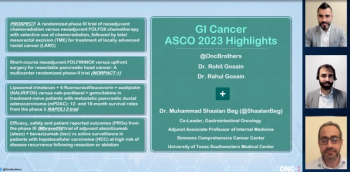
Rohit Gosain, MD, and Rahul Gosain, MD, provide a summary of the key gastrointestinal cancer data updates discussed following the 2023 ASCO Annual Meeting.
The Oncology Brothers, joined by Muhammad Shaalan Beg, MD, share their thoughts on data from the IMbrave050 trial investigating adjuvant atezolizumab plus bevacizumab in patients with high-risk hepatocellular carcinoma.
A review of recent data from NAPOLI-3 comparing the NALIRIFOX chemotherapy regimen versus nab-paclitaxel plus gemcitabine for patients with metastatic pancreatic ductal adenocarcinoma.
Expert oncologists review recent data from the NORPACT-1 study on the use of neoadjuvant FOLFIRINOX chemotherapy for patients with resectable pancreatic head cancer.
Muhammad Shaalan Beg, MD, joins the Oncology Brothers, Rohit Gosain, MD, and Rahul Gosain, MD, to discuss recent data from the PROSPECT trial investigating neoadjuvant therapy regimens for the treatment of locally advanced rectal cancer.
Interim analysis results of the phase 3 PANOVA-3 trial in patients with unresectable, locally advanced pancreatic cancer support the company proceeds with the final analysis

Roby Thomas, MD discusses chemotherapy shortages and the impact these shortages have had on oncology research.

Tara Seery, MD, explains the next steps for the QUILT 88 study looking at a novel combination of therapies for patients with metastatic pancreatic cancer.

In the phase 3 TIGeR-PaC study, intra-arterial administration of gemcitabine demonstrated positive progression-free and overall survival outcomes in patients with locally advanced pancreatic cancer.

During a Targeted Oncology™ Case-Based Roundtable™ event, Daneng Li, MD, and participants discussed current approaches to treating biliary tract cancers, including the TOPAZ-1 study regimen of cisplatin, gemcitabine, and durvalumab.
The FDA plans to conduct a speedy review of an approval application for zolbetuximab in first-line locally advanced, unresectable, or metastatic HER2-negative, claudin18.2-positive gastric or gastroesophageal junction adenocarcinoma.
Data from an early access program and the eNRGy trial evaluating zenocutuzumab have led the FDA to grant the agent breakthrough designation for patients with NRG1 fusion-positive pancreatic cancer.
The phase 2b VIRAGE study will investigate the safety and efficacy of VCN-01 plus standard chemotherapy in patients with first-line pancreatic ductal adenocarcinoma.
Durable responses in patients with metastatic pancreatic ductal adenocarcinoma treated with mitazalimab plus chemotherapy have led to discussions with regulatory authorities.
Druggable targets for patients with gastrointestinal cancers were discussed during the 20th Annual Meeting of the International Society of Gastrointestinal Oncology.
According to phase 3 study results, the combination of pembrolizumab and chemotherapy can induce high rates of response in patients with gastroesophageal junction adenocarcinoma while maintaining safety.
Data from the phase 3 NAPOLI 3 trial have led the FDA to accept a supplemental new drug application for NALIRIFOX in patients with metastatic pancreatic ductal adenocarcinoma
A regular review of an FDA approval application is underway for the combination of pembrolizumab and standard chemotherapy for the treatment of advanced biliary tract cancer.

The same high cure rates achieved with preoperative chemoradiation can be achieved with preoperative FOLFOX, according to Deb Schrag, MD, FASCO, MPH.
Advertisement
Advertisement
Trending on Targeted Oncology - Immunotherapy, Biomarkers, and Cancer Pathways
1
Denosumab Biosimilar Approved For Existing Oncology Indications
2
Plinabulin Receives FDA Fast Track Designation in Post-ICI NSCLC
3
FDA Oncology Recap: Approvals, Designations, and Decisions in September 2026
4
Tile-Based Radiation Improves Local Control in Resected Brain Metastases
5