


GI CANCERS
Latest News
Advertisement
Latest Videos

















































Advertisement
More News
Yanghee Woo, MD, discusses a debate which focused on determining the best neoadjuvant therapy for patients with gastroesophageal junction adenocarcinoma.
A biologics license application for zanidatamab is being reviewed by the FDA for treating previously treated, HER2-positive biliary tract cancer.

During a Case-Based Roundtable® event, David Zhen, MD, discussed the issue of treating patients with upper gastrointestinal cancer with a PD-L1 composite positive score less than 5 with nivolumab vs chemotherapy alone, in the first article of a 2-part series.

Daniel H. Ahn, DO, discusses how regorafenib continues to benefit patients with advanced colorectal cancer as researchers look to modify treatment strategies with the therapy.
A fast track designation from the FDA has been given to PT886 for the treatment of patients with metastatic claudin 18.2-positive pancreatic adenocarcinoma.

The phase 3 CheckMate -9DW study of frontline nivolumab plus ipilimumab in hepatocellular cancer met its primary end point of overall survival vs sorafenib or lenvatinib.
Identifying differences in pancreatic cancer subtypes could be at the center of developing targeted treatments in this challenging disease.
Cambritaxestat, a first-in-class therapy in development for highly fibrotic cancer indications that overexpress autotaxin, has been granted an orphan drug designation from the FDA in pancreatic cancer.

In a discussion with Targeted Oncology, Michael Gibson, MD, PhD, discusses the benefits of using a patient’s PD-L1 combined positive score to determine if they are given nivolumab and chemotherapy to treat their gastric cancer.
The FDA has accepted the biologics license application of tislelizumab in combination with chemotherapy for the treatment of locally advanced or metastatic gastric or gastroesophageal cancers.
The FDA has granted an investigational new drug application to the investigational chimeric antigen receptor T-cell therapy IMC001 for the treatment of EpCAM-positive advanced gastrointestinal tumors.
IMM-1-104 has gained a fast track designation from the FDA for the treatment of patients with pancreatic ductal adenocarcinoma who have progressed after 1 line of treatment.
A phase 2 trial for the treatment of gastric, esophageal, and gastroesophageal junction cancer is evaluating agenT-797 with botensilimab, balstilimab, ramucirumab, and paclitaxel.
Liposomal irinotecan with 5-fluorouracil, leucovorin, and oxaliplatin (NALIRIFOX) is now an FDA-approved treatment option for patients with metastatic pancreatic ductal adenocarcinoma.
212PB-DOTAMTATE is the first targeted alpha therapy to receive a breakthrough therapy designation in this intent-to-treat population.

In separate virtual live events, R. Kate Kelley, MD, with Daneng Li, MD, and Chih-Yi (Andy) Liao, MD, with Anjana Pillai, MD, discussed imaging and treatment for a patient with biliary tract cancer with event participants.

For Gallbladder Cancer Awareness Month, Horacio J. Asbun, MD, and Domenech Asbun, MD, shared their thoughts and strategies for treating patients with this disease from the surgical and clinical sides.
Fruquintinib combined with paclitaxel significantly improved progression-free survival in patients with advanced gastric/GEJ cancer compared with paclitaxel alone.
In an interview with Targeted Oncology, Sanjay Goel, MD, MS, discussed the mystery of cachexia in pancreatic cancer and why it remains a challenging symptom to target.
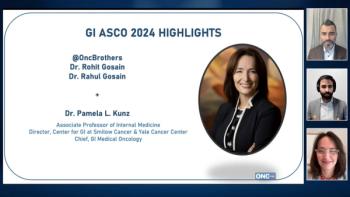
Following their review of recent data from the 2024 ASCO GI Cancers Symposium, the Oncology Brothers discuss their key takeaways.
Medical oncologists offer comprehensive insights on the role of circulating tumor DNA in the treatment of patients with colorectal cancer.
Clinical insights on the recent data from the NETTER-2 trial looking at Lu-177 Dotatate in patients with advanced gastroenteropancreatic neuroendocrine tumors.
Pamela L. Kunz, MD, and the Oncology Brothers provide insights on the EMERALD-1 trial looking at durvalumab and bevacizumab plus TACE in patients with unresectable, embolization-eligible hepatocellular carcinoma.
Following ASCO GI 2024, Pamela L. Kunz, MD, joins the Oncology Brothers, Rahul Gosain, MD, and Rohit Gosain, MD, to discuss results from the CheckMate 8HW study investigating nivolumab plus ipilimumab in MSI-high/mismatch repair deficient metastatic colorectal cancer.
During a live event on Twitter/X, Pashtoon Kasi, MD, MS, discussed the potential of ctDNA and other advancements that have the potential to improve the lives of patients with GI cancers.
Advertisement
Advertisement
Trending on Targeted Oncology - Immunotherapy, Biomarkers, and Cancer Pathways
1
Plinabulin Receives FDA Fast Track Designation in Post-ICI NSCLC
2
Denosumab Biosimilar Approved For Existing Oncology Indications
3
FDA Oncology Recap: Approvals, Designations, and Decisions in September 2026
4
Tile-Based Radiation Improves Local Control in Resected Brain Metastases
5