





HER2 Breast Cancer
Latest News
Advertisement
Latest Videos













































Advertisement
More News

In the first article of a 2-part series, Yara Abdou, MD, discussed the most significant challenges and transformative advancements in the treatment of HER2-positive breast cancer.

In an interview with Targeted Oncology, Reshma Mahtani, DO, discussed data from a quality improvement initiative identifying issues for health care professionals and patients with HER2-positive breast cancer.

Following their review of clinical trial data presented at SABCS 2023, the Oncology Brothers discuss their key takeaways on recent updates in HER2+ breast cancer.
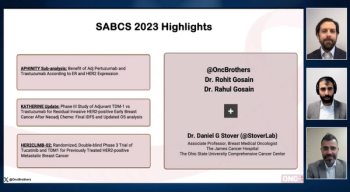
Daniel Stover, MD, and the Oncology Brothers review results from HER2CLIMB-02, a randomized, double-blind phase 3 trial of tucatinib and T-DM1 in patients with previously treated HER2+ metastatic breast cancer.
Medical oncologists discuss the recent update from the KATHERINE trial investigating adjuvant T-DM1 (trastuzumab emtansine) following neoadjuvant chemotherapy in patients with residual invasive HER2+ early breast cancer.
Treatment with trastuzumab maintains its place as the backbone of therapy in the first-line setting for management of patients with HER2-positive metastatic breast cancer.
Trastuzumab deruxtecan emerges as a superior second-line option for HER2-positive metastatic breast cancer, with a fourfold increase in median progression-free survival vs trastuzumab emtansine, as reported in the DESTINY-Breast03 trial.

Trastuzumab administered subcutaneously delivered unique immunomodulation effects vs intravenous trastuzumab in patients with treatment-naive HER2-positive breast cancer.

The addition of atezolizumab to neoadjuvant trastuzumab plus pertuzumab (HP) and chemotherapy led to a numerical, but not statistically significant, increase in pathologic complete response vs HP/chemotherapy alone in patients with HER2-positive operable breast cancer.
Preliminary study results examining the bispecific antibody, CDK4/6 inhibitor, and hormone therapy combination in patients with advanced breast cancer were presented at SABCS.
After more than 8 years of follow-up, T-DM1 continued to improve invasive disease-free survival and overall survival in patients with HER2-positive early breast cancer that had residual invasive disease.
Anastrozole or fulvestrant plus fam-trastuzumab deruxtecan-nxki showed promising antitumor activity in patients with chemotherapy-naïve, HER2-low, hormone receptor-positive metastatic breast cancer.
The RELIEVE study looked at real-world patients receiving trastuzumab deruxtecan based on HER2 expression status and time to next treatment including in those whose HER2 status changed during course of treatment.
The introduction of tucatinib to ado-trastuzumab emtansine significantly improved progression-free survival vs placebo plus T-DM1 in patients with previously treated HER2-positive metastatic breast cancer.
Results from an international phase 2 study show that using metronomic capecitabine in combination with the tyrosine kinase inhibitor pyrotinib continued to have promising efficacy results for patients with HER2-positive metastatic breast cancer.

In this companion article, Sandra M. Swain, MD, FACP, FASCO, provides insights into effective management of patients with early-stage HER2+ breast cancer and reviews recent data in the evolving treatment landscape.
In an interview, Funda Meric-Bernstam, MD, discussed the phase 2 DESTINY-PanTumor02 trial and the data on fam-trastuzumab deruxtecan-nxki for the treatment of patients with HER2-expressing cancers.

Progression-free survival in the central nervous system appears to be longer with trastuzumab deruxtecan than with comparator treatment in patients with HER2-positive metastatic breast cancer and brain metastases.

The dual primary end points of overall survival and progression-free survival were encouraging when patients with hormone receptor-positive, HER2-negative breast cancer were treated with datopotamab deruxtecan.
In an interview with Targeted Oncology, Sara A. Hurvitz, MD, discusses the impact of trastuzumab deruxtecan, new developments, and unmet needs in the HER2-positive breast cancer space.
If approved, DB-1303 may provide a potential alternative to treatment with fam-trastuzumab deruxtecan-nxki for the treatment of patients with breast cancer.
According to Manali Bhave, MD, neratinib plus fulvestrant plus trastuzumab and should be considered as a therapeutic option with clinically meaningful benefit in patients with HER2-mutant metastatic breast cancer.
Data from HER2CLIMB-02 will be presented at an upcoming medical meeting and the results will be shared with the FDA.
In an 8-year follow up analysis of patients on the ExteNET trial, researchers saw that overall survival was not significantly different to rates on placebo.
Advertisement
Advertisement
Trending on Targeted Oncology - Immunotherapy, Biomarkers, and Cancer Pathways
1
Anito-Cel Delivers Durable Responses With Low Neurotoxicity in RRMM
2
Risk, Histology, and Metastatic Site Guide First-Line RCC Treatment Choices
3
FDA Application Withdrawn for I-DXd in Small Cell Lung Cancer
4
Frontline CAR T and Bispecific Antibodies Are the Next Frontier in Myeloma
5