


LYMPHOMAS
Latest News

Advertisement
Latest Videos





CME Content

































Advertisement
More News
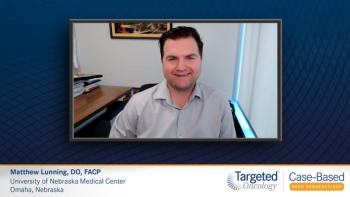
Matthew Lunning, DO, FACP, presents the case of a 64-year-old man with diffuse large B-cell lymphoma (DLBCL) and shares his initial impressions.

In season 3, episode 6 of Targeted Talks, Yazan Samhouri, MD, discusses the exciting new agents for the treatment of non-Hodgkin lymphoma, the clinical trials that support their use, and hopes for the future of treatment.

The FDA has granted priority review to an approval application for mosunetuzumab for the treatment of patients with relapsed or refractory follicular lymphoma.

Experts discuss the newest approaches for treating patients with diffuse large B-cell lymphoma.
In an interview with Targeted Oncology, Manali Kamdar, discussed the recent FDA approval of lisocabtagene maraleucel for the treatment of patients with relapsed or refractory large B-cell lymphoma, and how community oncologists should approach patient referrals and post-treatment care.

Grzegorz S. Nowakowski, MD, presents the case of a woman with relapsed DLBLC and provides his initial impressions.
In a phase 1 clinical trial, treatment with GFH009 showed early signal s of efficacy in patients with advanced relapsed or refractory lymphoma and acute myeloid leukemia.
The FDA has granted orphan drug designation to MB-106, for the treatment of patients with Waldenstrom macroglobulinemia. The agent is being investigated in a phase 1/2 clinical trial.
Patients with relapsed/refractory diffuse large B-cell lymphoma who benefit most from novel therapies vs patients who would likely do well with standard treatment were identified among all curatively treated patients in Sweden from 2007 to 2014.

In season 3, episode 5 of Targeted Talks, Thomas Habermann, MD, discusses the upcoming advances in the treatment of diffuse large B-cell lymphoma.

Clinically meaningful efficacy seen with epcoritamab in patients with highly refractory large B-cell lymphoma, according to data from the phase 2 EPCORE NHL-1 clinical trial.
Results from JACKPOT8 presented during the 2022 EHA Congress show that golidocitnib has encouraging anti-tumor efficacy and tolerable safety in patients with relapsed or refractory peripheral T-cell lymphoma.
Data from ANTLER presented during the 2022 EHA Congress show initial findings of CB-010 in patients with relapsed or refractory B-cell non-Hodgkin lymphoma.

At the 2022 ASCO Annual Meeting, the primary analysis of the phase 2 PILOT study showed the durability and feasibility of lisocabtagene maraleucel as second-line therapy in certain patients with large B-cell lymphoma.

According to Michael Dickinson, MBBS, glofitamab is a highly active drug. The agent showed durable response in patients with heavily pretreated large B-cell lymphoma.
Therapy with brentuximab vedotin plus doxorubicin, vinblastine, and dacarbazine lead to a significant reduction in the risk of death vs doxorubicin, bleomycin, vinblastine, and dacarbazine, in patients with previously untreated stage III/IV classical Hodgkin lymphoma.
Treatment with sugemalimab shown to be well-tolerated and have a consistent safety profile to other studies, according to results of the GEMSTONE-201 trial.

The FDA has withdrawn its approval for the umbralisib, which had previously been approved for marginal zone lymphoma and follicular lymphoma.

In an interview with Targeted Oncology, Manali Kamdar, MD, discussed the current relapsed/refractory B-cell non-Hodgkin lymphoma space, along with data from the phase 1 clinical trial of an anti-CD19 CAR T-cell product for these patients.

In relapse/refractory follicular lymphoma, promising results have been observed with PI3K inhibitors and are encouraging because of the less than optimal outcome associated with Bruton's tyrosine kinase inhibitors.
The use of single-agent odronextamab demonstrated a manageable safety profile and promising preliminary activity in heavily pretreated patients with B-cell non-Hodgkin lymphoma.
Looking at 4 CAR T-cell agents for the treatment of large B-cell lymphoma, a systematic review and analysis showed that these therapies do not appear to increase the risk of cytokine release syndrome or immune effector cell–associated neurotoxicity syndrome.
Continued benefit of axicabtagene ciloleucel in patients with relapse/refractory indolent non-Hodgkin lymphoma was observed in the phase 2 ZUMA-5 clinical trial.
In patients with relapsed/refractory large B-cell lymphoma, the chimeric antigen receptor T-cell agent, lisocabtagene maraleucel demonstrated durable responses.
According to a long-term analysis of the ZUMA-1 study, the overall survival rate yielded by axicabtagene ciloleucel may support 1- and 2-year event-free survival as a surrogate end point in relapsed/refractory large B-cell lymphoma.
Advertisement
Advertisement
Trending on Targeted Oncology - Immunotherapy, Biomarkers, and Cancer Pathways
1
NCCN Survey Finds Persistent Cancer Drug Shortages Across US Centers
2
Risk-Adapted Quadruplet Therapy Sustains 5-Year Survival Benefit in High-Risk Myeloma
3
FDA Grants Final Approval to Cabozantinib Capsule Formulation
4
Subcostal Robotic Surgery Cuts Thoracic Pain
5