


MULTIPLE MYELOMA
Latest News
Advertisement
Video Series


Latest Videos
Shorts
0:15
2026 IMS Annual Meeting Highlights Across Myeloma
a day ago
1:37
How Etentamig Stands Out From Other BCMA Bispecifics
12 days ago
by
Peter Voorhees, MD

1:12
Upcoming Trials Could Bring New Drug Classes into Prostate Cancer
a month ago
by
Manojkumar Bupathi, MD, MS
1:10
Personalizing Therapy After Iberdomide Approval in Myeloma
a month ago
by
Surbhi Sidana, MD
1:17
The Link Between Inflammation, Aging, and Cancer
a month ago
by
Hearn Jay Cho, MD, PhD
0:34
An Often-Missed Early Step in Myeloma Care
2 months ago
by
Sagar Lonial, MD
0:50
Does ENDURANCE Support Lenalidomide Discontinuation At 2 Years?
2 months ago
by
Sagar Lonial, MD
0:43
The Future of Myeloma Care: Home Administration
2 months ago
by
Joseph Mikhael, MD
1:04
Breaking Free From Infusion Centers With SC Myeloma Treatment
2 months ago
by
Joseph Mikhael, MD
1:01
Why CAR T Clinical Trials Don't Tell the Whole Story
3 months ago
by
Doris K. Hansen, MD
Podcasts








































Advertisement
More News
Half of patients who stopped MRD-guided maintenance in GEM2014MAIN remained progression-free at 7 years, as IMS 2026 also featured DREAMM-9, MIDAS, and novel bispecific data.
A new IMS/IMWG consensus definition requires 5 years of treatment-free, MRD-negative remission before multiple myeloma can be called cured.
Mezigdomide plus elranatamab yielded a 100% ORR in MELT-MM, as other IMS 2026 abstracts covered cevostamab, anito-cel vs cilta-cel, and linvoseltamab in HR-SMM.

Preview the 2026 International Myeloma Society meeting: the IMS/IMWG cure consensus, plenary session phase 3 trials, and new bispecific/CAR T myeloma findings.

During a live event, Sikander Ailawadhi, MD, and participants considered a case patient with relapsed multiple myeloma after a quadruplet induction who declined CAR T-cell therapy.
The UK's OPTIMUM trial showed significant differences with a more aggressive treatment regimen for high-risk newly diagnosed multiple myeloma, based on long-term follow-up.
During a live Case-Based Roundtable event, Brea Lipe, MD, and participants discussed treatment options for an older patient who already received multiple bispecific antibodies for multiple myeloma.
In the pivotal phase 2 QUINTESSENTIAL trial, arlo-cel, a GPRC5D-targeted CAR T-cell therapy, showed favorable overall response rate in patients who had received multiple prior lines including BCMA-targeted therapy.
Etentamig surpassed standard therapy in terms of response rate and progression-free survival in the phase 3 CERVINO trial for relapsed/refractory multiple myeloma.
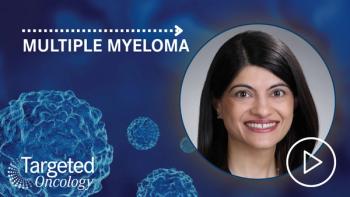
Surbhi Sidana, MD, discusses the key aspects of iberdomide that make the CELMoD's FDA approval so significant for multiple myeloma treatment.
Surbhi Sidana, MD, discusses the versatility of iberdomide and the approved Iber-Dd regimen in relapsed multiple myeloma.

In an interview, Surbhi Sidana, MD, explores the significance of iberdomide's FDA approval and how this agent fits into the growing array of novel multiple myeloma therapies.
In transplant-ineligible or transplant-deferred multiple myeloma, the quadruplet regimen demonstrated sustained benefit in minimal residual disease negativity at nearly 5 years.
Hearn Jay Cho, MD, explains how immune profiling could inform what impairs T-cell fitness, a crucial consideration when using CAR T-cell therapy or bispecific T-cell engagers.
During a live Case-Based Roundtable event, Brea Lipe, MD, and participants discussed how aggressively to bridge a CAR T-eligible patient with high-risk relapsed myeloma.
Hearn Jay Cho, MD, PhD, discusses the ongoing role of the CoMMpass dataset in researching immunotherapy and targeted therapy in high-risk multiple myeloma.

Sagar Lonial, MD, provides commentary on the key questions raised by recent data on lenalidomide maintenance for patients with newly-diagnosed multiple myeloma.
Learn how community oncologists deliver bispecific antibodies safely: step-up dosing, CRS prevention, infection support, and patient counseling.
FDA Approves Iberdomide, the First CELMoD for Relapsed/Refractory Multiple Myeloma
Published: | Updated:
The iberdomide-daratumumab-dexamethasone regimen was approved based on superior MRD negativity rate vs standard of care in relapsed/refractory multiple myeloma.
Hearn Jay Cho, MD, PhD, of the Multiple Myeloma Research Foundation, looks back on 15 years of the groundbreaking CoMMpass genomic study.
Three-year follow-up from the single-arm trial that led to talquetamab's approval showed durable progression-free survival and overall survival in heavily pretreated multiple myeloma.
Sagar Lonial, MD, discusses the importance of baseline MRD assessment to aid in using sustained MRD negativity for eventual discontinuation of lenalidomide in newly diagnosed multiple myeloma.
During a live event, Sikander Ailawadhi, MD, and participants discussed how the route of CD38-antibody delivery, including a newly approved on-body injector, is shaping frontline regimen selection for transplant-ineligible multiple myeloma.
Sagar Lonial, MD, discusses why to take an individualized approach despite the trial's findings supporting discontinuation of lenalidomide at 2 years.
Joseph Mikhael, MD, MEd, discusses the potential and limitations of at-home cancer care using on-body injection technology.
Advertisement
Advertisement
Trending on Targeted Oncology - Immunotherapy, Biomarkers, and Cancer Pathways
1
Anito-Cel Delivers Durable Responses With Low Neurotoxicity in RRMM
2
Risk, Histology, and Metastatic Site Guide First-Line RCC Treatment Choices
3
FDA Application Withdrawn for I-DXd in Small Cell Lung Cancer
4
Frontline CAR T and Bispecific Antibodies Are the Next Frontier in Myeloma
5