
Prostate Cancer
Latest News
Advertisement
Latest Videos















































Advertisement
More News






The early development of PARP inhibitors in 2003 focused on their use in combination with cytotoxic chemotherapy agents, but this was eventually abandoned because of excess toxicity.
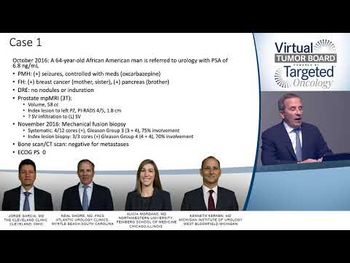
In an interview with Targeted Oncology during the 2019 Prostate Cancer Consensus Conference, James L. Mohler, MD, explained the reasons for changes to the NCCN guidelines on genetic testing and counseling in prostate cancer. He also discussed what needs to be addressed in the future to further increase knowledge of genetic testing and improve its use.
William K. Oh, MD, discusses the rationale for presenting the data for the phase III ENZAMET trial in a plenary session at the 2019 ASCO Annual Meeting. He says these data were significant because it was a large randomized clinical trial for the treatment of newly diagnosed patients with metastatic hormone-sensitive prostate cancer.
Apalutamide plus androgen deprivation therapy maintained health-related quality of life in patients with metastatic castration-sensitive prostate cancer in addition to showing positive overall survival and radiographic progression-free survival outcomes in the phase III TITAN trial, said Neeraj Agarwal, MD.
A. Oliver Sartor, MD, discusses a discrepancy found between conventional imaging and PSMA PET/CT scanning for prostate cancer.
In an interview with Targeted Oncology, Alan Bryce, MD, discussed the significance of the data from PROfound for men with mCRPC. He also highlighted findings from the CARD trial and where the field is headed in terms of targeted therapies versus chemotherapies.

In October 2019, the FDA approved a new treatment option for patients with advanced ovarian, fallopian tube, or primary peritoneal cancer, as well as a new dosing regimen for patients receiving moderately emetogenic chemotherapy. Additionally, the FDA granted breakthrough therapy designations to 2 therapies, as well as an orphan drug designation, a priority review, and 2 fast track designations.
In an interview with Targeted Oncology, Raoul S. Concepcion, MD, discussed the existing challenges with implementing genetic testing and genetic counseling in community practices and how they can potentially be addressed.
The FDA has approved a supplemental New Drug Application for a single dose of aprepitant injectable emulsion for intravenous use in patients receiving moderately emetogenic chemotherapy. The approval expands the dose for aprepitant to include a 130 mg single-dose regimen for the prevention of acute and delayed chemotherapy-induced nausea and vomiting.<br />

James Mohler, MD, discusses the rationale for the latest updates to the National Comprehensive Cancer Network guidelines for genetic testing in prostate cancer.
In an interview with Targeted Oncology, Maha Hussain, MD, discussed targeting DNA repair defects in metastatic castration-resistant prostate cancer with the PARP inhibitor olaparib in the phase III PROfound trial.
The introduction of<strong> </strong>CDK4/6 inhibitors for the treatment of hormone receptor–positive, HER2-negative breast cancer has transformed therapy management and extended survival for this patient population. The next step in the process of tailoring therapy towards individual patients is the introduction of targeted therapies for patient subsets with driver aberrations.
The addition of direct oral oral anticoagulants for the management of venous thromboembolism in patients with cancer is the latest change to previous guidelines issued by the American Society of Clinical Oncology.
The FDA has granted a breakthrough therapy designation to niraparib for the treatment of patients with <em>BRCA1/2</em>-mutated metastatic castration-resistant prostate cancer who have previously received taxane chemotherapy and androgen receptor–targeted therapy.

Using a measure known as the growth modulation index, patients with TRK fusion–positive cancers who were treated with larotrectinib had a clinically meaningful improvement in progression-free survival compared with the time to progression on their prior treatment, an analysis of patients enrolled in 1 of 3 clinical trials has found.
Advertisement
Advertisement
Trending on Targeted Oncology - Immunotherapy, Biomarkers, and Cancer Pathways
1
Denosumab Biosimilar Approved For Existing Oncology Indications
2
Plinabulin Receives FDA Fast Track Designation in Post-ICI NSCLC
3
FDA Oncology Recap: Approvals, Designations, and Decisions in September 2026
4
Tile-Based Radiation Improves Local Control in Resected Brain Metastases
5