Nini Wu, MD, MBA, discusses long-term investments aimed at stabilizing and strengthening the future of community oncology


Your AI-Trained Oncology Knowledge Connection!
Nini Wu, MD, MBA, discusses long-term investments aimed at stabilizing and strengthening the future of community oncology

A panelist discusses how axatilimab is particularly effective for patients with bronchiolitis obliterans syndrome, showing response rates of almost 50% with 20% complete responses, and offers the advantage of reliable intravenous delivery despite logistical challenges of infusion center visits.
A panelist discusses how axatilimab demonstrated efficacy in a heavily pretreated patient population with predominantly severe chronic graft-vs-host disease (cGVHD) in the AGAVE-201 trial, with manageable adverse effects including infusion reactions and enzyme elevations that rarely required discontinuation of treatment.
Dong Chen, MD, PhD, discusses how AI has changed the landscape for genomic testing and patient management.
Prof Martin Dreyling discusses the unmet needs in MCL and the potential next lines of research on the BTK inhibitor acalabrutinib.
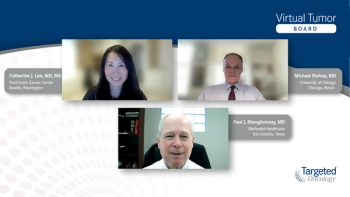
Panelists discuss how most clinicians prefer ruxolitinib over ibrutinib as second-line therapy due to better tolerability
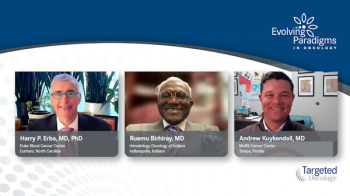
Panelists discuss how hepcidin mimetics like rusfertide offer a novel approach to managing polycythemia vera (PV) by regulating iron metabolism, reducing iron overload, and improving hematocrit control, particularly in patients with iron deficiency or refractory disease, while also potentially enhancing disease management and quality of life when used alone or in combination with standard therapies like hydroxyurea or ruxolitinib.
Panelists discuss how clinical trial data has shaped second-line therapy in polycythemia vera (PV), highlighting ruxolitinib and interferon as key options for patients resistant or intolerant to hydroxyurea due to their efficacy in symptom control, quality of life improvement, and disease-modifying benefits, especially for those with splenomegaly or inadequate response to first-line treatments.
Panelists discuss how FDA-approved therapies such as ibrutinib, ruxolitinib, belumosudil, and axatilimab provide treatment options for steroid-refractory chronic graft-vs-host disease (cGVHD).
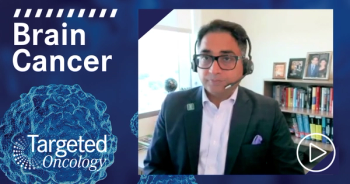
Manmeet Ahluwalia, MD, MBA, FASCO, shares a message during Brain Cancer Awareness Month.

Anuradha Krishnamurthy, MBBS, discusses the exciting frontier of tumor-infiltrating lymphocyte therapy in melanoma and other disease states.
Prof Martin Dreyling discusses the safety profile of the BTK inhibitor acalabrutinib in patients with mantle cell lymphoma.
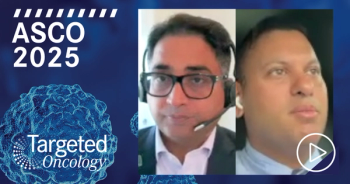
Neel Shah, MD, and Manmeet Ahluwalia, MD, MBA, FASCO, discuss what they look most forward to hearing about and learning at the 2025 ASCO Annual Meeting.

David P. Carbone, MD, PhD, discusses the outcomes of the phase 3 CheckMate 9LA trial in non–small cell lung cancer based on treatment discontinuation.
Anuradha Krishnamurthy, MBBS, discusses what physicians and patients must aware of regarding the safety of TIL therapy in melanoma.

Deepak Bhamidipati, MD, discusses a review conducted to investigate how the design of early-phase clinical trials has evolved.

C. Ola Landgren, MD, PhD, discusses the feedback he received on minimal residual disease at this year’s Miami Myeloma MRD Meeting in April.
Anuradha Krishnamurthy, MBBS, provides backgrounds on TILs and discusses their critical role in the advanced melanoma treatment landscape.
Deepak Bhamidipati, MD, discusses the impact of the FDA's Project Optimus on early-phase drug development protocols.
A panelist discusses how the CABINET trial showed significant progression-free survival benefits for cabozantinib compared with placebo (particularly in pancreatic neuroendocrine tumors (NETs), why progression-free survival (PFS) is a meaningful end point for NETs, and that safety findings revealed familiar adverse effects requiring dose reductions in about two-thirds of patients.
Panelists discuss how the CYTO-PV study provides compelling evidence for maintaining strict hematocrit control below 45% in polycythemia vera patients, demonstrating that even a 3% difference in hematocrit levels can lead to a fourfold increase in cardiovascular events and thrombosis risk while also emphasizing the independent importance of controlling white blood cell counts below 11 × 109/L to further reduce thrombotic complications.
A panelist discusses how the CABINET trial was a National Cancer Institute (NCI)–supported study conducted by the Alliance for Clinical Trials in Oncology that enrolled patients with well-differentiated grade 1 through 3 pancreatic or extrapancreatic neuroendocrine tumors who had progressed after somatostatin analogue therapy and at least 1 other FDA-approved therapy.
Panelists discuss how multiple pivotal clinical trials inform polycythemia vera management strategies, highlighting key findings from CYTO-PV (strict hematocrit control <45% reduces thrombosis risk fourfold), RESPONSE (ruxolitinib’s superiority over best available therapy for controlling both hematocrit and splenomegaly), MAJIC-PV (demonstrating improved event-free survival with ruxolitinib), and PROUD-PV/CONTINUATION-PV (showing ropeginterferon’s durable molecular responses compared with hydroxyurea’s diminishing effect over time).
John L. Marshall, MD, discusses unmet needs in the targeted therapy space and the importance of optimizing dosing in colorectal cancer.

Co-hosts Kristie L. Kahl and Andrew Svonavec highlight what to look forward to at the 2025 ASCO Annual Meeting, from hot topics and emerging trends to travel recommendations.
Manmeet Ahluwalia, MD, MBA, FASCO, highlights genomic testing as a crucial area of current research with immediate implications for patients with brain cancer.

Panelists discuss how JAK inhibitor therapy, while effective in treating myelofibrosis and other hematologic disorders, increases the risk of skin cancers, particularly non-melanoma skin cancers, and emphasize the importance of regular screening, patient education, and preventive measures to manage this risk.
Panelists discuss how the evolution of myelofibrosis care has led to advancements in pharmacotherapy, risk stratification, and emerging therapies while highlighting ongoing unmet needs such as long-term disease control, treatment resistance, anemia and thrombocytopenia management, and the need for personalized treatment approaches.
Prof Martin Dreyling discusses the shifting treatment landscape for patients with difficult-to-treat mantle cell lymphoma.