Sophia Kamran, MD, discusses how salvage therapy after biochemical recurrence may improve outcomes for patients with prostate cancer.


Your AI-Trained Oncology Knowledge Connection!
Sophia Kamran, MD, discusses how salvage therapy after biochemical recurrence may improve outcomes for patients with prostate cancer.
Panelists discuss how thrombotic risk assessment—anchored in age, thrombotic history, and additional factors like leukocytosis and JAK2 allele burden—guides personalized therapy in polycythemia vera (PV), balancing cytoreduction, symptom control, and prevention of vascular events.
Panelists discuss how integrating molecular markers—particularly JAK2 V617F allele burden—and clinical features such as symptom burden and thrombotic history inform diagnosis, risk stratification, and monitoring strategies in polycythemia vera to anticipate disease progression and guide personalized treatment.
A panelist discusses how the treatment landscape for chronic graft-vs-host disease (cGVHD) has evolved significantly in recent years, with several pivotal clinical trials beyond REACH3 informing our approach, including the REACH1 and REACH2 trials for acute GVHD; the ROCKstar trial supporting belumosudil approval; and studies evaluating ibrutinib, axatilimab, and extracorporeal photopheresis.

Felix Guerrero-Ramos, MD, PhD, discusses findings from cohort 4 of the phase 2 SunRISe-1 trial of TAR-200 in patients with high-risk, BCG-unresponsive NMIBC with papillary-only disease.
Oncologists at AUA 2025 share promising data, including sasanlimab, cretostimogene grenadenorepvec, and TAR-200 in NMIBC.
Joseph Jacob, MD, discusses data from the phase 2b SunRISe-1 study, cohort 2, evaluating TAR-200 in BCG-unresponsive high-risk NMIBC with carcinoma in situ.

Colin P.N. Dinney, MD, discusses updated translational analyses from the BOND-003 and CORE-001 trials.

Douglas A. Tremblay, MD, discusses the data showing disease-modifying potential of ropeginterferon alfa-2b-njft in patients with polycythemia vera.

Arvind Trindade, MD, discusses a large database study looking at rising rates of pancreatic and colon cancer in young adults.
Arvind Trindade, MD, discusses the background of a study investigating rates of pancreatic and colon cancer among younger patients.
Hannah Abrams, MD, discusses the key takeaways of research into nonmedical barriers to HCT and CAR T therapy.
Hannah Abrams, MD, discusses the background behind research into nonmedical barriers to cell transplant and CAR T therapy.
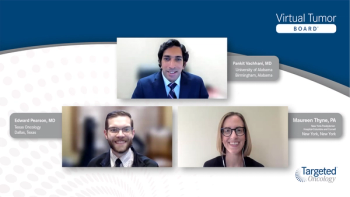
Panelists discuss how clinical trial data from the COMFORT studies supports using Janus kinase (JAK) inhibitors such as ruxolitinib for myelofibrosis patients beyond the original high-risk study population, with experts noting they often treat intermediate-1-risk patients based on symptomatic burden and splenomegaly rather than risk stratification alone to achieve meaningful spleen volume reduction and symptom improvement.
Panelists discuss how treatment goals for intermediate-risk myelofibrosis patients focus on achieving meaningful clinical outcomes including relieving symptoms, preventing worsening of anemia, maintaining transfusion independence, reducing symptomatic splenomegaly, and ultimately improving survival while considering patient-specific factors like age and transplant eligibility.

Pedro C. Barata, MD, MSc, discusses the use of darolutamide in patients with hormone-sensitive prostate cancer.

A panelist discusses how the COCOON study's findings will lead to the integration of enhanced dermatologic management into clinical practice for patients receiving amivantamab and lazertinib, focusing on proactive care to reduce dermatologic adverse events (DAEs), improve patient comfort, and increase treatment adherence, ultimately optimizing patient outcomes.

Panelists discuss how initiating therapy in myelofibrosis requires a personalized approach that balances symptom burden, risk stratification, cytopenias, and patient goals, with treatment decisions—often involving Janus kinase (JAK) inhibitors—tailored to optimize both disease control and quality of life.
A panelist discusses how prophylactic dermatologic management, including the proactive use of moisturizers, topical steroids, and antibiotics, significantly improves the tolerability and adherence to first-line treatment with amivantamab and lazertinib for advanced non–small cell lung cancer (NSCLC) by reducing the severity of dermatologic adverse events (DAEs) and preventing treatment interruptions.
Panelists discuss how accurate risk stratification using clinical and molecular prognostic tools like DIPSS, MIPSS70, and GIPSS guides personalized treatment decisions in myelofibrosis, ranging from observation in low-risk patients to Janus kinase (JAK) inhibitor therapy and early transplant evaluation in higher-risk cases.
Mark Litzow, MD, discusses the challenges of using immunotherapy for the treatment of acute lymphoblastic leukemia.

Paolo Ghia, MD, discusses the implications of the long-term follow-up of the CAPTIVATE trial investigating ibrutinib and venetoclax in CLL.
A panelist discusses how managing adverse events (AEs) in patients with chronic graft-vs-host disease (cGVHD) treated with ruxolitinib requires a structured monitoring approach that balances therapeutic efficacy with patient safety through regular clinical evaluations, laboratory assessments, and proactive management strategies tailored to individual risk profiles.
Enriqueta Felip, MD, PhD, discusses the 3475A-D77 trial of subcutaneous pembrolizumab vs intravenous pembrolizumab plus chemotherapy in metastatic NSCLC.

Hany Elmariah, MD, discusses how he sees fedratinib fitting into clincal practice for the treatment of myeloproliferative neoplasms.