
Videos
Regina Barragan-Carrillo, MD, discusses a pilot study evaluating the use of camu camu in combination with ipilimumab and nivolumab for treating metastatic renal cell carcinoma.
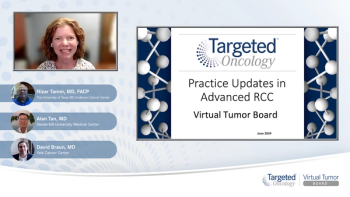
Renal cell carcinoma specialists analyze the case of a 59-year-old woman with RCC, focusing on the partial response observed on CT imaging four months after initiating combination therapy with nivolumab and ipilimumab.
Medical experts examine strategies for monitoring treatment response in patients initiating first-line immune checkpoint inhibitor-based therapy for metastatic renal cell carcinoma.
Focusing on the future of CLL/SLL treatment, Mazyar Shadman, MD, MPH, discusses promising therapies in the pipeline.

Matthew Hadfield, DO, discusses what community oncologists should know about immunotherapy toxicities.

Drs Koprivnikar and Chedid highlight prognostic scoring systems in MDS.
Medical experts discuss currently available treatments MDS.

Francis P. Worden, MD, discusses the background of a study evaluating lenvatinib for the treatment of patients with radioiodine-refractory differentiated thyroid cancer, including in those with BRAF-mutated, wild-type and BRAF untested tumors.
Matthew Galsky, MD, discusses the disease-free survival of nivolumab vs placebo in patients with high-risk muscle-invasive bladder cancer.

Timothy F. Cloughesy, MD, director of UCLA’s neuro-oncology program and distinguished professor in neurology, discusses the mechanism of action of vorasidenib.

Ali Duffens, MD, discusses the relative effectiveness of different detection modalities in identifying breast cancer recurrences.

Dr. Tarantino provides final thoughts, highlighting unmet needs and future directions in early HER2+ breast cancer on Precision Medicine in Oncology.
Dr. Tarantino discuss the integration of recent trial data into post-neoadjuvant treatment strategies, comparing adjuvant T-DM1 with pertuzumab plus trastuzumab.
Dr. Tarantino summarize the trial's design comparing adjuvant T-DM1 versus trastuzumab for residual invasive disease post-neoadjuvant therapy. Discussions include efficacy comparisons, recent 5-year OS analysis results, and the significant IDFS benefits observed with T-DM1 over an 8+ year follow-up period.
Dr. Tarantino discuss long-term safety and efficacy findings from the APHINITY trial's 8-year follow-up with pertuzumab, and insights from the NeoSphere study's impact on treatment strategies based on efficacy and safety data.
Paolo Tarantino, MD, discusses risk factors in early breast cancer, NCCN guideline-recommended therapies, and the transformative impact of HER2-targeted treatments over the past decade.
Neeraj Agarwal, MD, discusses some of the unmet needs that exist in the prostate cancer space.
Christina Henson, MD, discusses unmet needs among patients with head and neck cancer.
Mayuko Sakae, MD, discusses findings from research presented at the 2024 Multinational Association of Supportive Care in Cancer Annual Meeting on refractory pain in patients who have undergone a bone marrow transplant.

Taiga Nishihori, MD, discusses the findings from a study evaluating ciltacabtagene autoleucel given in the outpatient setting to patients with relapsed/refractory multiple myeloma.
Dr Sekeres discusses when to start therapy for a patient who has lower-risk MDS with amnesia.
Dr Sekeres discusses how he approaches second-line therapy selection in ESA-refractory, transfusion-dependent lower-risk MDS (LR-MDS) patients, specifically with imetelstat.
Dr Sekeres discusses treatment goals for a patient with lower-risk MDS.
Advertisement
Advertisement
Trending on Targeted Oncology - Immunotherapy, Biomarkers, and Cancer Pathways
1
ASCO 2026 Highlights: Breast & Lung Cancer Advances With Ajaz Khan, MD
2
FDA Grants Fast Track Status to Azercabtagene Zapreleucel in CLL/SLL and MZL
3
KLN-1010 In Vivo CAR Achieves 100% MRD Negativity in R/R Myeloma
4
Generic Larotrectinib Capsules Gain Tentative FDA Approval
5