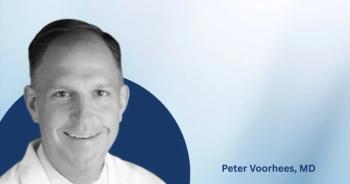
In an interview, Peter Voorhees, MD, discusses his presentation of the CERVINO trial data from the International Myeloma Society meeting.

Jeffrey V. Matous, MD, discusses moving fixed-duration T-cell–redirecting therapy into frontline multiple myeloma treatment and the persistent challenge of ultra-high-risk disease.
"It needs to be a fixed duration. We cannot have patients on therapy indefinitely. We have to give their T cells a rest. I think we need to eventually get rid of bortezomib, because if we are going to try to cure people with myeloma, we cannot cure them and leave them with peripheral neuropathy."
Jeffrey V. Matous, MD, a myeloma specialist and member physician at the Colorado Blood Cancer Institute in Denver, Colorado, and assistant chair of myeloma research for Sarah Cannon Research Institute, discusses the movement of T-cell–redirecting therapy into frontline multiple myeloma treatment.
At the 23rd International Myeloma Society (IMS) Annual Meeting & Exposition, held September 23-26, 2026, in Glasgow, Scotland, investigators presented interim data from the phase 2 IFM 2022-01 trial (NCT06353022), which is evaluating teclistamab (Tecvayli) and talquetamab (Talvey) consolidation, each for a finite duration, in patients with newly diagnosed multiple myeloma who remain minimal residual disease (MRD) positive after quadruplet D-VRd (daratumumab, bortezomib [Velcade], lenalidomide [Revlimid], dexamethasone) induction.
Matous said he expects T-cell redirection to move into the upfront setting for essentially all patients within the next 5 years, though how it gets there is still being worked out. One path, reflected in the IFM 2022-01 data, pairs a standard quadruplet induction with teclistamab-talquetamab consolidation to convert patients with residual MRD positivity to MRD negativity; whether that approach ultimately supersedes upfront T-cell redirection as initial therapy remains open, he said.
Beyond sequencing, Matous points to fixed-duration dosing and the eventual removal of bortezomib from frontline regimens as priorities for improving long-term outcomes without trading disease control for irreversible toxicity such as peripheral neuropathy.
He adds that the greatest unmet need in multiple myeloma remains the ultra-high-risk and high-risk populations, for whom novel therapies have not conferred the same benefit: a question he expects the field to spend the next 5 years trying to resolve.