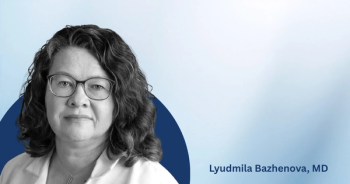
Lyudmila Bazhenova, MD, explains why the updated taletrectinib label does not change her practice and reviews new WCLC subgroup data in ROS1+ NSCLC.

Theodore Wagener, PhD, of Ohio State discusses the design of the phase 2 DREAM LUNG study of psilocybin-assisted therapy for depression in non–small cell lung cancer.
Theodore Wagener, PhD, founding director of the Center for Tobacco Research at The Ohio State University and co-leader of the Cancer Control Program at the Ohio State University Comprehensive Cancer Center – James (OSUCCC – James), is co-leading a phase 2 study (DREAM LUNG; NCT07216404) of psilocybin-assisted therapy for major depressive disorder in patients with non–small cell lung cancer. The single-center trial, led with Alan K. Davis, PhD, is enrolling 10 patients and is described as a proof-of-concept study.1
According to the trial listing, primary end points include safety, adverse events, suicidal ideation, and the acceptability of and satisfaction with psilocybin-assisted therapy, while secondary end points include depression symptom severity and quality of life. Patients must have moderate to severe depressive symptoms and may continue chemotherapy, radiation, or biologic therapy if they are able to tolerate oral psilocybin.
In an interview with Targeted OncologyTM, Wagener discussed what prompted the study, how it is designed, early observations from the first 3 patients treated, and what he wants oncologists to know about psychedelic-assisted therapy.
Theodore Wagener, PhD: The study I'm co-leading with Alan Davis, PhD, here at Ohio State—what really was the impetus for it was that, unfortunately, lung cancer has a pretty high psychological morbidity. About 40% of patients with lung cancer meet criteria for depression. There are also high levels of suicide in patients with lung cancer. Seeing that, and also seeing the research going on in psychedelic-assisted therapy showing significant benefit for people with treatment-resistant depression or treatment-resistant [posttraumatic stress disorder (PTSD)] the question became: Could it work for this lung cancer population?
The study is a single-arm acceptability and feasibility study. It's the first psychedelic study being done with patients with cancer at Ohio State. It's a 10-patient study using a schedule I drug, psilocybin, and we are bringing in patients with non–small cell lung cancer. After screening, once they're enrolled, they go through preparation therapy, then there's a dosing session where they're actually dosed with psilocybin, and integration therapy follows. Then we have different follow-ups and assessments to see how they're doing.
We've had 3 patients go through, and without giving too much away, we're seeing what we would expect to see from other psilocybin and depression studies—a very good signal of efficacy. Even though this study really isn't designed for efficacy analyses, we are seeing a similar pattern, with some significant improvement.
There are a number of things psychedelics could do in the cancer area, and I'll talk about that. But first, part of what got us into this was that when patients have depression resulting from a cancer diagnosis, lung cancer in particular, it's not always just low mood and difficulty enjoying things they once enjoyed. That's definitely there, as you'd see in a traditional depression. But you also see feelings of existential distress and hopelessness: What's my life's meaning? Am I a burden now on my family?
With lung cancer in particular, a lot of the time, there's also stigma. Not everyone who has lung cancer smokes cigarettes, obviously, but many did, and so there's this feeling of, "I did this to myself. I did this to my family."
While there are effective psychological and psychiatric treatments for depression in patients with cancer, they tend not to work for everyone, they often don't touch those deeper things, and they can be slower, taken over long periods of time. With psychedelics, when you look at other populations, including studies in patients with cancer—just never in patients with lung cancer—you see that it touches those deeper things. That's especially true in the qualitative literature, where, following these trials, they ask people what their experience was like during the dosing session and afterward. They report it as very meaningful, sometimes the most meaningful experience of their life. It has profound effects.
Patients with lung cancer often come in with very advanced disease, so they're hit right away with, "What am I going to do now?" This can all come on quickly, and they might not have a long time. What psychedelics offer are very rapid and profound changes, which has been shown in various other studies. We hope to see the same in this study.
For
I've given grand rounds at various cancer centers over the last 4 or 5 years, and I've said that if a cancer center within the next decade does not have a robust psychedelic research and potentially clinical program, depending on these trials, it's going to be behind. It's a very interesting area of research, and I think it has the potential to really help a lot of people.
I think this is changing, but 5 years ago, when I was bringing this up to various physicians, they saw it as a little bit of woo-woo stuff—"Oh, you mean that stuff I experimented with back in the day?" What I always try to impress upon them is a couple of things.
One, the dose we're talking about is not like popping a mushroom cap and going around a museum looking at pretty colors. We're talking about a heroic dose, given in a very specific way, with specific intentions, in a specific setting, with preparation that gives the patient an idea of what they're going to encounter. It's very much an internal experience. Patients are wearing eye shades and headphones and listening to instrumental music. It's very well controlled and planned.
Two, just look at the data. They're in The New England Journal of Medicine, Science, and JAMA. These are pretty well-done studies, and while the sample sizes aren't 1000 patients—because it's a schedule I drug, it takes a lot to get, and we have to screen people out—the results themselves are incredible. Will that be true for this population? I don't know, but I don't see why not. That's why we're doing the study.
Stay up to date on practice-changing data in community practice.
Subscribe