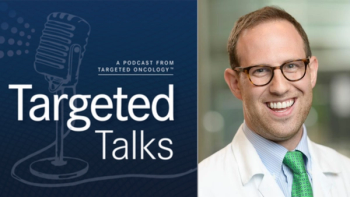
Benjamin Herzberg, MD, discusses KRAS-mutant non–small cell lung cancer, upfront biomarker testing, and the emerging RAS inhibitor toolkit on Targeted Talks.

MD Anderson trial uses psilocybin-assisted therapy to help head and neck cancer patients cope with trauma and improve recovery.
Moran Amit, MD, PhD, didn't set out to study psilocybin. He set out to understand nerves.
"I did my master's in neuroscience and my PhD in cancer biology,” said Amit, a head and neck surgical oncologist at The University of Texas MD Anderson Cancer Center. "When I started looking at nerves within the tumors, we learned—and we published this in 2020 in Nature1—that cancer has the capacity to hijack the nervous system and to modify the nervous system in a way that is beneficial for [it]."
That discovery led to an obvious next question. "Your initial, or almost reflexive, thought is: How do I hijack it back? How do we harness the nervous system to fight cancer?" Amit said. His lab began chasing that idea, and the deeper they went, the more the research pointed somewhere unexpected. "The more we dug into that, we found that the only compounds that we are actually familiar with, that are available and safe to use, are a family of drugs that falls under the family of psychedelics—or, more scientifically, called tryptamines. So, I just started digging into it."
What he found surprised him: a body of potential clinical applications that had little to do with his original question about nerve hijacking, and everything to do with the patients he was already treating every day. "As a surgical oncologist who is treating those patients almost every day—specifically within my realm, which is head and neck cancer—I know how devastating this is for the patients," Amit said. "Head and neck cancer specifically has [one of] the highest suicide rates,2 and this is a cancer you cannot hide. You can't put a shirt on it, you can't really conceal it, and it really affects our interaction with the world."
That recognition reframed the goal for him. "I realized that there are some things that we won't be able to fix, but we can definitely try to help our patients feel better, or at least fix the way they deal with it, the way they cope with it. So, it's more about acceptance, in that sense."
For Amit, the toll of head and neck cancer goes well beyond the tumor itself. "Think about the mouth, for example—everything goes through our mouth. You’re breathing, eating, drinking, making love, speaking. All those things are affected. This is our port to the world." Treatment for the disease, he said, can leave patients with real physical changes and functional losses, and that combination often produces a particular kind of isolation. "In many ways, people are having a lot of shame and trauma after treatment. They're cured from cancer…but they're not going back to society."
That gap between being medically cured and feeling whole again is what his research aims to close. "The goal was to bring them as close as possible to the mental state of what they were before cancer."
Amit and his team currently have 2 trials underway. The first targets a population that previous psychedelic research had largely passed over.3
"The thought process was that a lot of the psilocybin or psychedelics research was done in the terminally ill patient population, which is a very important patient population," Amit said. "We had really good data on that, and we knew it's effective and transformative for those patients. But we didn't really have good data on patients that are undergoing treatment with curative intent.”
Advances in oncology have changed what survival looks like for many patients, he notes, which creates its own psychological weight. "We have really great therapeutics for cancer that keep many patients alive, with cancer as a chronic disease. We cannot really eradicate the cancer, but they're living with it for sometimes even a decade. So, living with a deadly disease, especially given all the stigma and all the things attached to the diagnosis of cancer, might be very scary—to a point that people have an existential crisis." The trial was designed, he said, "to allow those patients to accept the new self and to allow them to cope a little bit better."
Soon after launching that study, Amit's team identified a second population in need: patients who had already finished treatment. "Immediately after, we figured out that we have another patient population that needs help, which is patients that actually survived cancer. They completed all the treatment, they're cancer-free, but they're still carrying the trauma of either the diagnosis or the treatment." He reaches for a comparison from outside oncology entirely. "Very much like making an analogy to veterans—you survived the war, but now you're back home, and it's really sometimes hard to get back."
Both trials follow what Amit called "a very classic paradigm" for psilocybin-assisted psychotherapy: a full treatment package built around 2 dosing days. "We are providing the patients a full package of treatment of psilocybin-assisted psychotherapy, which includes a couple of preparation sessions that are done by our therapists, and then they're coming here to MD Anderson." The setting matters as much as the substance, he says. "We actually built a very nice room. It's not here at the main hospital. We wanted to de-medicalize this, so it will be a nice atmosphere."
Each dosing day runs a full day, with 2 therapists present throughout. "You have 2 therapists in the room that are monitoring the patients and keeping them safe." Dosing is followed by integration sessions—first within a day, then about a week later—before a second dosing day and a second round of integration. "Patients are done within 2 or 3 weeks," Amit says, "and it has been, so far, very transformative. The feedback we're getting from patients is like, 'Oh, wow, you condensed…years of therapy…into a few sessions.'"
Amit is careful to separate the clinical protocol from the cultural baggage that often surrounds psychedelics. "If we're talking about psychedelics in general, there's a lot of stigma from recreational use and those kinds of things, but the most important thing is the set and the setting," he said. "The set is the mindset of the patient; that's why we're doing the preparation sessions. The settings are the safety settings. We want the patient to stay in the room, not jump out of the window, not run into a driving car. So, we build really nice, comfortable, and safe settings for the patients, with 2 monitors or therapists who are with them throughout the entire experience."
Asked what remains unresolved, Amit returns first to the basics: feasibility and safety, specifically in a population that hasn't been well studied in psychedelic research before. "Psychedelics have already shown to be effective in the traditional mental health indications—if you're looking at depression, anxiety, PTSD, addiction, there are a lot of studies out there that have shown those are effective," he said. "But when we're looking at patients with cancer, there are specific needs that still haven't been addressed."
Many of the logistical questions are unique to patients who are actively undergoing cancer treatment rather than sitting at the end of life. "Patients are coming and doing this treatment with us while they are on radiation treatment. How safe is that? How safe is it to give it with chemotherapy, for example?” And the medical complexity doesn't stop at drug interactions, he added. "Of course, those patients have a lot of depression and sometimes anxiety, but they have a lot of other things going on in their life. I'm not talking just about feasibility—coordinating the care. How, for example, do you dose a patient who cannot speak? How do you dose a patient who cannot swallow? Those are the main questions that we're asking in those trials."
Beyond feasibility, the team is also tracking the kinds of outcomes you'd expect from any psychotherapy trial. "We're also assessing all the other outcomes—how it affects their depression, function, performance, and family relationships. All those things are being asked as well. But first and foremost, we want to make sure that we're doing this in the safest and most convenient way for our patients, because, in a way, they have a bigger fish to fry."
The full data set isn't in yet, but Amit describes the early signal as encouraging. "We're looking at the safety, and while we still don't have the entire data set, so far we have amazing feedback from our patients. With dozens of patients here at MD Anderson, it has been safe and very transformative for many patients."
He's also looking past mental health end points entirely, toward a new application: using psilocybin to address physical adverse effects of cancer treatment, not just psychological ones. "We do have an intention, and we're looking into a protocol…looking at somatic indications as well," he says. "A lot of patients are experiencing toxicity because of their treatment, so we also want to see how psilocybin can affect and mitigate this toxicity, specifically neurotoxicity. We're about to open a trial in this space as well."
For Amit, that expansion reflects how early this whole field still is. "There are a lot of different facets of psychedelics that we still haven't uncovered, and we are exploring them actively here at MD Anderson."