

BREAST CANCER
Latest News

Patritumab Deruxtecan With/Without Letrozole Shows Comparable Efficacy in HR+/HER2- Breast Cancer
By Kristi Rosa
Advertisement
Latest Videos




























Advertisement
More News

Immediate surgery significantly lowered local recurrence rates in elderly patients with breast cancer compared with delayed surgery, according to a meta-analysis presented at SABCS 2024.

A phase 1 trial of α-lactalbumin vaccine for the treatment of patients with triple-negative breast cancer demonstrated safety and tolerability.

Denise Yardley, MD, discussed results with ribociclib in patients with early-stage breast cancer with no lymph node involvement who were enrolled in the phase 3 NATALEE trial.

Erika P. Hamilton, MD, discusses antibody-drug conjugates in multiple types of breast cancer, and when to use these drugs in sequence.

During a Case-Based Roundtable® event, Aditya Bardia, MD, MS, FASCO, discussed data from the DESTINY-Breast04 and DESTINY-Breast06 trials for HER2-low breast cancer in the second article of a 2-part series.
Significant Ki-67 protein suppression in HR-positive, HER2-negative breast cancer was seen among patients treated with lasofoxifene.
The FDA recently approved the combination of inavolisib, fulvestrant, and palbociclib in this patient population.

Providers advised to halt use, monitor patients, and report any complications with BioZorb devices to the FDA.
In an interview with Targeted Oncology, Peter Schmid, MD, PhD, discussed the results from the phase 3 KEYNOTE-522 trial.
Holly Pederson, MD, and Elisha Hughes, MD, discussed the use of a polygenic risk score to identify why Black women incur higher rates of triple-negative breast cancer at younger ages.

DeepHRD predicted homologous recombination deficiency with greater accuracy than FDA-approved standard molecular tests.

Sarah Sammons, MD, highlights the need for further investigation into trastuzumab deruxtecan in breast cancer treatment.

Following discussions on ado-trastuzumab emtansine and fam-trastuzumab deruxtecan-nxki, Tanya Gupta, MD, discusses sacituzumab govitecan and its approval from the FDA in the breast cancer space.
Tanya Gupta, MD, discusses the use of ado-trastuzumab emtansine for the treatment of patients with HER2-positive breast cancer.
During a Case-Based Roundtable® event, Aditya Bardia, MD, MS, FASCO discussed recent updates from the DestinyBreast03 trial and other key data on treatment for HER2+ breast cancer in the first article of a 2-part series.
During a Case-Based Roundtable® event, Ursa Brown-Glaberman, MD, discussed options for the treatment of patients with PIK3CA-altered metastatic breast cancer.

Peter Schmid, MD, PhD, discusses the background, methods, and design of the phase 3 KEYNOTE-522 trial.

For Breast Cancer Awareness Month, Deborah Toppmeyer, MD, emphasizes the crucial role of early breast cancer detection.
During a Case-Based Roundtable® event, Sagar D. Sardesai, MD, moderated a discussion on using antibody-drug conjugates and managing their toxicities in patients with metastatic breast cancer.

The approval of inavolisib is supported by findings from the phase 3 INAVO120 study evaluating the agent plus palbociclib and fulvestrant.
Erika P. Hamilton, MD, discusses the patient population with breast cancer enrolled in the TROPION-PanTumor01 trial in relation to the efficacy of datopotamab deruxtecan.
The final analysis of the phase 3 PANTHER study confirmed survival benefits for patients receiving dose-dense vs standard chemotherapy.
M. Michele Blackwood, MD, FACS, provided an overview of the significant advancements with personalized medicine with genomic testing in the breast cancer space.
For Breast Cancer Awareness Month, Oranus Mohammadi, MD, discussed the remarkable progress made in improving survival rates for patients with breast cancer.
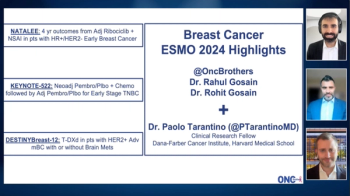
Panelists discuss how ESMO 2024 presented important updates on primary end points and progression-free survival data from recent clinical studies.
Advertisement
Advertisement
Trending on Targeted Oncology - Immunotherapy, Biomarkers, and Cancer Pathways
1
FDA Accepts NDA for Daraxonrasib in Metastatic Pancreatic Cancer
2
Advanced Renal Cell Carcinoma: Tailoring Second-Line Therapy After Prior Immunotherapy
3
FDA Approves Zidesamtinib for Previously Treated ROS1-Positive NSCLC
4
Teclistamab/Talquetamab Reduces Risk of Progression by 89% in R/R Multiple Myeloma
5