


BREAST CANCER
Latest News
Advertisement
Latest Videos




























Advertisement
More News
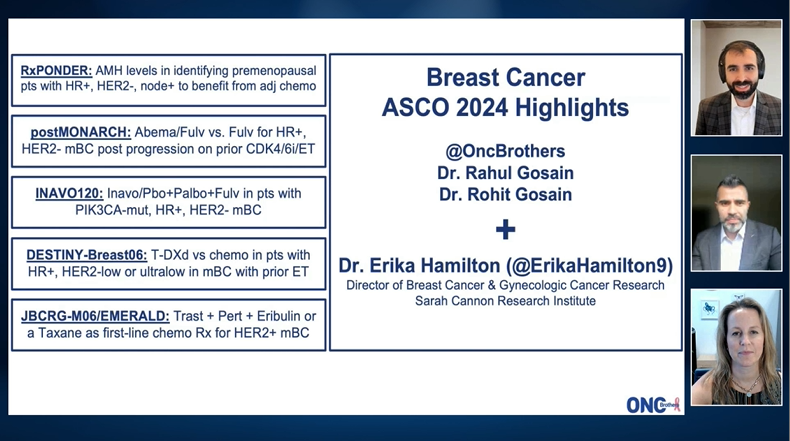
Following ASCO 2024, Erika P. Hamilton, MD, joins the Oncology Brothers, Rahul Gosain, MD, and Rohit Gosain, MD, to review recent updates from the RxPONDER trial investigating the use of AMH levels in premenopausal women.
Tarah Ballinger, MD, discusses what she considers to be the biggest developments from the 2024 ASCO Annual Meeting.

Aditya Bardia, MD, MPH, discusses results of a biomarker analysis of the TROPiCS-02 study of sacituzumab govitecan in HR-positive, HER2-negative metastatic breast cancer presented at ASCO 2024.

In separate, virtual live events, Sarah Sammons, MD, and Ruth O’Regan, MD, discussed molecular profiling and therapeutic options for a patient with advanced breast cancer after multiple lines of therapy.

Holly Pederson, MD, and Elisha Hughes, PhD, discuss the findings and implications of a study evaluating risk of triple-negative breast cancer for Black women presented at the 2024 ASCO Annual Meeting.

During a Case-Based Roundtable® event, Ruth M. O'Regan, MD, looks at options for a patients with hormone receptor–positive, HER2-negative breast cancer and an ESR1 mutation in the second article of a 2-part series.
Study Suggests Docetaxel is Superior for Neuropathy in Black Patients With Breast Cancer
Published: | Updated:
Tarah Ballinger, MD, discusses findings from the phase 2 EAZ171 study of taxane-induced peripheral neuropathy in Black patients with breast cancer.
Rebecca Shatsky, MD, discusses findings from the ISPY2.2 trial presented at the 2024 ASCO Annual Meeting.

Trastuzumab deruxtecan therapy led to superior PFS vs chemotherapy in pretreated, HR-positive, HER2-low metastatic breast cancer as well as ‘ultralow’ disease with IHC 0 and membrane staining.
A retrospective study revealed outcomes of sequencing the 2 antibody-drug conjugates trastuzumab deruxtecan and sacituzumab govitecan in patients with metastatic breast cancer.
Progression-free survival was numerically improved with pembrolizumab plus sacituzumab govitecan vs sacituzumab govitecan alone in patients with HR-positive, HER2-negative metastatic breast cancer.

Halle Moore, MD, discusses key takeaways from a study on young patients with breast cancer carrying BRCA mutations presented at the 2024 ASCO Annual Meeting.

Data from the phase 3 INAVO120 trial support the priority review granted by the FDA to inavolisib, palbociclib, and fulvestrant for the treatment of PIK3CA-mutated breast cancer.

Pembrolizumab combined with chemotherapy significantly improved overall survival in patients with high-risk early triple-negative breast cancer, according to the prespecified interim analysis of the phase 3 KEYNOTE-522 trial.
Data from the phase 3 INAVO120 trial support the breakthrough therapy designation granted by the FDA to inavolisib, palbociclib, and fulvestrant for the treatment of PIK3CA-mutated breast cancer.

Gabriel N. Hortabagyi, MD, FACP, provides an overview of the phase 3 NATALEE trial evaluating the combination of ribociclib with endocrine therapy as adjuvant treatment in patients with hormone receptor-positive/HER2-negative early breast cancer.
During a Case-Based Roundtable® event, Stephanie L. Graff, MD, discussed multiple later-line treatment options in hormone receptor–positive breast cancer with participants in the first article of a 2-part series.

Halle Moore, MD, discusses some of the main concerns that patients with breast cancer have about fertility after treatment.
Findings from a phase 1b/2 study support the continued development of palazestrant plus ribociclib for patients with estrogen receptor-positive/HER2-negative metastatic breast cancer.

With the clearance of an investigational new drug application for BTX-9341 from the FDA, a phase 1 trial will evaluate the agent in HR-positive/HER2-negative breast cancer.
During a Case-Based Roundtable® event, Ruth M. O'Regan, MD, led a discussion on whether to order next-generation sequencing and/or circulating tumor DNA testing for a patient with hormone receptor–positive breast cancer after progression in the first article of a 2-part series.

Finalized breast cancer screening recommendations from the United States Preventive Services Task Force suggest women aged 40 to 74 should get a mammogram every other year.
Although immune checkpoint inhibitors have become a cornerstone of therapy across cancer settings, their use in most breast cancer settings has fallen short.
New data from the DESTINY-Breast06 trial indicate that trastuzumab deruxtecan could become a new standard of care for patients with HER2-low and HER2-ultralow metastatic breast cancer.

Anne O’Dea, MD, discusses factors that contribute to second-line treatment selection and offers clinical insights on improving outcomes for patients being treated for breast cancer.
Advertisement
Advertisement
Trending on Targeted Oncology - Immunotherapy, Biomarkers, and Cancer Pathways
1
FDA Accepts NDA for Daraxonrasib in Metastatic Pancreatic Cancer
2
Advanced Renal Cell Carcinoma: Tailoring Second-Line Therapy After Prior Immunotherapy
3
FDA Approves Zidesamtinib for Previously Treated ROS1-Positive NSCLC
4
Teclistamab/Talquetamab Reduces Risk of Progression by 89% in R/R Multiple Myeloma
5