



BREAST CANCER
Latest News
Advertisement
Latest Videos






























Advertisement
More News

Virginia Kaklamani, MD, presents the case of a 56-year-old woman with HR+/HER2- metastatic breast cancer and visceral metastases.
Paolo Tarantino, MD, discusses what to know about the real-world findings from the RELIEVE study which were presented at the 2023 San Antonio Breast Cancer Symposium.

Ruta D. Rao, MD, and Virginia G. Kaklamani, MD, discuss with participants the case of a patient with breast cancer who has received multiple lines of therapy and what the next steps are for her treatment.
A cohort study highlighted the racial and ethnic survival disparities that exist among patients with early breast cancer who are being treated with standardized initial care.
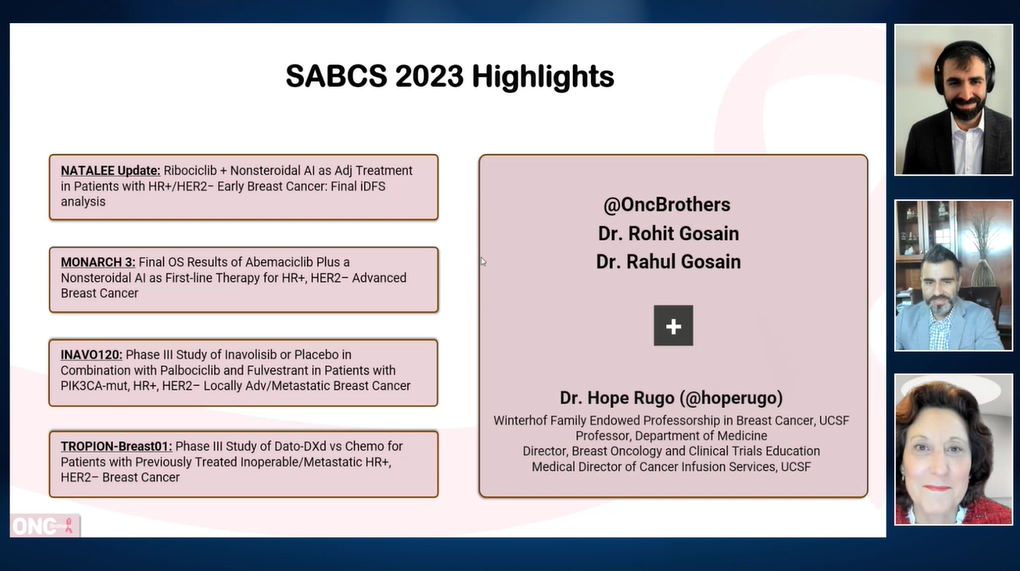
Following their review of clinical trial data presented at SABCS 2023, the Oncology Brothers offer their key takeaways on recent updates in breast cancer.
Medical oncologists discuss recent data from KEYNOTE-522 looking at event-free survival with neoadjuvant and adjuvant pembrolizumab in triple-negative breast cancer.
Eleonora Teplinsky, MD, and the Oncology Brothers discuss recent updates from the ICARO study following the 2023 San Antonio Breast Cancer Symposium.
Experts on breast cancer review recent data updates from the IDEA trial investigating endocrine therapy without radiotherapy following breast-conserving surgery.
Following SABCS 2023, Eleonora Teplinsky, MD, joins the Oncology Brothers, Rohit Gosain, MD, and Rahul Gosain, MD, to discuss recent data from NSABP B-51 on loco-regional irradiation in patients who became node negative after neoadjuvant chemotherapy.

Trastuzumab administered subcutaneously delivered unique immunomodulation effects vs intravenous trastuzumab in patients with treatment-naive HER2-positive breast cancer.

In the second article of a 2-part series, Hope S. Rugo, MD, FASCO, leads a conversation on the results of the EMERLAD study that showed elacestrant’s longer survival outcomes against standard of care endocrine therapy for patients with HR+, HER2- metastatic breast cancer.

Gabriel Hortabagyi, MD, provides an update on data from the phase 3 NATALEE trial of ribociclib and endocrine therapy in patients with early breast cancer.

Neoadjuvant nivolumab and non–anthracycline containing chemotherapy produced promising pathologic complete response rates regardless of whether nivolumab was administered before or during treatment with carboplatin and paclitaxel in patients with stage I to IIB triple-negative breast cancer.
Findings from the ADAPTcycle trial suggest that endocrine therapy plus ovarian suppression can generate high response rates in patients with hormone receptor-positive early breast cancer, regardless of age.
Neoadjuvant pembrolizumab combined with chemotherapy followed by adjuvant pembrolizumab compared with placebo plus chemotherapy continued to show a clinically meaningful improvement in event-free survival in patients with high-risk, early-stage triple-negative breast cancer.
The addition of atezolizumab to neoadjuvant trastuzumab plus pertuzumab (HP) and chemotherapy led to a numerical, but not statistically significant, increase in pathologic complete response vs HP/chemotherapy alone in patients with HER2-positive operable breast cancer.
Preliminary study results examining the bispecific antibody, CDK4/6 inhibitor, and hormone therapy combination in patients with advanced breast cancer were presented at SABCS.
Clinical, transcriptomic, and genomic differences that may contribute to aggressive tumor biology were observed between Latin-American and non-Hispanic White patients with breast cancer.
The MammaPrint and BluePrint tests may be able to predict which patients with HR-positive, HER2-negative breast cancer are most likely to respond to neoadjuvant chemotherapy.

Dr. Paolo Tarantino offers expert guidance on optimizing outcomes for patients with ER+/HER2-low metastatic breast cancer.
A comprehensive review of the safety and efficacy from a HER2-low subgroup analysis in the EMERALD Trial presented at SABCS 2023 and clinical implications in practice.
The brain-penetrant oral selective estrogen receptor degrader SIM0270 exhibited a favorable safety profile and early signals of antitumor activity in patients with estrogen receptor-positive, HER2-negative locally advanced or metastatic breast cancer, including those with ESR1 mutations.
Adjuvant ribociclib plus standard non-steroidal aromatase inhibitors improved invasive disease-free survival in HR-positive, HER2-negative early breast cancer, compared with nonsteroidal aromatase inhibitors alone.
Improvement in progression-free-survival was demonstrated across all relevant subgroups in patients with ER-positive/HER2-negative, ESR1-mutated advanced or metastatic breast cancer.
Advertisement
Advertisement
Trending on Targeted Oncology - Immunotherapy, Biomarkers, and Cancer Pathways
1
FDA Accepts NDA for Daraxonrasib in Metastatic Pancreatic Cancer
2
Advanced Renal Cell Carcinoma: Tailoring Second-Line Therapy After Prior Immunotherapy
3
FDA Approves Zidesamtinib for Previously Treated ROS1-Positive NSCLC
4
Teclistamab/Talquetamab Reduces Risk of Progression by 89% in R/R Multiple Myeloma
5