



BREAST CANCER
Latest News

Advertisement
Latest Videos





























Advertisement
More News
Experts on breast cancer review recent data updates from TROPION-Breast01 on Dato-DXd (datopotamab deruxtecan) in metastatic HR+/HER2- breast cancer.
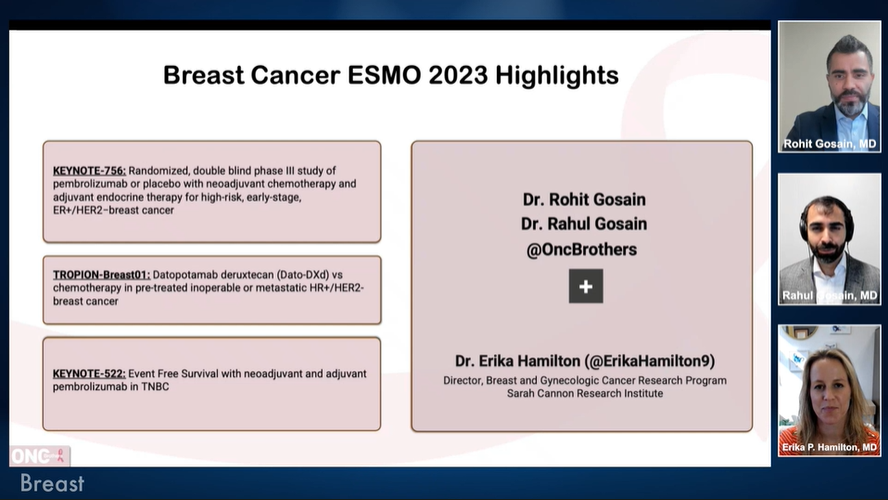
Erika P. Hamilton, MD, joins the Oncology Brothers, Rohit Gosain, MD, and Rahul Gosain, MD, to discuss recent data from KEYNOTE-756 investigating pembrolizumab plus chemotherapy in early-stage ER+/HER2- breast cancer.

Johanna Kaufmann, PhD, discusses promising preclinical findings on first-in-class oncolytic viral therapy in breast cancer treatment.

Findings from the phase 2 AVATAR trial suggest stereotactic ablative body radiotherapy may postpone the use of systemic therapy, offering patients with ER-positive/HER2-negative metastatic breast cancer another option.

In the second article of a 2-part series, Aditya Bardia, MD, MPH, discusses the favorable toxicity profile of sacituzumab govitecan for patients with metastatic breast cancer and how he handles neutropenia through the course of treatment.
In an interview, Funda Meric-Bernstam, MD, discussed the phase 2 DESTINY-PanTumor02 trial and the data on fam-trastuzumab deruxtecan-nxki for the treatment of patients with HER2-expressing cancers.

Rhenium obisbemeda shows potential to address the unmet need of new treatment options for patients with breast cancer and leptomeningeal metastases and will continue to be evaluated in the ReSPECT-LM program.


Adam Brufsky, MD, PhD, FACP, discusses background and next steps of the phase 3 PALOMA-2 study which evaluated palbociclib plus letrozole in patients that identified as Black or Hispanic with advanced breast cancer.
The primary end point of progression-free survival was met in TROPION-Breast01, a phase 3 study of datopotamab deruxtecan for patients with hormone receptor-positive/HER2-negative breast cancer.
Treatment with datopotamab deruxtecan led to a statistically significant and clinically meaningful improvement in progression-free survival in patients with metastatic hormone receptor-positive breast cancer.
Findings from a recent analysis of the DESTINY-Breast04 trial demonstrate improvement in efficacy when trastuzumab deruxtecan monotherapy is used for patients with HER2-low metastatic breast cancer.
Adding pembrolizumab to chemotherapy reduced the risk for disease recurrence, progression, complications, or death compared with chemotherapy alone in the treatment of triple-negative breast cancer.
Extending abemaciclib with endocrine therapy for 2 years continues to lower the risk of invasive disease and distant relapse in hormone receptor-positive, HER2-negative breast cancer, as demonstrated in the 5-year efficacy findings from the monarchE trial.
During a Targeted Oncology™ Case-Based Roundtable™ event, Laura Huppert, MD, and participants discussed treatment approaches for a patient HR-positive, HER2-negative breast cancer with liver and lung metastases who continues to progress on endocrine therapy and CDK4/6 inhibitors.

In the first article of a 2-part series, Aditya Bardia, MD, MPH, explains how recent survival outcomes with sacituzumab govitecan impressed physicians treating patients with metastatic breast cancer.

Sandra M. Swain, MD, FACP, FASCO, reviews clinical trial data and how they inform the evolving treatment landscape in HER2+ early breast cancer.

Chirag Shah, MD, discusses the challenges in predicting the risk of local recurrence in patients with ductal carcinoma in situ, and what led to the DCISionRT test.

During a Targeted Oncology™ Case-Based Roundtable™ event, Reshma L. Mahtani, DO, discussed with other physicians their experience with elacestrant in patients with estrogen receptor–positive, HER2-negative breast cancer. This is the second article based on this event.

At a live virtual event, Jane Lowe Meisel, MD, provided insights into the latest practice updates for patients with hormone receptor–positive, HER2-negative metastatic breast cancer.

Rebecca A. Shatsky, MD, looks to the future of biomarker testing in metastatic breast cancer and offers advice to community oncologists.
A medical oncologist discusses challenges with conducting molecular testing and reviews clinical trials focused on biomarkers for patients with ER+/HER2- metastatic breast cancer.
During a Targeted Oncology™ Case-Based Roundtable™ event, Reshma L. Mahtani, DO, and participants discussed switching CDK4/6 inhibitors and continuing use beyond progression in patients with metastatic breast cancer. This is the first of 2 articles based on this event.
IDE161 now has 2 fast track designations from the FDA for patients with breast cancer and ovarian cancer. The agent continues to be evaluated in a first-in-human, phase 1 study for patients with advanced solid tumors.
Advertisement
Advertisement
Trending on Targeted Oncology - Immunotherapy, Biomarkers, and Cancer Pathways
1
FDA Accepts NDA for Daraxonrasib in Metastatic Pancreatic Cancer
2
Advanced Renal Cell Carcinoma: Tailoring Second-Line Therapy After Prior Immunotherapy
3
FDA Approves Zidesamtinib for Previously Treated ROS1-Positive NSCLC
4
Teclistamab/Talquetamab Reduces Risk of Progression by 89% in R/R Multiple Myeloma
5